

[Apr-2026] The Best Oracle Database 19c 1z0-076 Professional Exam Questions
Try 100% Updated 1z0-076 Exam Questions [2026]
NEW QUESTION # 63
Your Data Guard environment has two remote physical standby databases.
Client applications use the local naming method to connect to the primary database instance.
You want applications to automatically connect to the new primary database instance in case of a switchover or a failover.
Which set of actions will fulfill this requirement?
- A. Set the LOCAL_LISTENER parameter for all the database instance to register services with the default listener on the primary database host.
- B. Create a database service on the primary database that is started automatically by a trigger, when the database role is PRIMARY; modify the connection descriptors used by client applications to include all the standby hosts and connect to the database instance using that service name.
- C. Set the INSTANCE NAME parameter identically on all databases; modify the connection descriptor on client applications to include all the standby hosts and connect to the database instance using that service name.
- D. Set DB_NAME and DB_UNIQUE_NAME identically on all databases; modify the connection descriptors on client applications to include all the standby hosts and connect to the database instance using that service name.
Answer: B
Explanation:
For seamless client redirection in a Data Guard environment, the following steps should be taken:
Create a database service on the primary database that is started automatically by a trigger when the database role is PRIMARY (B): This ensures that the service is only available on the primary database and is automatically started after a role transition due to switchover or failover.
Modify the connection descriptors used by client applications to include all the standby hosts and connect to the database instance using that service name (B): Client applications use the connection descriptors that include all potential primary hosts (i.e., the current primary and all standbys). This enables clients to connect to whichever database is currently acting as the primary using the service name.
Reference:
Oracle Data Guard Concepts and Administration Guide
Oracle Real Application Clusters Administration and Deployment Guide
NEW QUESTION # 64
Examine the Data Guard configuration: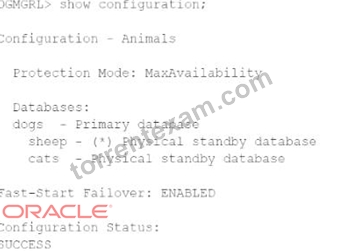
What happens if you issue "switchover to sheep;" at the DGMGRL prompt?
- A. It results in an error indicating that a switchover is not allowed.
- B. The switchover succeeds and Cats becomes the new failover target.
- C. The switchover succeeds and Dogs becomes the new failover target.
- D. The switchover succeeds and Fast-Start Failover is suspended.
- E. The switchover succeeds but Dogs needs to be reinstated.
Answer: C
Explanation:
When issuing a "switchover to sheep;" command in a Data Guard configuration, the primary database (Dogs) transitions to a standby role, and the target standby database (Sheep) becomes the new primary database.
Fast-Start Failover (FSFO) remains enabled, but its target changes according to the new roles of the databases.
Since Cats is also a physical standby database, it does not become the failover target by default unless it is specified in the broker configuration. After the switchover, the original primary (Dogs) becomes the new standby database and thus the new failover target for FSFO.References:Oracle Data Guard Broker documentation provides detailed procedures and explanations of switchover operations, including how FSFO targets are affected post-switchover. This behavior is consistent across different Oracle Database versions that support Data Guard and FSFO.
NEW QUESTION # 65
You have a Data Guard broker configuration consisting of:
A primary database
One local physical standby database
One far sync instance
A remote physical standby database
The broker configuration was created with the DGMGRL utility after creating all the databases and the far sync instance with command-line tools.
What is the correct way to add this configuration to Enterprise Manager Cloud Control assuming all the nodes have been discovered already as Enterprise Manager targets?
- A. Discover either of the physical standby databases as a target by refreshing the node on which they run, and the other databases and instances in the Data Guard Broker configuration will be discovered as targets automatically and be ready to be monitored.
- B. Delete the Data Guard Broker configuration using DGMGRL and then re-create it using Enterprise Manager Cloud Control to enable all the databases in the configuration to be discovered as targets and to be ready to be monitored.
- C. Discover the primary database as a target in Enterprise Manager Cloud Control. Then discover the existing Data Guard Broker configuration for the primary and all the other databases in the configuration will be discovered as targets and be ready to be monitored.
- D. Discover the primary as a target by refreshing the node on which it runs, and the other databases and instances in the Data Guard broker configuration will be discovered as targets automatically and be ready to be monitored.
- E. Use the DGMGRL utility to register the configuration with the Enterprise Manager Cloud Control agent on the primary database node. This will enable the discovery of all the other databases in the configuration as targets which will be ready to be monitored.
Answer: C
NEW QUESTION # 66
Attempting to start the observer raises an error:
DGMGRL> start observer;
DGM-16954: Unable to open and lock the Observer configuration file
Failed.
Identify two possible ways to start the observer successfully.
- A. Create a broker configuration and enable Fast-Start Failover before starting the observer.
- B. Set the ObserverOverride property to TRUE before starting the observer.
- C. Start the observer using a different observer configuration file.
- D. Enable Fast-Start Failover before starting the observer.
- E. Start the observer in a different working directory.
Answer: C,E
NEW QUESTION # 67
Which TWO statements are true regarding Data Guard Broker?
- A. It can be used to monitor redo transport and log apply services.
- B. It can be used to perform failovers and switchovers.
- C. It automatically adds the primary database to an existing broker configuration when Enterprise Manager Cloud Control is used to create a standby.
- D. It can be used to create and manage standby databases.
- E. It automatically starts the DMON process for the database instances that are part of a Data Guard configuration.
Answer: B,D
NEW QUESTION # 68
You must design an Oracle Data Guard configuration for a DSS database that meets these permanent requirements:
1. Creating and maintaining bitmap indexes should not impact the performance of the primary database.
2. Creating and maintaining materialized views should not impact the performance of the primary database.
Additionally, there are these requirements, only one of which is ever done at any one time:
1. It should be possible to apply designated patches with a minimum amount of downtime.
2. Upgrading to a new database release should be performed with the least possible amount of downtime.
3. New application software releases should be tested against an exact and up-to-date replica of the primary database.
Which configuration meets these requirements with the fewest of databases?
- A. A primary database with one logical and one physical standby database
- B. a primary database with one logical standby database
- C. a primary database with two physical standby databases
- D. a primary database with one physical standby database
- E. a primary database with two logical standby databases
Answer: B
Explanation:
* Logical standby databases allow the execution of DDL and DML operations, which makes them suitable for maintaining bitmap indexes and materialized views without affecting the performance of the primary database .
* Logical standby databases can be used for performing rolling upgrades and patching with minimum downtime, meeting another requirement .
* They also enable the testing of new application software releases against an up-to-date replica of the primary database, fulfilling the last requirement.
Other configurations involving physical standby databases or combinations of logical and physical standby databases might not meet all the specified requirements as efficiently or with the same level of performance isolation for the primary database.
NEW QUESTION # 69
Which two Data Guard features require the use of flashback database by the broker?
- A. Read-Mostly physical standby implementations
- B. Far Sync Instances
- C. Real Time Query
- D. Snapshot Standby databases
- E. Fast-Start Failover
Answer: D,E
NEW QUESTION # 70
Which three actions are performed by the START PLAN procedure of the DBMS ROLLING package?
- A. creating a guaranteed restore point on the primary database
- B. converting the designated physical standby database into a logical standby database
- C. building a LogMiner dictionary on the primary database instance
- D. creating a guaranteed restore point on the standby databases
- E. switching the primary database to the logical standby role
- F. starting media recovery on all the Leading Group Standby databases
Answer: A,C,D
Explanation:
The DBMS_ROLLING package facilitates a rolling upgrade process across a Data Guard configuration. The START PLAN procedure in particular handles several critical actions, including:
Creating a guaranteed restore point on the standby databases (B): This ensures that the standby databases can be reverted to their state before the rolling upgrade process in case of any issues.
Building a LogMiner dictionary on the primary database instance (C): This is necessary for logical standby databases to interpret redo data during the SQL Apply process.
Creating a guaranteed restore point on the primary database (D): Similar to the standby databases, this ensures that the primary database can be reverted to a known good state if necessary.
Reference:
Oracle Database PL/SQL Packages and Types Reference
Oracle Data Guard Concepts and Administration Guide
NEW QUESTION # 71
Which TWO statements are true about Real-Time Query?
- A. A standby database enabled for Real-Time Query cannot be the Fast-Start Failover target of the Data Guard configuration.
- B. Disabling Real-Time Query prevents the automatic start of redo apply when a physical standby databases opened read only.
- C. Real-Time Query sessions can be connected to a Far Sync instance.
- D. Real-Time Query has no limitations regarding the protection level of the Data Guard environment.
- E. Setting standby_max_data_delay=0 requires synchronous redo transport.
Answer: B,E
Explanation:
Real-Time Query is a feature that allows queries to be run on a physical standby database while it is applying redo data. The relevant truths about it are:
Setting standby_max_data_delay=0 requires synchronous redo transport (A): For the real-time apply feature to function with no data delay (zero delay), synchronous redo transport must be used. This setting ensures that the data on the standby database is as current as possible before queries are executed against it.
Disabling Real-Time Query prevents the automatic start of redo apply when a physical standby database is opened read-only (C): If Real-Time Query is disabled, opening the standby database in read-only mode will not start the redo apply process automatically. Redo apply needs to be manually started to synchronize the standby database with the primary.
Reference:
Oracle Data Guard Concepts and Administration Guide
NEW QUESTION # 72
Active Data Guard (ADG) databases are widely used to offload reporting or ad hoc query-only jobs from the primary database. Reporting workload profile is different from the primary database and often requires tuning.
Which tool is used to tune SQL workloads running on an ADG database?
- A. Standby Statspack
- B. Automatic Diagnostic Database Monitor (ADDM)
- C. Automatic Workload Repository (AWR)
- D. SQL Tuning Advisor
- E. In-Memory Active Session History (ASH)
Answer: C
Explanation:
AWR collects, processes, and maintains performance statistics for problem detection and self-tuning purposes. In an Active Data Guard environment, where the physical standby database can be used for read-only workloads, AWR can be instrumental in identifying performance bottlenecks and areas for optimization. It provides detailed reports that include wait events, time model statistics, and active session history, making it an invaluable tool for tuning SQL queries and overall database performance in an ADG setup.
NEW QUESTION # 73
Which three are prerequisites for using Data Guard Broker?
- A. The primary and standby databases must run the same version of the Oracle Database server.
- B. A statically defined listener end-point must be registered with the local listener on the servers hosting the standby database instances.
- C. DG_BROKEB_START must be set to TRUE for a database instance before adding the database to the broker configuration.
- D. Network connectivity to the primary database instance must be defined on the servers hosting the standby database instances.
- E. The broker configuration files for a RAC database must reside in shared storage accessible by all the RAC database instances.
- F. If any database in the configuration is a RAC database, then the broker configuration files must reside in shared storage accessible by all database instances for all databases in the broker configuration.
Answer: A,D,F
Explanation:
Data Guard Broker is a management tool that simplifies the configuration, management, and monitoring of Data Guard environments. The prerequisites for using Data Guard Broker include:
* The primary and standby databases must run the same version of the Oracle Database server (A):
This ensures compatibility between the primary and standby databases and enables seamless role transitions and data synchronization.
* Network connectivity to the primary database instance must be defined on the servers hosting the standby database instances (B): Proper network connectivity is essential for communication between the primary and standby databases, allowing for the replication of data and the synchronization of changes.
* If any database in the configuration is a RAC database, then the broker configuration files must reside in shared storage accessible by all database instances for all databases in the broker configuration (D): In Real Application Clusters (RAC) environments, shared storage ensures that all instances of the RAC database can access the broker configuration files, facilitating the management of the Data Guard environment across all instances.References:
* Oracle Data Guard Broker documentation
* Oracle Real Application Clusters Administration and Deployment Guide
NEW QUESTION # 74
Which THREE statements are true about Far Sync instances?
- A. They use an spfMe, a standby controlfile, and standby redo logs.
- B. They enable standby databases to be configured at remote distances from the primary without impacting performance on the primary.
- C. They work with any protection level.
- D. A primary database can ship redo directly to multiple Far Sync instances.
- E. The Data Guard Broker must be used to deploy and manage Far Sync instances.
Answer: B,D,E
NEW QUESTION # 75
Which TWO statements correctly describe the behavior of Automatic Block Media Recovery in a Data Guard environment, for a corrupt block in the example tablespace encountered by a session logged in as the SH user?
- A. A corrupt block on the primary database can be automatically recovered, using a block from a standby database with Real-Time Query enabled.
- B. A corrupt block on a standby database with Real-Time Query enabled, can be automatically recovered, using a block from the primary database.
- C. A corrupt block on the primary database is automatically recovered, using a block from a flashback log from the primary database.
- D. A corrupt block on the primary database is automatically recovered, using a block from a flashback log from a standby database with Real-Time Query enabled.
- E. A corrupt block on a standby database with Real-Time Query enabled, is automatically recovered, using flashback logs from the standby database.
Answer: A,C
Explanation:
Automatic Block Media Recovery can be a significant feature for maintaining data integrity within a Data Guard configuration.
* A corrupt block on the primary database can be automatically recovered, using a block from a standby database with Real-Time Query enabled (A): When a corrupted block is encountered on the primary database, Oracle can automatically replace it with a good block from the standby database where Real-Time Query is enabled, leveraging the standby as a source of good data.
* A corrupt block on the primary database is automatically recovered, using a block from a flashback log from the primary database (E): If a good block version is available in the flashback logs of the primary database, Automatic Block Media Recovery can use it to recover the corrupted block on the primary.References:
* Oracle Database Backup and Recovery User's Guide
NEW QUESTION # 76
Your Data Guard environment has a remote physical standby database with real-time query enabled, which is used for reporting, and a logical standby database used for DSS reporting.
Switchovers or failovers are possible due to testing or in case of a disaster.
Clients use local TNSNAMES.ORA files to define connection strings to the database instances.
Which three will prevent clients from connecting to the wrong database instances?
- A. The DB_NAME and DB_UNIQUE_NAME parameters must be set to the same value for all the databases in the Data Guard environment.
- B. The standby database services must be defined statically with the Listeners running on the standby database hosts.
- C. A service name is registered with the local listener of each database instance.
- D. The client applications must use the correct TNS entries when requesting connections to the database instances.
- E. Oracle Net connectivity to the primary database instance must be established on all the standby database instances.
- F. The LOCAL_LISTENER parameter on the primary database instance must always be set.
- G. Client TNS entries for the databases use the correct service names for the intended service.
Answer: B,D,G
Explanation:
Based on Oracle Database 19c: Data Guard Administration documents, the three measures that can prevent clients from connecting to the wrong database instances during switchovers, failovers, or regular operations in a Data Guard environment are:
B . The standby database services must be defined statically with the Listeners running on the standby database hosts.
D . The client applications must use the correct TNS entries when requesting connections to the database instances.
E . Client TNS entries for the databases use the correct service names for the intended service.
In an Oracle Data Guard configuration, correctly configuring Oracle Net Services (including TNS entries and listeners) is crucial for ensuring that clients connect to the appropriate database instance, whether it's the primary or standby. Defining services on the standby database and associating them with listeners ensures that client applications can connect to the standby when needed, especially useful in a role transition or when the standby is open for read-only access or real-time query. It's essential that TNS entries used by client applications specify the correct service names that correspond to the intended database roles, such as primary or standby. This setup facilitates seamless connectivity to the appropriate instance based on the role, especially critical during switchovers and failovers when the roles of the databases change.
Reference:
Oracle's Data Guard concepts and administration guide provides extensive information on configuring network services for Data Guard environments, ensuring that applications connect to the correct database instance based on the current role of the databases in the Data Guard configuration.
NEW QUESTION # 77
Which THREE are true about using flashback database in a Data Guard environment?
- A. You can use it when real-time apply is enabled in case the physical standby suffers from logical corruption.
- B. It may be used to flash back a physical standby that receives redo from a far sync instance.
- C. When a flashback database operation is performed on a primary database, a physical standby database is also flashed back automatically.
- D. You can use it when real-time apply is enabled in case the phylt may not be used to flash back a primary database after a failover to a logical standby.
- E. It may not be used to flash back a primary database after a failover to a physical standby.
- F. When a flashback database operation is performed on a primary database, a logical standby database is also flashed back automatically.
Answer: A,B,E
Explanation:
Flashback Database is a feature that allows reverting a database to a previous point in time, which is extremely useful in various Data Guard configurations:
* It may be used to flash back a physical standby that receives redo from a far sync instance (C):
Flashback Database can be used on a physical standby database to revert it to a past point in time, even when it is receiving redo data from a far sync instance. This can be particularly useful to recover from logical corruptions or unwanted changes.
* You can use it when real-time apply is enabled in case the physical standby suffers from logical corruption (D): Even when real-time apply is enabled, which allows redo data to be applied to the standby database as soon as it is received, Flashback Database can be used to revert the physical standby database to a point in time before the logical corruption occurred.
* It may not be used to flash back a primary database after a failover to a physical standby (E):
After a failover has occurred from a primary to a physical standby database, making the standby the new primary, Flashback Database cannot be used to revert the old primary database to a state before the failover because the failover operation makes irreversible changes to the database role and configuration.References:
* Oracle Database Backup and Recovery User's Guide
* Oracle Data Guard Concepts and Administration
NEW QUESTION # 78
Which two are prerequisites for configuring flashback database for Oracle 19c databases, in a Data Guard environment?
- A. The Data Guard real-time apply feature must be enabled.
- B. The data guard broker must be used.
- C. A far sync instance must be configured to flash back a standby when the primary has been flashed back.
- D. The database must be in ARCHTVELOG mode.
- E. A fast recovery area must be configured.
Answer: D,E
Explanation:
A fast recovery area must be configured (B): Flashback Database requires a fast recovery area to be set up because flashback logs are stored there. The fast recovery area is a unified storage location for all recovery-related files and activities.
The database must be in ARCHIVELOG mode (C): Flashback Database operation relies on the ability to archive redo logs. Therefore, the database must be running in ARCHIVELOG mode for Flashback Database to be enabled.
Reference:
Oracle Database Backup and Recovery User's Guide
Oracle Data Guard Concepts and Administration Guide
NEW QUESTION # 79
Which three are prerequisites for enabling Fast-Start Failover?
- A. The maximum protection mode can be used, but with two or more standby databases.
- B. The configuration must be operating in either Maximum Performance or Maximum Protection mode.
- C. Flashback Database must be enabled on both the primary database and the Fast-Start Failover target standby database.
- D. Flashback Database must be enabled only on the Fast-Start Failover target standby database.
- E. The Data Guard environment must be managed by the Data Guard Broker.
- F. You can specify only one standby database as the fast-start failover target.
Answer: C,E,F
Explanation:
To enable Fast-Start Failover in a Data Guard environment, the following conditions must be in place:
* The Data Guard environment must be managed by the Data Guard Broker (A): The Broker simplifies management tasks and is required to enable fast-start failover, which is an automatic failover mechanism provided by Data Guard.
* You can specify only one standby database as the fast-start failover target (C): Fast-start failover is designed to fail over to a single, predetermined standby database, known as the target standby.
* Flashback Database must be enabled on both the primary database and the Fast-Start Failover target standby database (F): Flashback Database provides a quick way to revert a database to a point
* in time before a logical or physical corruption or error occurred. It must be enabled on both the primary and target standby databases to allow for the possibility of reinstating the old primary as a standby after a failover.References:
* Oracle Data Guard Concepts and Administration Guide
* Oracle Database High Availability Overview
NEW QUESTION # 80
Which three types of backups offload ........ with the primary database in a data Guard
- A. Control files
- B. Password files
- C. Broker configuration files
- D. Data files
- E. Archive logs
- F. Online logs
Answer: A,D,E
Explanation:
In a Data Guard environment, you can offload the backups of certain database components to a physical standby database. Incremental backups of a standby database are interchangeable with the primary database, meaning you can apply a backup taken on a standby database to a primary database and vice versa. This includes control files, data files, and archive logs. Backups of control files and nonstandby control files are interchangeable. You can restore a standby control file on a primary database and a primary control file on a physical standby database, demonstrating their interchangeability and the ability to offload control file backups to one database in a Data Guard environment.
NEW QUESTION # 81
Examine the Data Guard configuration: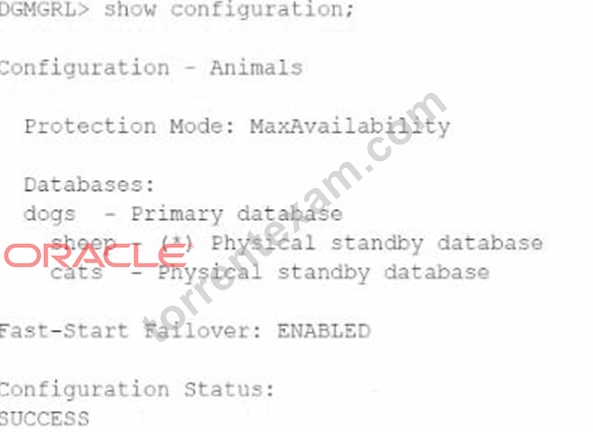
What happens if you issue "switchover to sheep;" at the DGMGRL prompt?
- A. It results in an error indicating that a switchover is not allowed.
- B. The switchover succeeds and Cats becomes the new failover target.
- C. The switchover succeeds and Dogs becomes the new failover target.
- D. The switchover succeeds and Fast-Start Failover is suspended.
- E. The switchover succeeds but Dogs needs to be reinstated.
Answer: C
Explanation:
When issuing a "switchover to sheep;" command in a Data Guard configuration, the primary database (Dogs) transitions to a standby role, and the target standby database (Sheep) becomes the new primary database. Fast-Start Failover (FSFO) remains enabled, but its target changes according to the new roles of the databases. Since Cats is also a physical standby database, it does not become the failover target by default unless it is specified in the broker configuration. After the switchover, the original primary (Dogs) becomes the new standby database and thus the new failover target for FSFO.
Reference:
Oracle Data Guard Broker documentation provides detailed procedures and explanations of switchover operations, including how FSFO targets are affected post-switchover. This behavior is consistent across different Oracle Database versions that support Data Guard and FSFO.
NEW QUESTION # 82
Which two factors can cause an increase in redo transport lag?
- A. The size of the online redo log files on the primary database.
- B. The size of the standby redo log files on the primary database.
- C. Increase in redo generation rate on the primary database.
- D. Increase in network latency between the primary database and a redo transport destination.
- E. The size of the online redo log files on the standby database.
Answer: C,D
NEW QUESTION # 83
You created the PRODSBY1 physical standby database for the PROD primary database using gql and RMAN. You are planning to create a Data Guard Broker configuration. You execute the command:
Which three statements are true regarding the execution of the command?
- A. The PRODSBY1 standby database is automatically added to the configuration if DG_BROKER_START is TRUE for PRODSBYl.
- B. The Data Guard Broker configuration files is automatically created in the destinations specified by the DG_BROKER_CONFIG_FILEn initialization parameters on the primary database.
- C. The command will execute successfully only if the DG_BROKER_START initialization parameter is set to TRUE for the PROD database instance.
- D. The PRODSBYI standby database is automatically added to the configuration if Oracle Net connectivity to the PRODSBYl database instance is defined on the primary host.
- E. The command will execute successfully only if Oracle Net connectivity to the PROD database instance is defined on the primary host.
- F. The command will execute successfully only if Oracle Net connectivity to the PROD and PRODSBYl database instances are defined on the primary host.
Answer: B,C,E
Explanation:
The command executed (CREATE CONFIGURATION 'DGConfig' AS PRIMARY DATABASE IS 'PROD' CONNECT IDENTIFIER IS PROD;) is used to create a Data Guard Broker configuration named 'DGConfig'. The successful execution of this command depends on several conditions:
A: The DG_BROKER_START parameter must be set to TRUE on the primary database to start the Data Guard Broker processes. Without the broker processes running, the configuration cannot be created.
D: Oracle Net connectivity to the PROD database instance must be established on the primary host. This is because the Data Guard Broker requires network accessibility to communicate with the primary database and manage the configuration.
E: When the configuration is created, the Data Guard Broker configuration files are indeed automatically created in the locations specified by the DG_BROKER_CONFIG_FILEn parameters on the primary database.
It's important to note that the command will not automatically add the PRODSBY1 standby database to the configuration (thus B and C are not correct), and there is no requirement for the standby database to have Oracle Net connectivity defined on the primary host for the execution of this command (making F incorrect as well).
NEW QUESTION # 84
Active Data Guard (ADG) databases are widely used to offload reporting or ad hoc query-only jobs from the primary database. Reporting workload profile is different from the primary database and often requires tuning.
Which tool is used to tune SQL workloads running on an ADG database?
- A. Standby Statspack
- B. Automatic Diagnostic Database Monitor (ADDM)
- C. Automatic Workload Repository (AWR)
- D. SQL Tuning Advisor
- E. In-Memory Active Session History (ASH)
Answer: C
Explanation:
AWR collects, processes, and maintains performance statistics for problem detection and self-tuning purposes.
In an Active Data Guard environment, where the physical standby database can be used for read-only workloads, AWR can be instrumental in identifying performance bottlenecks and areas for optimization. It provides detailed reports that include wait events, time model statistics, and active session history, making it an invaluable tool for tuning SQL queries and overall database performance in an ADG setup.
NEW QUESTION # 85
Which three statements are true about Data Guard database modes and states?
- A. The Primary Database can operate in noarchivelog mode.
- B. Databases in a Data Guard Configuration need not operate in Flashback Logging mode.
- C. A Logical Standby Database can be in MOUNT state while applying changes.
- D. Force Logging Mode is not required for a primary database but is recommended.
- E. A primary database may ship redo directly to more than nine standby databases.
Answer: B,C,D
NEW QUESTION # 86
......
1z0-076 Exam Questions Get Updated [2026] with Correct Answers: https://dumpscertify.torrentexam.com/1z0-076-exam-latest-torrent.html
