

Guaranteed Accomplishment with Newest Nov-2025 FREE Workday Workday-Prism-Analytics
Use Valid New Free Workday-Prism-Analytics Exam Dumps & Answers
NEW QUESTION # 27
Using three different source files, you want to load rows of data into an empty table through a Data Change task. What needs to be the same about the three source files?
- A. Schema
- B. Size
- C. Source
- D. Naming convention
Answer: A
Explanation:
Comprehensive and Detailed Explanation From Exact Extract:
In Workday Prism Analytics, a Data Change task is used to load or update data into a table, which can involve importing data from multiple source files. According to the official Workday Prism Analytics study path documents, when loading rows from multiple source files into an empty table, the source files must share the same schema. The schema defines the structure of the data, including the column names, data types, and their order, which ensures that the data from all source files can be consistently mapped and loaded into the target table without errors.
The schema is critical because the Data Change task relies on a predefined table structure to process the incoming data. If the schemas of the source files differ (e.g., different column names or data types), the task will fail due to inconsistencies in data mapping. The other options are not required to be the same:
* Source: The source files can originate from different systems or locations (e.g., Workday, external systems, or file uploads) as long as the schema aligns.
* Naming convention: The names of the source files do not need to follow a specific convention for the Data Change task to process them.
* Size: The size of the source files (e.g., number of rows or file size) can vary, as the task processes the data based on the schema, not the volume.
Thus, the requirement for the source files to have the same schema ensures seamless data loading into the table, maintaining data integrity and consistency during the transformation process.
References:
Workday Prism Analytics Study Path Documents, Section: Data Prep and Transformation, Topic: Data Change Tasks and Schema Requirements Workday Prism Analytics Training Guide, Module: Data Prep and Transformation, Subtopic: Loading Data into Tables Using Data Change Tasks
NEW QUESTION # 28
In a Prism project, you have a dataset containing customer purchase transactions, including the customer ID, purchase amount, and purchase date. You want to analyze the total purchase amount for each customer over the entire period. What transformation stage should you apply to calculate the total purchase amount for each customer?
- A. Join
- B. Group By
- C. Union
- D. Explode
Answer: B
Explanation:
Comprehensive and Detailed Explanation From Exact Extract:
In Workday Prism Analytics, calculating the total purchase amount for each customer requires aggregating data by customer ID. According to the official Workday Prism Analytics study path documents, the appropriate transformation stage for this task is a Group By stage (option C). The Group By stage allows you to group the dataset by a specific field (e.g., customer ID) and apply aggregation functions, such as SUM, to calculate the total purchase amount for each customer. For example, you would group by customer ID and use SUM(purchase_amount) to compute the total. This stage reduces the dataset to one row per customer, with the aggregated total purchase amount, enabling the desired analysis over the entire period.
The other options are incorrect:
* A. Join: A Join stage combines data from two datasets based on a matching condition, but it does not aggregate data to calculate totals.
* B. Union: A Union stage appends rows from one dataset to another, which does not help with calculating totals per customer.
* D. Explode: An Explode stage transforms multi-instance fields into multiple rows, which is unrelated to aggregating purchase amounts.
The Group By stage is the correct choice to aggregate purchase amounts by customer, facilitating the analysis of totals over the entire period.
References:
Workday Prism Analytics Study Path Documents, Section: Data Prep and Transformation, Topic:
Aggregating Data with Group By Stages
Workday Prism Analytics Training Guide, Module: Data Prep and Transformation, Subtopic: Using Group By for Summarization
NEW QUESTION # 29
You want to delete a Prism data source, but you are unable to complete the dataset unpublish. You have deleted the Report Writer reports. What else must you delete, if present?
- A. Discovery board visualizations
- B. Upstream tables
- C. Upstream datasets
- D. Published rows
Answer: A
Explanation:
Comprehensive and Detailed Explanation From Exact Extract:
In Workday Prism Analytics, unpublishing a dataset to delete a Prism data source requires removing all dependencies that reference the data source. According to the official Workday Prism Analytics study path documents, if you have already deleted Report Writer reports but are still unable to unpublish the dataset, you must also delete any discovery board visualizations that reference the Prism data source (option C). Discovery boards in Workday allow users to create visualizations based on Prism data sources, and these visualizations create a dependency on the data source. If such visualizations exist, the system prevents the dataset from being unpublished until they are removed, ensuring that no downstream dependencies are broken.
The other options are incorrect:
* A. Upstream tables: Upstream tables are the source of data for the dataset, but they are not dependencies of the published data source and do not need to be deleted to unpublish the dataset.
* B. Published rows: Published rows are part of the data source itself and are removed when the dataset is unpublished; they are not a separate dependency to delete.
* D. Upstream datasets: Upstream datasets may feed into the dataset being unpublished, but they are not dependencies of the published data source and do not prevent unpublishing.
Deleting discovery board visualizations ensures all dependencies are cleared, allowing the dataset to be unpublished and the Prism data source to be deleted.
References:
Workday Prism Analytics Study Path Documents, Section: Publishing and Visualizing Data, Topic:
Unpublishing Prism Data Sources
Workday Prism Analytics Training Guide, Module: Publishing and Visualizing Data, Subtopic: Managing Dependencies for Data Source Deletion
NEW QUESTION # 30
For a Prism use case, you have two datasets: one contains daily sales data, and the other contains monthly budget allocations. Before performing a join between these datasets, what transformation stage should you apply to the sales data to ensure it matches the granularity of the budget data?
- A. Group By
- B. Filter
- C. Union
- D. Manage Fields
Answer: A
Explanation:
Comprehensive and Detailed Explanation From Exact Extract:
In Workday Prism Analytics, joining datasets with different levels of granularity requires aligning their granularity to ensure a meaningful match. The sales data is at a daily level (one row per day), while the budget data is at a monthly level (one row per month). According to the official Workday Prism Analytics study path documents, to match the granularity of the monthly budget data, you should apply a Group By stage to the sales data (option B). The Group By stage aggregates the daily sales data into monthly totals (e.g., summing sales amounts by month), reducing the granularity from daily to monthly. This allows the sales data to be joined with the monthly budget data on a common key, such as the month.
For example, a Group By stage could group the sales data by a derived month field (e.g., using a function like EXTRACT(YEAR_MONTH, sale_date)) and aggregate the sales amounts using a function like SUM (sales_amount). The resulting dataset would have one row per month, matching the budget data's granularity.
The other options are incorrect:
* A. Union: A Union stage appends rows from one dataset to another but does not change granularity; it cannot aggregate daily data into monthly data.
* C. Manage Fields: The Manage Fields stage modifies field properties (e.g., type, name) but does not aggregate data to change granularity.
* D. Filter: A Filter stage removes rows based on conditions but does not aggregate data to align granularity levels.
The Group By stage is the appropriate transformation to align the sales data's granularity with the monthly budget data for a successful join.
References:
Workday Prism Analytics Study Path Documents, Section: Data Prep and Transformation, Topic: Aligning Granularity for Joins in Prism Analytics Workday Prism Analytics Training Guide, Module: Data Prep and Transformation, Subtopic: Using Group By Stages for Data Aggregation
NEW QUESTION # 31
A custom report uses your recently published Prism data source, but you noticed a minor error in the published data. You need to delete the published rows to fix it. What happens to your custom report?
- A. The report definition remains intact and will work after republishing.
- B. The report definition will need to be manually recreated.
- C. The report definition will be copied and a new version will appear after republishing.
- D. The report definition will need to be edited to reflect changes.
Answer: A
Explanation:
Comprehensive and Detailed Explanation From Exact Extract:
In Workday Prism Analytics, deleting published rows from a Prism data source (PDS) is a step taken to correct errors in the published data, often followed by republishing the dataset with corrected data. According to the official Workday Prism Analytics study path documents, when you delete the published rows, the report definition remains intact and will work after republishing (option A). The custom report's definition, which is based on the Prism data source, is not affected by the deletion of published rows because the report definition references the data source's structure (e.g., fields and metadata), not the specific data rows. Once the dataset is republished with the corrected data, the report will automatically reflect the updated data without requiring any changes to the report definition, assuming the structure of the data source remains the same.
The other options are incorrect:
* B. The report definition will need to be manually recreated: The report definition is not deleted or invalidated by deleting published rows, so recreation is not necessary.
* C. The report definition will be copied and a new version will appear after republishing: Workday does not automatically copy or version report definitions when a data source is republished.
* D. The report definition will need to be edited to reflect changes: No edits are required unless the structure of the data source (e.g., field names or types) changes, which is not indicated in this scenario.
The report definition's integrity is maintained, and it will function as expected after republishing the corrected data.
References:
Workday Prism Analytics Study Path Documents, Section: Publishing and Visualizing Data, Topic: Impact of Data Source Updates on Reports Workday Prism Analytics Training Guide, Module: Publishing and Visualizing Data, Subtopic: Managing Data Corrections in Prism Data Sources
NEW QUESTION # 32
The Prism use case is to classify workers based on their pay. You must create a field that evaluates worker pay and returns a value that represents various pay ranges. How would you add this field for inclusion on the Prism data source?
- A. Create a derived dataset and build a CASE calculated field to classify workers against their pay.
- B. Build a CASE calculated field function on the TBL directly to ease later transformation.
- C. Add the additional field to your raw data before you ingest into Prism.
- D. Build an Evaluate Expression calculated field on your final Prism business object to evaluate workers against their pay.
Answer: A
Explanation:
Comprehensive and Detailed Explanation From Exact Extract:
In Workday Prism Analytics, classifying workers into pay ranges based on their pay requires creating a new field that evaluates the pay values and assigns them to defined ranges (e.g., "Low," "Medium," "High").
According to the official Workday Prism Analytics study path documents, the recommended approach is to create a derived dataset (DDS) and build a CASE calculated field to classify workers against their pay (option B). The CASE function in a calculated field allows users to define conditional logic (e.g., CASE WHEN pay
< 50000 THEN "Low" WHEN pay < 100000 THEN "Medium" ELSE "High" END), which is ideal for creating pay range classifications. This calculated field is added within a deriveddataset, which can then be published as a Prism data source, making the new field available for reporting and analytics.
The other options are not optimal:
* A. Add the additional field to your raw data before you ingest into Prism: Modifying raw data outside Prism is unnecessary and less flexible, as Prism's transformation capabilities (like CASE) are designed for such tasks.
* C. Build a CASE calculated field function on the TBL directly to ease later transformation: Calculated fields cannot be created directly on a table (TBL) in Prism Analytics; they must be defined in a derived dataset.
* D. Build an Evaluate Expression calculated field on your final Prism business object to evaluate workers against their pay: Prism Analytics does not use "Prism business objects" for calculated fields, and "Evaluate Expression" is not a standard function; this option is not applicable.
Using a CASE calculated field in a derived dataset provides a flexible and maintainable way to classify workers by pay ranges, ensuring the field is included in the final Prism data source.
References:
Workday Prism Analytics Study Path Documents, Section: Data Prep and Transformation, Topic: Creating Calculated Fields with CASE Functions Workday Prism Analytics Training Guide, Module: Data Prep and Transformation, Subtopic: Classifying Data Using Calculated Fields in Derived Datasets
NEW QUESTION # 33
A Prism data writer needs to create a new Prism calculated field on a derived dataset using the CASE function. When creating a calculated field, what symbol do you use to view a list of fields that you can select from in the dataset?
- A. [
- B. #
- C. (
- D. {
Answer: A
Explanation:
Comprehensive and Detailed Explanation From Exact Extract:
In Workday Prism Analytics, when creating a calculated field in a derived dataset, users often need to reference existing fields in the dataset within their expressions, such as in a CASE function. According to the official Workday Prism Analytics study path documents, to view and select from a list of available fields in the dataset while building a calculated field expression, the user types the [ symbol (left square bracket). This symbol triggers a dropdown list of all fields in the dataset, allowing the user to select the desired field without manually typing its name, reducing the risk of errors. For example, typing [ and selecting a field like
"Employee_ID" will insert [Employee_ID] into the expression, which can then be used in the CASE function logic.
The other symbols do not serve this purpose:
* B. (: Parentheses are used for grouping expressions or defining function parameters, not for field selection.
* C. #: The hash symbol is not used in Prism Analytics for field selection; it may be associated with other functionalities in different contexts.
* D. {: Curly braces are not used for field selection in Prism Analytics; they may be used in other systems for different purposes, such as templating.
The use of the [ symbol ensures an efficient and accurate way to reference fields in a calculated field expression, streamlining the creation process in Prism Analytics.
References:
Workday Prism Analytics Study Path Documents, Section: Data Prep and Transformation, Topic: Creating Calculated Fields in Derived Datasets Workday Prism Analytics Training Guide, Module: Data Prep and Transformation, Subtopic: Using the Expression Editor for Calculated Fields
NEW QUESTION # 34
You have published a derived dataset to build a Prism data source. For reports using this Prism data source, when is data updated?
- A. At report runtime.
- B. At republish of the datasource only.
- C. At reimport into tables only.
- D. At reimport into tables and republish of the datasource.
Answer: D
Explanation:
Comprehensive and Detailed Explanation From Exact Extract:
In Workday Prism Analytics, a published Prism data source (PDS) contains a snapshot of data from a derived dataset at the time of publishing. According to the official Workday Prism Analytics study path documents, for reports using a Prism data source, the data is updated at reimport into tables and republish of the datasource (option B). A derived dataset typically sources data from underlying tables (via import stages), and any updates to the source data require two steps: (1) reimporting the updated data into the tables (e.g., via a Data Change task), and (2) republishing the derived dataset to refresh the Prism data source with the new data.
Reports using the PDS will reflect the updated data only after both steps are completed, as the data source is a static snapshot until republished.
The other options are incorrect:
* A. At republish of the datasource only: Republishing alone does not update the data if the underlying tables have not been reimported with new data; both steps are necessary.
* C. At reimport into tables only: Reimporting into tables updates the source data, but the PDS remains unchanged until the dataset is republished.
* D. At report runtime: Reports do not dynamically update the PDS at runtime; they use the data as it exists in the PDS at the time of the last publish.
The combination of reimporting into tables and republishing the data source ensures that reports reflect the most current data.
References:
Workday Prism Analytics Study Path Documents, Section: Publishing and Visualizing Data, Topic: Data Update Process for Prism Data Sources Workday Prism Analytics Training Guide, Module: Publishing and Visualizing Data, Subtopic: Refreshing Data in Prism Data Sources for Reporting
NEW QUESTION # 35
You are a new Prism customer and you want to ensure the correct set of fields is brought into a derived dataset. When should you apply a Manage Fields stage?
- A. After the dataset is published.
- B. At the beginning of the primary pipeline of the Base Dataset.
- C. At the beginning of the Primary Pipeline of the derived dataset.
- D. At the end of the Primary Pipeline of a published dataset.
Answer: C
Explanation:
Comprehensive and Detailed Explanation From Exact Extract:
In Workday Prism Analytics, a Manage Fields stage is used to control the fields in a dataset by renaming, hiding, or changing field types, among other actions. According to the official Workday Prism Analytics study path documents, to ensure the correct set of fields is brought into a derived dataset (DDS), the Manage Fields stage should be applied at the beginning of the Primary Pipeline of the derived dataset (option C).
Placing the Manage Fields stage early in the pipeline-right after the initial import stage (Stage 1)-allows you to define the field structure upfront, ensuring that subsequent transformationstages (e.g., Join, Filter, Calculate Field) operate on the desired set of fields. This approach helps maintain consistency and avoids unnecessary processing of fields that are not needed in later stages.
The other options are not optimal:
* A. After the dataset is published: You cannot add transformation stages like Manage Fields after a dataset is published; transformations must be applied during the dataset's creation or editing.
* B. At the end of the Primary Pipeline of a published dataset: Similar to option A, you cannot modify a published dataset's pipeline, and placing Manage Fields at the end would not prevent unnecessary fields from being processed in earlier stages.
* D. At the beginning of the primary pipeline of the Base Dataset: A Base Dataset does not have a transformation pipeline; it is a direct import of a table, so Manage Fields stages can only be applied in a Derived Dataset.
Applying the Manage Fields stage at the beginning of the derived dataset's Primary Pipeline ensures efficient data preparation and transformation.
References:
Workday Prism Analytics Study Path Documents, Section: Data Prep and Transformation, Topic: Using Manage Fields in Derived Datasets Workday Prism Analytics Training Guide, Module: Data Prep and Transformation, Subtopic: Best Practices for Field Management in Pipelines
NEW QUESTION # 36
Why should you include Workday instance field types in the Workday report that you use to import data into Prism?
- A. Performance is improved in the final Prism datasource when published.
- B. The final Prism datasource can support drilling into Workday objects.
- C. Joins are more easily performed with instance field types.
- D. Unions are more easily performed with instance field types.
Answer: B
Explanation:
Comprehensive and Detailed Explanation From Exact Extract:
When importing data into Workday Prism Analytics from a Workday report, including Workday instance field types in the report is critical for enabling specific functionality in the resulting Prism data source.
According to the official Workday Prism Analytics study path documents, including instance field types allows the final Prism data source to support drilling into Workday objects. Instance field types represent references to Workday business objects (e.g., Worker, Position, or Organization), and including them in the report ensures that the Prism data source retains the ability to navigate to these objects within Workday's reporting and analytics framework. This enables users to perform drill-down actions, such as accessing detailed object data directly from Prism visualizations or reports.
The other options do not accurately reflect the primary benefit of including instance field types:
* B. Performance is improved in the final Prism datasource when published: Instance field types do not directly impact the performance of the published data source; performance is more influenced by data volume and indexing.
* C. Unions are more easily performed with instance field types: Unions depend on schema compatibility, not instance field types, which are specific to Workday object references.
* D. Joins are more easily performed with instance field types: While instance field types can be used in joins, their primary purpose is to enable object navigation, not to simplify join operations.
By including instance field types, the Prism data source gains enhanced interactivity, allowing users to leverage Workday's object model for deeper analysis and navigation.
References:
Workday Prism Analytics Study Path Documents, Section: Integrating Prism with Workday Reports, Topic:
Workday Report Field Types and Prism Integration
Workday Prism Analytics Training Guide, Module: Publishing and Visualizing Data, Subtopic: Enabling Drill-Down Capabilities in Prism Data Sources
NEW QUESTION # 37
You want to configure access to a published Prism data source to use it in reporting and discovery boards.
What action must you take?
- A. Edit the data source security and select a domain.
- B. Schedule the recurring publish process.
- C. Share the imported Workday report to provide users with access to the published Prism data source.
- D. Share the dataset with appropriate users.
Answer: A
Explanation:
Comprehensive and Detailed Explanation From Exact Extract:
In Workday Prism Analytics, configuring access to a published Prism data source for use in reporting and discovery boards requires managing its security settings. According to the official Workday Prism Analytics study path documents, the necessary action is to edit the data source security and select a domain (option A).
After a dataset is published as a Prism data source, access is controlled through security domains. By editing the data source security and assigning it to an appropriate security domain (e.g., a domain that grants access to specific user groups like report writers or analysts), you ensure that authorized users can access the data source for reporting and discovery boards. This aligns with Workday's configurable security framework, ensuring that only users with the appropriate permissions can view or use the data source.
The other options are incorrect:
* B. Share the dataset with appropriate users: Sharing the dataset itself does not grant access to the published Prism data source; access to the data source is controlled through its security settings, not the dataset's sharing settings.
* C. Share the imported Workday report to provide users with access to the published Prism data source:
Sharing an imported Workday report does not affect access to the Prism data source; the data source's security must be configured directly.
* D. Schedule the recurring publish process: Scheduling a recurring publish process ensures the data source is updated regularly, but it does not configure access for reporting or discovery boards.
Editing the data source security and selecting a domain is the critical step to enable access for reporting and discovery boards.
References:
Workday Prism Analytics Study Path Documents, Section: Security and Governance in Prism, Topic:
Configuring Access to Prism Data Sources
Workday Prism Analytics Training Guide, Module: Security and Governance in Prism, Subtopic: Managing Data Source Security for Reporting
NEW QUESTION # 38
A Prism data writer has two pipelines of data that need to be joined together:
* The primary pipeline includes point of sale data by sales agent.
* The secondary pipeline includes performance rating by sales agent.
The requirement is to keep all of the point of sale data from the primary pipeline and blend in performance rating data for the agents from the secondary pipeline where it exists. What Join type should be used to blend the data together?
- A. Left Outer Join
- B. Full Outer Join
- C. Right Outer Join
- D. Inner Join
Answer: A
Explanation:
Comprehensive and Detailed Explanation From Exact Extract:
In Workday Prism Analytics, the requirement to keep all data from the primary pipeline (point of sale data by sales agent) and blend in matching data from the secondary pipeline (performance rating by sales agent) where it exists indicates the need for a specific type of join. According to the official Workday Prism Analytics study path documents, a Left Outer Join (option C) is the appropriate join type for this scenario. A Left Outer Join includes all rows from the primary pipeline and matches them with rows from the secondary pipeline based on the join condition (e.g., sales agent ID). If no match is found in the secondary pipeline, the fields from the secondary pipeline will have NULL values, but the primary pipeline's data is fully retained, meeting the requirement to keep all point of sale data while blending in performance ratings where available.
The other options do not meet the requirement:
* A. Inner Join: An Inner Join only includes rows where matches exist in both pipelines, which would exclude point of sale data for sales agents without performance ratings, violating the requirement to keep all primary pipeline data.
* B. Right Outer Join: A Right Outer Join includes all rows from the secondary pipeline and matching rows from the primary pipeline, which prioritizes the secondary pipeline and may exclude some point of sale data, not meeting the requirement.
* D. Full Outer Join: A Full Outer Join includes all rows from both pipelines, with NULLs for non- matching rows, but this is broader than the requirement, which only needs all data from the primary pipeline, not necessarily all data from the secondary pipeline.
A Left Outer Join ensures that all point of sale data is retained while blending in performance ratings where they exist, aligning with the stated requirement.
References:
Workday Prism Analytics Study Path Documents, Section: Data Prep and Transformation, Topic: Join Types and Their Applications in Prism Analytics Workday Prism Analytics Training Guide, Module: Data Prep and Transformation, Subtopic: Blending Data Using Join Stages
NEW QUESTION # 39
You want to convert each instance of a multi-instance field and convert it to a single-instance field. What transformation stage can you use to do this?
- A. Explode
- B. Manage Fields
- C. Group By
- D. Unpivot
Answer: A
Explanation:
Comprehensive and Detailed Explanation From Exact Extract:
In Workday Prism Analytics, a multi-instance field contains multiple values for a single record (e.g., a list of skills for a worker). To convert each instance of a multi-instance field into a single-instance field, you need a transformation that expands the data into multiple rows, with each row containing one instance. According to the official Workday Prism Analytics study path documents, the Explode stage (option B) is the transformation stage designed for this purpose. The Explode stage takes a multi-instance field and creates a new row for each instance, transforming the multi-instance field into a single-instance field in the output. For example, if a worker has three skills in a multi-instance field, the Explode stage will create three rows, each with a single skill value in a single-instance field.
The other options are incorrect:
* A. Unpivot: Unpivot transforms columns into rows (e.g., converting wide data to long format), but it does not handle multi-instance fields, which are a specific Workday data type.
* C. Manage Fields: The Manage Fields stage modifies field properties (e.g., type, name) but cannot expand a multi-instance field into multiple rows.
* D. Group By: The Group By stage aggregates data (e.g., summing values by a key) but does not convert multi-instance fields into single-instance fields.
The Explode stage is the correct transformation to achieve the conversion of a multi-instance field into a single-instance field by expanding the data into multiple rows.
References:
Workday Prism Analytics Study Path Documents, Section: Data Prep and Transformation, Topic: Handling Multi-Instance Fields with Explode Stages Workday Prism Analytics Training Guide, Module: Data Prep and Transformation, Subtopic: Converting Multi-Instance Fields to Single-Instance Fields
NEW QUESTION # 40
A Prism data writer has to create an intermediary Prism calculated field A, used only to achieve a final result in Prism calculated field B and they only need to publish out field B. What should they do?
- A. Delete field A from their DDS and just leave field B.
- B. Add a Manage Fields stage to the DDS and hide field B.
- C. Add a Manage Fields stage to the DDS and hide field A.
- D. Mark field A as intermediate calculation.
Answer: C
Explanation:
Comprehensive and Detailed Explanation From Exact Extract:
In Workday Prism Analytics, when a data writer creates an intermediary calculated field (e.g., field A) solely to derive a final calculated field (e.g., field B) in a Derived Dataset (DDS), they may want to exclude the intermediary field from the published output to keep the dataset clean and focused. According to the official Workday Prism Analytics study path documents, the recommended approach is to add a Manage Fields stage to the DDS and hide field A. The Manage Fields stage allows users to control the visibility of fields in the dataset, enabling them to hide fields that are not needed in the final output while retaining their calculations for internal use within the dataset's transformation logic. By hiding field A, field B can still leverage field A's calculations, and only field B will be visible in the published dataset or data source.
The other options are not suitable:
A: Mark field A as intermediate calculation: There is no specific feature in Prism Analytics to "mark" a field as an intermediate calculation; this is not a supported action.
C: Add a Manage Fields stage to the DDS and hide field B: Hiding field B would defeat the purpose, as field B is the intended output to be published.
D: Delete field A from their DDS and just leave field B: Deleting field A would break the calculation of field B, as field B depends on field A, making this option infeasible.
Using the Manage Fields stage to hide field A ensures that the dataset remains functional while presenting only the necessary fields in the final output, aligning with best practices for data transformation and publishing.
References:
Workday Prism Analytics Study Path Documents, Section: Data Prep and Transformation, Topic: Managing Fields in Derived Datasets Workday Prism Analytics Training Guide, Module: Data Prep and Transformation, Subtopic: Configuring Field Visibility in Datasets
NEW QUESTION # 41
You created a derived dataset that imports data from a table, which will become your Stage 1. What can you add to this dataset?
- A. Up to five transformation stages.
- B. As many transformation stages of any type as your scenario requires.
- C. As many transformation stages of any type as long as they are in a particular order.
- D. Up to two Manage Fields transformation stages.
Answer: B
Explanation:
Comprehensive and Detailed Explanation From Exact Extract:
In Workday Prism Analytics, a derived dataset (DDS) allows users to transform data by adding various transformation stages after the initial import stage (Stage 1). According to the official Workday Prism Analytics study path documents, you can add as many transformation stages of any type as your scenario requires (option A). Prism Analytics supports a variety of transformation stages, such as Join, Union, Filter, Manage Fields, and Calculate Field, among others. There are no strict limits on the number of stages or their types, and they can be added in any order that makes sense for the data transformation logic, as long as the stages are configured correctly to produce the desired output. This flexibility allows users to build complex transformation pipelines tailored to their specific use case.
The other options are incorrect:
* B. As many transformation stages of any type as long as they are in a particular order: While the order of stages matters for the transformation logic (e.g., a Filter before a Join), there is no predefined order requirement for all stages; the order depends on the scenario.
* C. Up to five transformation stages: There is no limit of five transformation stages in Prism Analytics; you can add more as needed.
* D. Up to two Manage Fields transformation stages: There is no restriction to only two Manage Fields stages; you can add as many as required.
The ability to add as many transformation stages as needed provides maximum flexibility in shaping the data within a derived dataset.
References:
Workday Prism Analytics Study Path Documents, Section: Data Prep and Transformation, Topic: Building Transformation Pipelines in Derived Datasets Workday Prism Analytics Training Guide, Module: Data Prep and Transformation, Subtopic: Adding and Configuring Transformation Stages
NEW QUESTION # 42
The final derived dataset in a Prism pipeline is complete and ready to publish. What should be done prior to publishing?
- A. Edit the Dataset API Name to reflect in the name of the Prism data source.
- B. Create a derived dataset with the PDS suffix.
- C. Add a Group By stage to the final derived dataset to add summary calculations.
- D. Create a table without the Enable for Analysis checkbox selected.
Answer: A
Explanation:
Comprehensive and Detailed Explanation From Exact Extract:
In Workday Prism Analytics, before publishing a derived dataset as a Prism data source (PDS), it's important to ensure that the dataset is properly configured for downstream use. According to the official Workday Prism Analytics study path documents, one key step to take prior to publishing is to edit the Dataset API Name to reflect in the name of the Prism data source (option D). The Dataset API Name determines the name of the published Prism data source, which is used in reporting, discovery boards, and integrations. Setting a meaningful and descriptive API name (e.g., "Expense_Reports_by_Location") ensures that the data source is easily identifiable and aligns with naming conventions, improving usability and manageability in the Workday ecosystem. This step is a best practice to avoid confusion and ensure clarity for report writers and analysts.
The other options are not required or relevant:
* A. Add a Group By stage to the final derived dataset to add summary calculations: Adding a Group By stage is not mandatory unless the use case specifically requires summarizations, which is not indicated here.
* B. Create a table without the Enable for Analysis checkbox selected: Creating a new table is unnecessary, as the dataset is already complete, and the "Enable for Analysis" checkbox is relevant for real-time updates, not a requirement for publishing a derived dataset.
* C. Create a derived dataset with the PDS suffix: Creating a new dataset is not needed, as the final derived dataset is already prepared, and adding a "PDS" suffix is not a required step for publishing.
Editing the Dataset API Name ensures the Prism data source has a clear and meaningful name, facilitating its use in reporting and analytics.
References:
Workday Prism Analytics Study Path Documents, Section: Publishing and Visualizing Data, Topic: Best Practices for Publishing Prism Data Sources Workday Prism Analytics Training Guide, Module: Publishing and Visualizing Data, Subtopic: Configuring Dataset API Names Before Publishing
NEW QUESTION # 43
You have two tables. One with employee data from Workday and another with learner data from an external system. Both tables have an Employee ID field.
In the Employee Data TBL, Employee ID is text.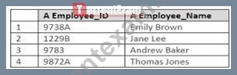
In the Learner Data TBL, Employee ID is numeric.
How can you prepare to join these tables, without the potential loss of data?
- A. Change the field type of Employee ID directly on the Learner Data TBL from Numeric to Text.
- B. Import the Employee Data TBL into a DDS and change the field type of Employee ID from text to numeric using a Manage Fields stage.
- C. Change the field type of Employee ID directly on the Employee Data TBL from text to numeric.
- D. Import the Learner Data TBL into a DDS and change the field type of Employee ID from numeric to text using a Manage Fields stage.
Answer: D
Explanation:
In Workday Prism Analytics, joining two tables requires that the fields used in the join condition have compatible data types to avoid data mismatches or loss. The Employee Data TBL has an Employee ID field as text, while the Learner Data TBL has an Employee ID field as numeric. According to the official Workday Prism Analytics study path documents, to join these tables without potential data loss, the best approach is to convert the numeric Employee ID in the Learner Data TBL to text, as text fields can safely store numeric values as strings, but converting text to numeric risks data loss if the text field contains non-numeric characters (e.g., leading zeros or special characters).
The correct method is to import the Learner Data TBL into a Derived Dataset (DDS) and use a Manage Fields stage to change the field type of Employee ID from numeric to text (option D). This ensures that the Employee ID field in both tables is text, enabling a safe and accurate join without losing data. The Manage Fields stage in a DDS allows for field type transformations, which is the recommended approach for preparing data for joins in Prism Analytics.
The other options are less suitable:
* A. Import the Employee Data TBL into a DDS and change the field type of Employee ID from text to numeric using a Manage Fields stage: Converting text to numeric risks data loss if the text field contains non-numeric values, which could lead to errors or missing records during the join.
* B. Change the field type of Employee ID directly on the Employee Data TBL from text to numeric:
Direct field type changes on tables are not supported in Prism Analytics, and even if possible, this approach risks data loss for the same reason as option A.
* C. Change the field type of Employee ID directly on the Learner Data TBL from Numeric to Text:
Direct field type changes on tables are not supported; field type transformations must be done in a DDS using a Manage Fields stage.
By converting the numeric Employee ID to text in a DDS, the join can be performed safely, preserving all data from both tables.
References:
Workday Prism Analytics Study Path Documents, Section: Data Prep and Transformation, Topic: Preparing Data for Joins in Prism Analytics Workday Prism Analytics Training Guide, Module: Data Prep and Transformation, Subtopic: Field Type Transformations Using Manage Fields Stage
NEW QUESTION # 44
The Prism use case is to classify workers based on their pay. You must create a field that evaluates worker pay and returns a value that represents various pay ranges. How would you add this field for inclusion on the Prism data source?
- A. Create a derived dataset and build a CASE calculated field to classify workers against their pay.
- B. Build a CASE calculated field function on the TBL directly to ease later transformation.
- C. Add the additional field to your raw data before you ingest into Prism.
- D. Build an Evaluate Expression calculated field on your final Prism business object to evaluate workers against their pay.
Answer: A
Explanation:
Comprehensive and Detailed Explanation From Exact Extract:
In Workday Prism Analytics, classifying workers into pay ranges based on their pay requires creating a new field that evaluates the pay values and assigns them to defined ranges (e.g., "Low," "Medium," "High").
According to the official Workday Prism Analytics study path documents, the recommended approach is to create a derived dataset (DDS) and build a CASE calculated field to classify workers against their pay (option B). The CASE function in a calculated field allows users to define conditional logic (e.g., CASE WHEN pay
< 50000 THEN "Low" WHEN pay < 100000 THEN "Medium" ELSE "High" END), which is ideal for creating pay range classifications. This calculated field is added within a deriveddataset, which can then be published as a Prism data source, making the new field available for reporting and analytics.
The other options are not optimal:
* A. Add the additional field to your raw data before you ingest into Prism: Modifying raw data outside Prism is unnecessary and less flexible, as Prism's transformation capabilities (like CASE) are designed for such tasks.
* C. Build a CASE calculated field function on the TBL directly to ease later transformation: Calculated fields cannot be created directly on a table (TBL) in Prism Analytics; they must be defined in a derived dataset.
* D. Build an Evaluate Expression calculated field on your final Prism business object to evaluate workers against their pay: Prism Analytics does not use "Prism business objects" for calculated fields, and "Evaluate Expression" is not a standard function; this option is not applicable.
Using a CASE calculated field in a derived dataset provides a flexible and maintainable way to classify workers by pay ranges, ensuring the field is included in the final Prism data source.
References:
Workday Prism Analytics Study Path Documents, Section: Data Prep and Transformation, Topic: Creating Calculated Fields with CASE Functions Workday Prism Analytics Training Guide, Module: Data Prep and Transformation, Subtopic: Classifying Data Using Calculated Fields in Derived Datasets
NEW QUESTION # 45
You have a number of Workday reports that use a Prism data source. When are the values of the Prism calculated fields in the Workday reports calculated?
- A. At dataset creation time.
- B. At time of publishing.
- C. At the calculated field creation time.
- D. At report run time.
Answer: B
Explanation:
Comprehensive and Detailed Explanation From Exact Extract:
In Workday Prism Analytics, calculated fields in a dataset are evaluated as part of the dataset's processing logic, and their values are materialized when the dataset is published as a Prism data source. According to the official Workday Prism Analytics study path documents, the values of Prism calculated fields are calculated at the time of publishing (option D). When a dataset is published, Prism processes all transformation stages, including calculated fields, and the resulting values are stored in the publisheddata source. Workday reports that use this Prism data source then retrieve these pre-calculated values, ensuring consistent and efficient reporting without recalculating the fields at report run time.
The other options are incorrect:
* A. At report run time: Calculated field values are not computed when the Workday report is run; they are pre-calculated and stored in the Prism data source during publishing.
* B. At dataset creation time: Dataset creation involves defining the transformation logic, but the actual computation of calculated fields occurs during publishing, not at creation.
* C. At the calculated field creation time: Creating a calculated field defines its expression, but the values are not computed until the dataset is processed during publishing.
The calculation of Prism calculated fields at the time of publishing ensures that Workday reports can efficiently access the results without additional computation overhead.
References:
Workday Prism Analytics Study Path Documents, Section: Integrating Prism with Workday Reports, Topic:
Calculated Fields in Prism Data Sources
Workday Prism Analytics Training Guide, Module: Publishing and Visualizing Data, Subtopic: Processing Calculated Fields During Publishing
NEW QUESTION # 46
While viewing your lineage, you realize you have forgotten to add a description to some of your derived datasets. From the lineage, you double-click on a dataset to view the dataset details. What is the next step to add the missing descriptions?
- A. Select the pencil icon next to the Import stage to update the description.
- B. Select Add Field from the dataset details to create a description.
- C. Select Related Actions next to the dataset name and Edit Transformations.
- D. Select the pencil icon next to the dataset name and Edit Transformations.
Answer: C
Explanation:
To add or update the description of a derived dataset in Workday Prism Analytics, you should access the Edit Dataset Transformations task. This can be done by selecting the Related Actions next to the dataset name and choosing Edit Transformations. This method allows you to modify various aspects of the dataset, including its description.
This process is outlined in the Workday Prism Analytics User Guide, which states:
"If you have permission to edit a dataset, you can access the Edit Dataset Transformations task using these methods:
* Right-click the dataset name on the Data Catalog report and select Edit Transformations.
* Select Edit Transformations from the Quick Actions on the View Dataset Details report.
* Access the Edit Dataset task and select the dataset name that you want to edit." Once in the Edit Dataset Transformations task, you can update the dataset's description by clicking on the configuration icon (often represented as a gear or pencil icon) and editing the description field.
Reference: Workday Prism Analytics User Guide, "Concept: Dataset Workspace" section
NEW QUESTION # 47
You want to remove data within a Prism data source without deleting any dependent custom reports. What task can you use to do this?
- A. Delete Published Rows
- B. Unpublish Dataset
- C. Inactivate Dataset
- D. Delete Dataset
Answer: A
Explanation:
Comprehensive and Detailed Explanation From Exact Extract:
In Workday Prism Analytics, removing data from a Prism data source (PDS) without affecting dependent custom reports requires a careful approach to preserve the data source's structure and dependencies.
According to the official Workday Prism Analytics study path documents, the task to use is Delete Published Rows (option D). This task removes the data rows within the Prism data source while keeping the data source' s metadata (e.g., field definitions) and structure intact. Since custom reports depend on the data source's structure rather than the specific data rows, deleting the published rows will not break the reports. After deleting the rows, you can republish the dataset with updated data, and the reports will continue to function with the new data, assuming the structure remains unchanged.
The other options are incorrect:
* A. Inactivate Dataset: Inactivating a dataset disables it but does not remove data from the published data source, and it may still affect reports by making the data source inaccessible.
* B. Delete Dataset: Deleting the dataset entirely will also delete the Prism data source, breaking any dependent custom reports.
* C. Unpublish Dataset: Unpublishing the dataset removes the Prism data source, which will break dependent reports until the dataset is republished.
The Delete Published Rows task ensures that data is removed from the Prism data source without impacting the dependent custom reports, allowing for seamless data updates.
References:
Workday Prism Analytics Study Path Documents, Section: Publishing and Visualizing Data, Topic: Managing Data in Prism Data Sources Workday Prism Analytics Training Guide, Module: Publishing and Visualizing Data, Subtopic: Removing Data Without Breaking Report Dependencies
NEW QUESTION # 48
......
Workday-Prism-Analytics Braindumps PDF, Workday Workday-Prism-Analytics Exam Cram: https://dumpscertify.torrentexam.com/Workday-Prism-Analytics-exam-latest-torrent.html
