

[Mar-2026] Updated Cisco 400-007 Dumps – PDF & Online Engine
400-007.pdf - Questions Answers PDF Sample Questions Reliable
Cisco 400-007 Exam Syllabus Topics:
| Topic | Details |
|---|---|
| Topic 1 |
|
| Topic 2 |
|
| Topic 3 |
|
| Topic 4 |
|
| Topic 5 |
|
Cisco 400-007 exam is a challenging and rigorous exam that tests a candidate's knowledge of network design principles and methodologies. It is an essential certification for network architects, engineers, and designers who want to demonstrate their expertise in this field and advance their careers.
Cisco 400-007 exam validates the knowledge and skills of candidates in network design principles, network architecture, and network design requirements. 400-007 exam consists of multiple-choice questions and simulations that test the candidate's ability to design and implement complex network solutions. 400-007 exam covers various topics such as network infrastructure, network security, network services, network management, and network virtualization.
NEW QUESTION # 199
A network security team observes phishing attacks on a user machine from a remote location. The organization has a policy of saving confidential data on two different systems using different types of authentication. What is the next step to control such events after the security team verifies all users in Zero Trust modeling?
- A. Assess real-time security health of devices.
- B. Apply a context-based network access control policy for users.
- C. Ensure trustworthiness of devices.
- D. Enforce risk-based and adaptive access policies.
Answer: D
Explanation:
* A (Risk-based and adaptive access policies): After verifying user identity within a Zero Trust architecture, the next logical step is to apply continuous, adaptive risk-based policies that evaluate contextual factors (device posture, behavior, location, etc.) before granting access. This approach dynamically responds to threats such as phishing attacks by adjusting access permissions based on real- time risk.
Other options explained:
* B/C/D: These are supporting mechanisms, but risk-based policies directly address dynamic attack mitigation.
NEW QUESTION # 200
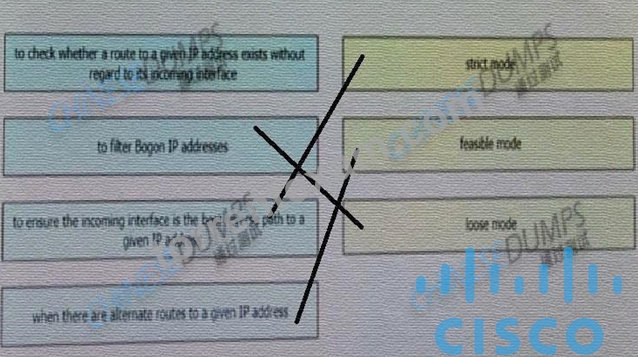
Drag and drop the design use cases from the left onto the correct uRPF techniques used to prevent spoofing attacks Not all options are used.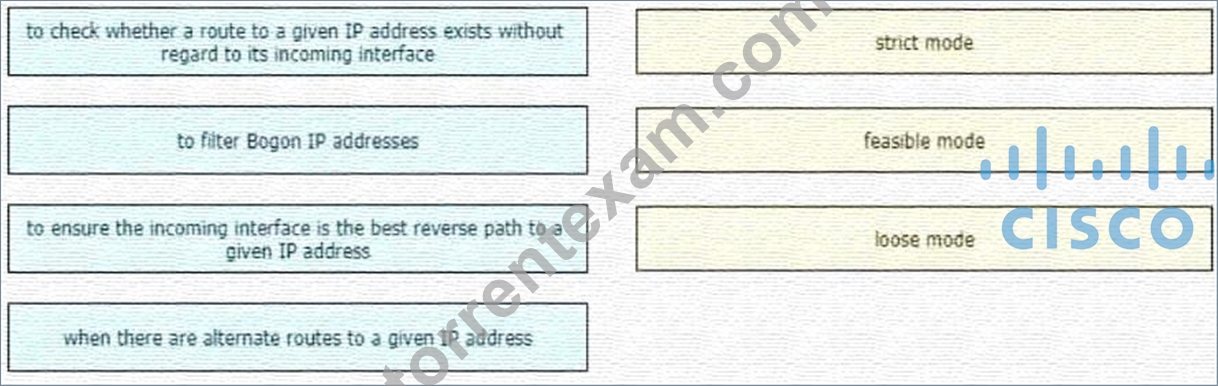
Answer:
Explanation: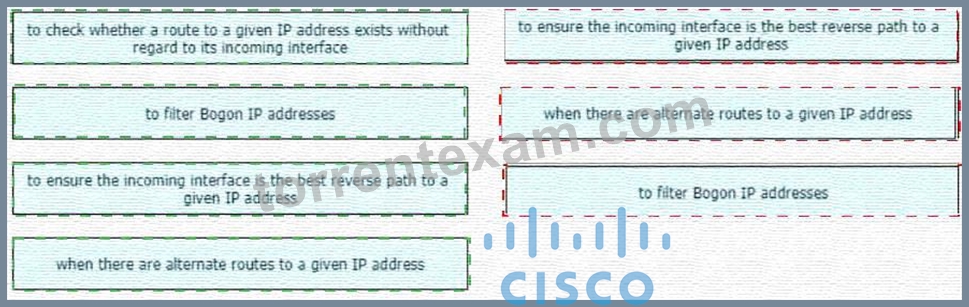
NEW QUESTION # 201
Refer to the exhibit.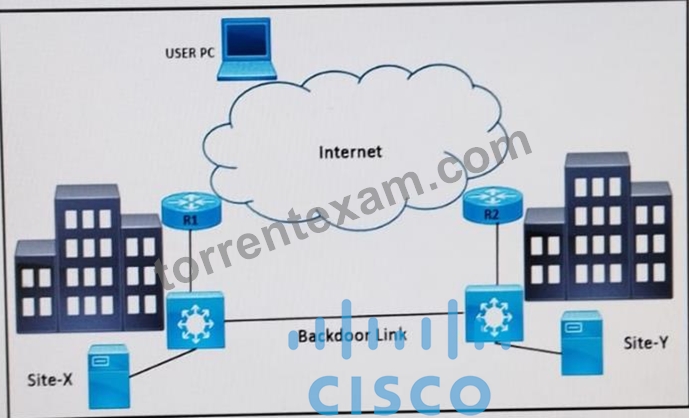
Two data center siles X and Y are connected with a direct backdoor link with these conditions *Site-specific firewalls are deployed behind the Internet edge routers R1 and R2 *Both sites are advertising the address pool 100 75 10 0/23 toward the internet Site-X finds that Internet traffic returning from user PCs comes back on the Site-Y link Which design resolves the issue?
- A. Add a static route toward the Internet on Site-X.
Change the DNS policy on Site-Y to block traffic. - B. Change the Site-Y firewall configuration to replicate the Site-X configuration.
Advertise the low MED attribute on Site-X to the Internet. - C. Use BGP MED to influence Site-X return traffic Change the IP address scheme of both sites.
- D. Establish control plane peering between edge routers.
Have Site-X advertise an IP pool with a longer prefix.
Answer: C
NEW QUESTION # 202
SDWAN networks capitalize the usage of broadband Internet links over traditional MPLS links to offer more cost benefits to enterprise customers. However, due to the insecure nature of the public Internet, it is mandatory to use encryption of traffic between any two SDWAN edge devices installed behind NAT gateways.
Which overlay method can provide optimal transport over unreliable underlay networks that are behind NAT gateways?
- A. TLS
- B. IPsec
- C. DTLS
- D. GRE
Answer: B
NEW QUESTION # 203
An enterprise requires MPLS-connected branches to access cloud-based Microsoft 365 services over an SD- WAN solution. Internet access is available only at dual regional hub sites that are connected to the MPLS network. Which connectivity method provides an optimum access method to the cloud-based services if one ISP suffers loss or latency?
- A. Cloud onRamp SWG
- B. Cloud onRamp SaaS
- C. Cloud onRamp
- D. Cloud onRamp gateway site
Answer: B
Explanation:
* Cisco SD-WAN Cloud OnRamp SaaS optimizes cloud application performance by dynamically measuring SaaS application paths from multiple branch edges toward the Microsoft 365 cloud.
* It automatically selects the best-performing path, continuously monitors SLA metrics (latency, loss, jitter), and dynamically reroutes based on real-time performance.
* This directly addresses SaaS resiliency across multiple ISPs with minimal manual intervention and is aligned with CCDE v3.1 SD-WAN design methodologies for SaaS optimization.
Why other options are incorrect:
* A: Cloud OnRamp gateway is for IaaS optimization (AWS, Azure), not SaaS.
* B: Cloud OnRamp SWG (Secure Web Gateway) is for internet-bound security inspection, not SaaS path optimization.
* C: "Cloud OnRamp" alone is too general; SaaS is the specific solution for this SaaS use case.
NEW QUESTION # 204
Refer to the exhibit. Company XYZ must design a DMVPN tunnel between the three sites.
Chicago is going to act as the NHS and the company wants DMVPN to detect peer endpoint failures. Which technology should be used in the design?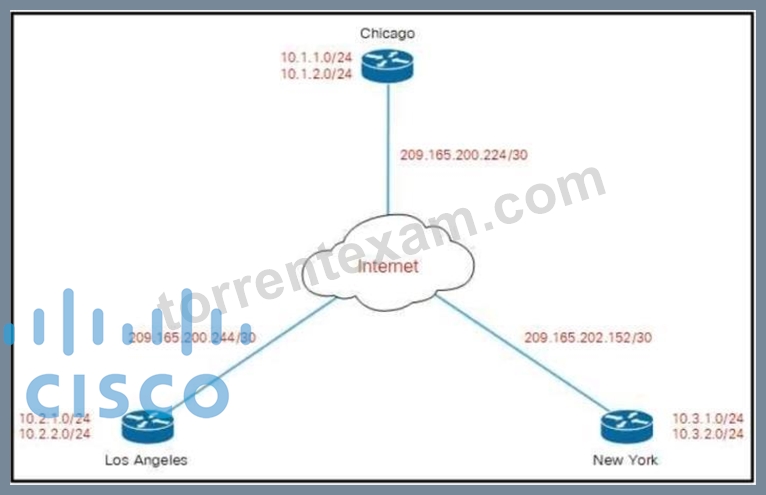
- A. L2TPv3
- B. IP SLA
- C. GRE
- D. VPLS
Answer: B
NEW QUESTION # 205
Which SDN architecture component is used by the application layer to communicate with the control plane layer to provide instructions about the resources required by applications?
- A. Orchestration layer
- B. Northbound APIs
- C. Southbound APIs
- D. SDN controller
Answer: B
Explanation:
* B (Northbound APIs):Northbound APIs allow applications to communicate with the SDN controller to express service requests and provide policy intent. The controller translates these into instructions for the underlying infrastructure.
Other options explained:
* A: Southbound APIs connect controllers to forwarding devices.
* C: Orchestration coordinates workflows across domains but doesn't directly connect applications to controllers.
* D: The SDN controller receives the northbound API calls but is not the API itself.
NEW QUESTION # 206
A business requirement stating that failure of WAN access for dual circuits into an MPLS provider for a Data Centre cannot happen due to related service credits that would need to be paid has led to diversely routed circuits to different points of presence on the provider's network. What should a network designer also consider as part of the requirement?
- A. Dual PSUs & Supervisors on each MPLS router
- B. Out of band access to the MPLS routers
- C. Provision of an additional MPLS provider
- D. Ensuring all related remote branches are dual-homed to the MPLS network
Answer: C
Explanation:
* A (Additional MPLS provider):True path diversity includes provider diversity to eliminate the possibility of shared failures within a single provider's infrastructure. Multiple providers minimize correlated failures, increasing WAN availability.
Other options explained:
* B: Out-of-band management improves operational access but doesn't address WAN availability.
* C: Dual-homing branches is valuable but not directly related to the data center's WAN failure condition.
* D: Hardware redundancy improves local device availability but doesn't mitigate WAN failures.
NEW QUESTION # 207
The network team in XYZ Corp wants to modernize their infrastructure and is evaluating an implementation and migration plan to allow integration MPLS-based, Layer 2 Ethernet services managed by a service provider to connect branches and remote offices. To decrease OpEx and improve response times when network components fail, XYZ Corp decided to acquire and deploy new routers. The network currently is operated over E1 leased lines (2 Mbps) with a managed CE service provided by the telco.
Drag and drop the implementation steps from the left onto the corresponding targets on the right in the correct order.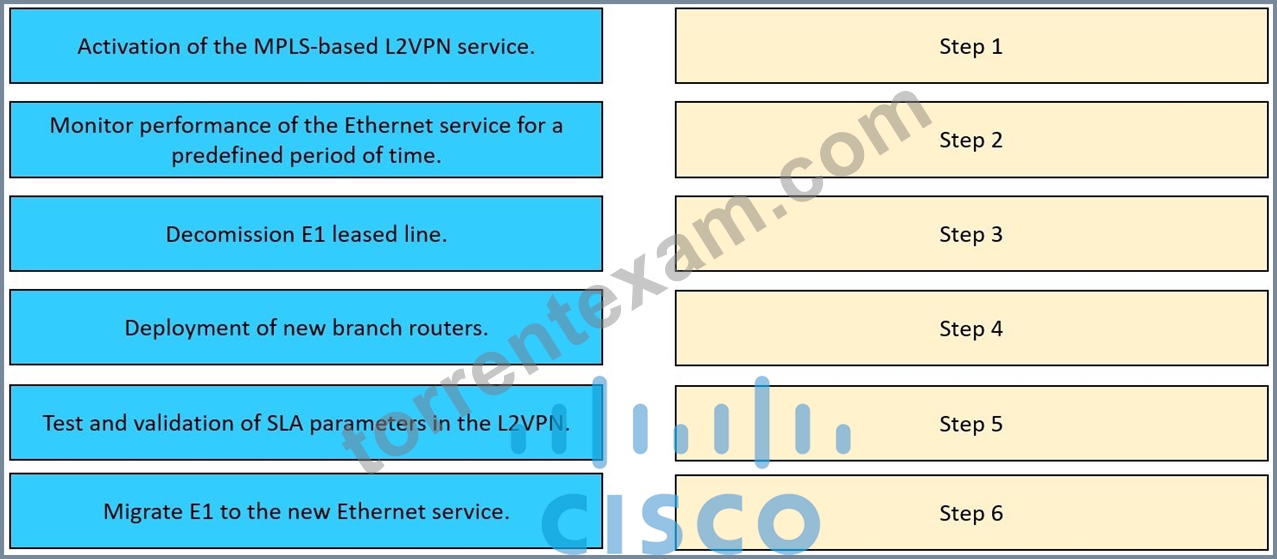
Answer:
Explanation: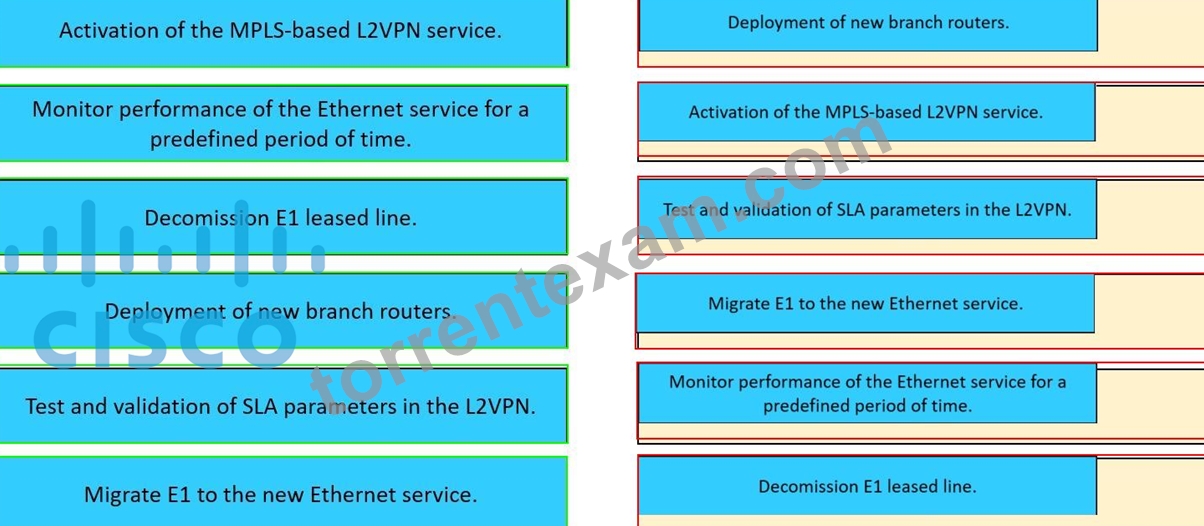
NEW QUESTION # 208
As technologies such as big data, cloud, and loT continue to grow, so will the demand for network bandwidth Business strategies must be flexible to accommodate these changes when it comes to priorities and direction and the network design strategy also must be agile and adaptable Drag and drop the benefits from the left onto the corresponding strategic approaches on the right as they relate to network design and management.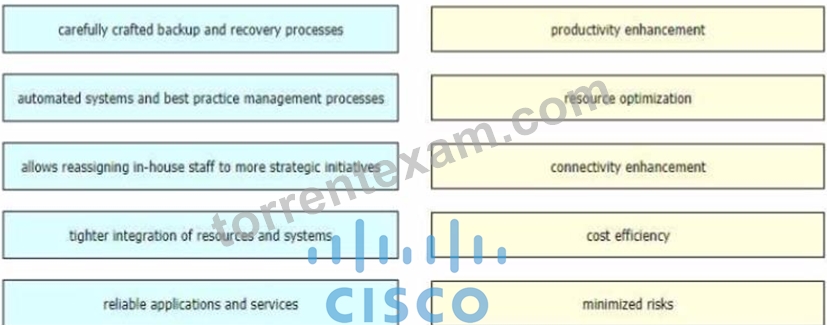
Answer:
Explanation: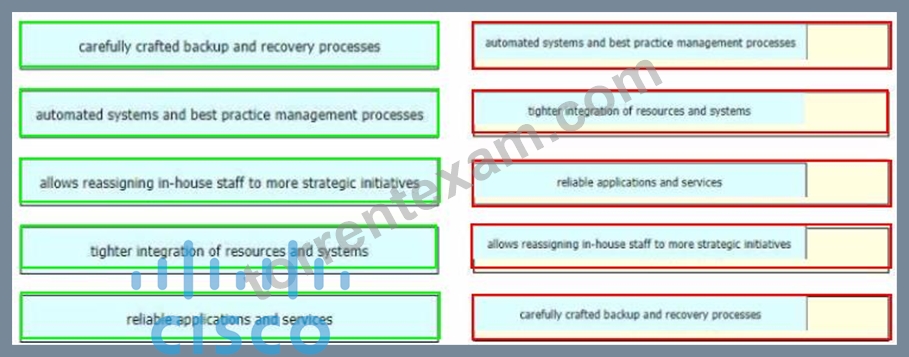
NEW QUESTION # 209
A customer asks you to perform a high-level review of their upcoming WAN refresh for remote sites. The review is specially focused on their retail store operations consisting of 500+ locations connected via multipoint IPsec VPN solution. Which routing protocol would be valid but would also be the most restrictive for the expansion of this deployment model?
- A. OSPF
- B. BGP
- C. EIGRP
- D. IS-IS
Answer: C
Explanation:
* EIGRP may be valid for initial deployment, but its scalability limitations - including proprietary nature, limited support over non-broadcast multipoint VPNs, and suboptimal convergence for large WAN overlays - make it most restrictive for future expansion.
* BGP is typically the most scalable choice for large-scale VPN WAN deployments.
Why other options are incorrect:
* B: IS-IS is not commonly deployed over Internet VPNs.
* C: OSPF has better scalability than EIGRP for multi-area design but still limited over VPN overlays.
* D: BGP is the preferred protocol for large-scale IPsec VPN WANs.
-
--------------------------------------------------------------------------------------------
-
NEW QUESTION # 210
[Security, Automation, and Policy Integration in Design] The network has high CPU usage due to excessive inbound traffic impacting the control and management planes. What should be implemented?
- A. control plane policing
- B. modular QoS
- C. TCAM carving
- D. deep interface buffers
Answer: A
Explanation:
#Explanation:
* A: Control Plane Policing (CoPP) protects the control plane by rate-limiting or dropping unnecessary or malicious traffic destined for the CPU. This is essential in preventing routing and management plane starvation under high traffic conditions.
Incorrect Options:
* B: Deep buffers help in data plane congestion, not control plane CPU usage.
* C: TCAM carving relates to hardware forwarding table allocations, not CPU protection.
* D: Modular QoS is valuable for traffic shaping but not specific to control plane protection.
NEW QUESTION # 211
Drag and Drop Question
When a detection system for protecting a network from threats sourced from the Internet is designed there are two common deployment methods, where the system is placed differently relative to the perimeter firewall:
- An unfiltered detection system examines the raw Internet data streams before it reaches the firewall
- A screened detection solution which monitors traffic that is allowed
through the firewall
Both have its advantages and disadvantages drag and drop the characteristics on the left to the corresponding category on the right in no particular order.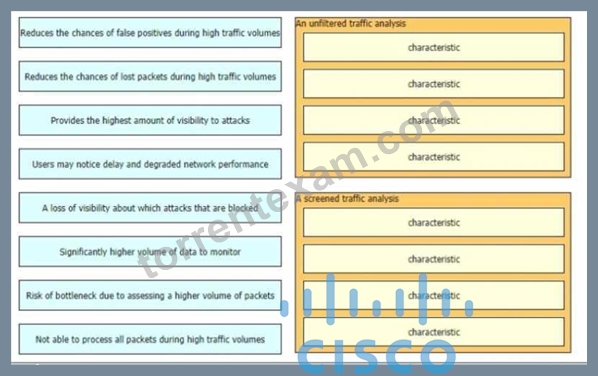
Answer:
Explanation: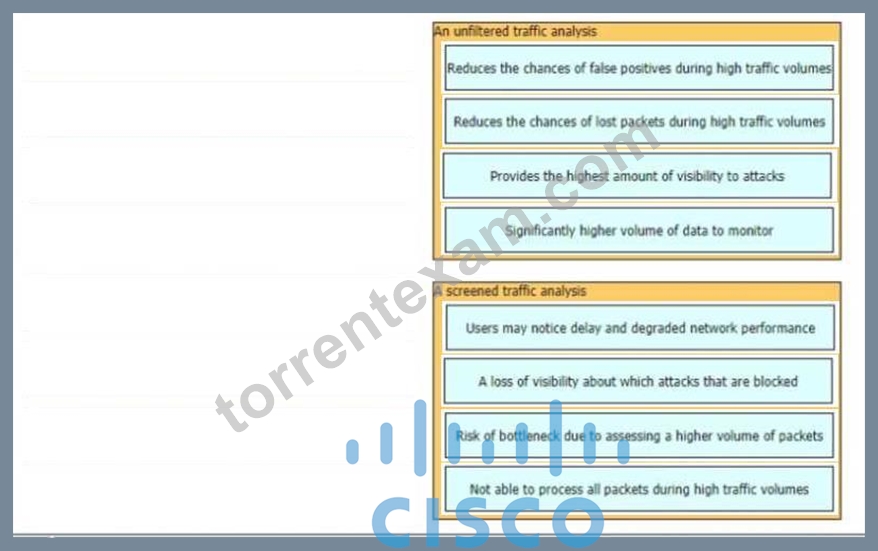
NEW QUESTION # 212
A business requirement stating that failure of WAN access for dual circuits into an MPLS provider for a Data Centre cannot happen due to related service credits that would need to be paid has led to diversely routed circuits to different points of presence on the providers network? What should a network designer also consider as part of the requirement?
- A. Ensuring all related remote branches are dual homed to the MPLS network
- B. Dual PSUs & Supervisors on each MPLS router
- C. Out of band access to the MPLS routers
- D. Provision of an additional MPLS provider
Answer: D
NEW QUESTION # 213
You are designing the routing design for two merging companies that have overlapping IP address space.
Which of these must you consider when developing the routing and NAT design?
- A. Local to global NAT translation is done after routing
- B. Global to local NAT translation is done before routing.
- C. Global to local NAT translation is done after policy-based routing.
- D. Local to global NAT translation is done before policy-based routing
Answer: B
NEW QUESTION # 214
A healthcare provider discovers that protected health information of patients was altered without patient consent. The healthcare provider is subject to HIPAA compliance and is required to protect PHI dat
a. Which type of security safeguard should be implemented to resolve this issue?
- A. administrative security management processes
- B. technical integrity and transmission security
- C. technical and physical access control
- D. physical device and media control
Answer: B
Explanation:
https://www.cisco.com/en/US/docs/solutions/Enterprise/Compliance/HIPAA/HIP_AppC.html#wp1085353
NEW QUESTION # 215
When an SDN-based model is used to transmit multimedia traffic, which aspect should an architect consider while designing the network?
- A. flow forwarding
- B. traffic patterns
- C. security
- D. QoE estimation
Answer: D
NEW QUESTION # 216
You have been asked to design a high-density wireless network for a university campus. Which two principles would you apply in order to maximize the wireless network capacity? (Choose two.)
- A. Implement a four-channel design on 2.4 GHz to increase the number of available channels
- B. Make use of the 5-GHz band to reduce the spectrum utilization on 2.4 GHz when dual-band clients are used.
- C. Choose a high minimum data rate to reduce the duty cycle.
- D. Enable 802.11n channel bonding on both 2.4 GHz and 5 GHz to increase the maximum aggregated cell throughput.
- E. Increases the number of SSIDs to load-balance the client traffic.
Answer: B,C
Explanation:
* B: Setting a higher minimum data rate reduces airtime consumption from low-speed clients, improving overall capacity.
* D: Utilizing 5 GHz reduces contention on the heavily congested 2.4 GHz band, allowing better spectral efficiency in high-density environments.
Why other options are incorrect:
* A: 2.4 GHz only supports 3 non-overlapping channels; 4-channel design introduces interference.
* C: Excessive SSIDs increase management overhead and beacon traffic.
* E: Channel bonding in 2.4 GHz is discouraged in high-density deployments due to channel overlap and interference.
-
NEW QUESTION # 217
The General Bank of Greece plans to upgrade its legacy end-of-life WAN network with a new flexible, manageable, and scalable solution. The main requirements are ZTP support, end-to-end encryption, application awareness, and segmentation. The CTO states that the main goal of the bank is CAPEX reduction.
Which WAN technology should be used for the solution?
- A. SD-WAN
- B. SD-branch
- C. Managed SD-WAN
- D. DMVPN with PfR
Answer: A
Explanation:
In this case, the bank seeks a solution that addresses scalability, manageability, application visibility, security (encryption and segmentation), and operational simplicity while aiming to reduce capital expenses. All these characteristics point directly to an SD-WAN architecture.
A non-managed (self-hosted) SD-WAN deployment:
* Supports Zero Touch Provisioning (ZTP), reducing deployment time and operational burden.
* Provides application-level visibility and intelligent path control.
* Enables strong segmentation and end-to-end encryption via templates and policy engines.
* Helps reduce CAPEX through the use of lower-cost broadband and centralized management.
While a "managed SD-WAN" solution (Option C) might be suitable in some cases, it typically involves higher OPEX. The question emphasizes CAPEX reduction, favoring an in-house SD-WAN solution.
This approach aligns with CCDE v3.1's "Scenario-based Design Strategy Guidance" and "Technology Comparisons and Use Cases" topics that emphasize selecting technologies aligned to business objectives and architectural scalability.
NEW QUESTION # 218
Which project management methodology is characterized by a having a low client involvement?
- A. LEAN project management
- B. Traditional project management
- C. Agile project management
- D. Kanban project management
Answer: B
Explanation:
# Explanation:
* A: Traditional project management (often referred to as the Waterfall model) involves a fixed sequence of phases-planning, design, execution, and delivery. Client involvement is typically high at the beginning (requirements gathering) and low during implementation.
Other options:
* B, C, and D (LEAN, Kanban, Agile): These emphasize continuous feedback, flexibility, and frequent customer interaction throughout the project lifecycle. Agile in particular encourages constant client collaboration via sprints and reviews.
NEW QUESTION # 219
Which feature is supported by NETCONF but is not supported by SNMP?
- A. taking administrative actions
- B. collecting the status of specific fields
- C. distinguishing between configuration data and operational data
- D. changing the configuration of specific fields
Answer: C
NEW QUESTION # 220
Refer to the exhibit. The WAN network of the General Bank of Greece has experienced several outages. It takes too long to activate a new branch site. The networking department of the bank plans to upgrade the legacy end-of-life WAN network with a new flexible, manageable, and scalable in-house solution. The number of branches will increase exponentially in the next fiscal year. The CTO states that the bank's main goal is OPEX reduction. The network engineering team prepares a table to evaluate the available options. Which WAN technology can be used for the solution?
- A. DMVPN over L3VPN
- B. SD-WAN over L3VPN
- C. SD-WAN over L2VPN
- D. Managed SD-WAN
Answer: A
NEW QUESTION # 221
......
Cisco 400-007 Dumps PDF Are going to be The Best Score: https://dumpscertify.torrentexam.com/400-007-exam-latest-torrent.html
