

2025 Updated SAA-C03 Tests Engine pdf - All Free Dumps Guaranteed!
Latest AWS Certified Solutions Architect SAA-C03 Actual Free Exam Questions
Amazon SAA-C03 exam is one of the most sought-after certifications for IT professionals who are interested in cloud computing. AWS Certified Solutions Architect - Associate certification demonstrates a thorough understanding of Amazon Web Services (AWS) and solutions architecture. It is designed to test the candidates’ proficiency in designing and deploying scalable, highly available, and fault-tolerant systems on AWS. SAA-C03 exam is considered to be quite challenging, and requires extensive preparation and hands-on experience with AWS services.
Amazon SAA-C03 certification exam is designed for individuals who want to become skilled in the design and deployment of scalable, fault-tolerant, and highly available systems on Amazon Web Services (AWS) cloud. AWS Certified Solutions Architect - Associate certification is ideal for solution architects, system administrators, and developers who want to validate their knowledge and expertise in AWS infrastructure, services, and best practices. The SAA-C03 exam is the updated version of the previous SAA-C02 certification exam and is considered one of the most sought-after certifications in the cloud computing industry.
NEW QUESTION # 399
[Design Secure Architectures]
A solutions architect must design a solution that uses Amazon CloudFront with an Amazon S3 origin to store a static website. The company's security policy requires that all website traffic be inspected by AWS WAR How should the solutions architect comply with these requirements?
- A. Configure Amazon CloudFront to forward all incoming requests to AWS WAF before requesting content from the S3 origin.
- B. Configure Amazon CloudFront and Amazon S3 to use an origin access identity (OAI) to restrict access to the S3 bucket. Enable AWS WAF on the distribution.
- C. Configure an S3 bucket policy lo accept requests coming from the AWS WAF Amazon Resource Name (ARN) only.
- D. Configure a security group that allows Amazon CloudFront IP addresses to access Amazon S3 only. Associate AWS WAF to CloudFront.
Answer: B
Explanation:
https://docs.aws.amazon.com/AmazonCloudFront/latest/DeveloperGuide/private-content-restricting-access-to-s3.html
https://docs.aws.amazon.com/AmazonCloudFront/latest/DeveloperGuide/distribution-web-awswaf.html
NEW QUESTION # 400
The company that you are working for has a highly available architecture consisting of an elastic load balancer and several EC2 instances configured with auto-scaling in three Availability Zones. You want to monitor your EC2 instances based on a particular metric, which is not readily available in CloudWatch.
Which of the following is a custom metric in CloudWatch which you have to manually set up?
- A. Memory Utilization of an EC2 instance
- B. Network packets out of an EC2 instance
- C. CPU Utilization of an EC2 instance
- D. Disk Reads activity of an EC2 instance
Answer: A
Explanation:
CloudWatch has available Amazon EC2 Metrics for you to use for monitoring. CPU Utilization identifies the processing power required to run an application upon a selected instance. Network Utilization identifies the volume of incoming and outgoing network traffic to a single instance. Disk Reads metric is used to determine the volume of the data the application reads from the hard disk of the instance. This can be used to determine the speed of the application. However, there are certain metrics that are not readily available in CloudWatch such as memory utilization, disk space utilization, and many others which can be collected by setting up a custom metric.
You need to prepare a custom metric using CloudWatch Monitoring Scripts which is written in Perl. You can also install CloudWatch Agent to collect more system-level metrics from Amazon EC2 instances.
Here's the list of custom metrics that you can set up:
- Memory utilization
- Disk swap utilization
- Disk space utilization
- Page file utilization
- Log collection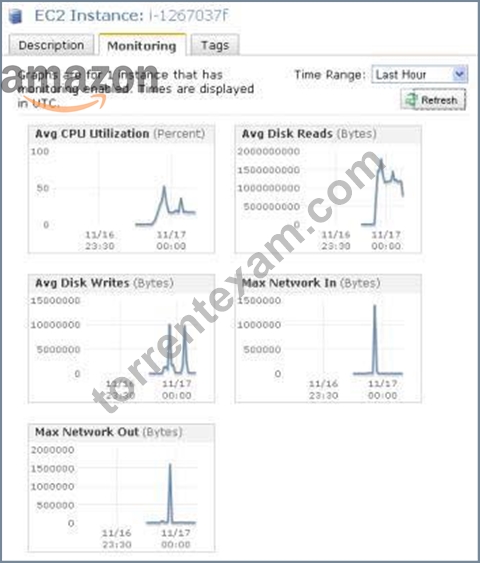
CPU Utilization of an EC2 instance, Disk Reads activity of an EC2 instance, and Network packets out of an EC2 instance are all incorrect because these metrics are readily available in CloudWatch by default.
References:
https://docs.aws.amazon.com/AWSEC2/latest/UserGuide/monitoring_ec2.html
https://docs.aws.amazon.com/AWSEC2/latest/UserGuide/mon-scripts.html#using_put_script Check out this Amazon EC2 Cheat Sheet: https://tutorialsdojo.com/amazon-elastic-compute-cloud- amazon-ec2/ Check out this Amazon CloudWatch Cheat Sheet: https://tutorialsdojo.com/amazon- cloudwatch/
NEW QUESTION # 401
[Design Cost-Optimized Architectures]
A company has a production workload that is spread across different AWS accounts in various AWS Regions. The company uses AWS Cost Explorer to continuously monitor costs and usage. The company wants to receive notifications when the cost and usage spending of the workload is unusual.
Which combination of steps will meet these requirements? (Select TWO.)
- A. In ys AWS accounts where the production workload is running, create a linked account monitor by using AWS Cost Anomaly Detection in the AWS Cost Management console
- B. Create a subscription with the required threshold and notify the company by using weekly summaries.
- C. In the AWS accounts where the production workload is running, create a Cost and Usage Report by using Cost Anomaly Detection in the AWS Cost Management console.
- D. In the AWS accounts where the production workload is running, create a linked account budget by using Cost Explorer in the AWS Cost Management console
- E. Create a report and send email messages to notify the company on a weekly basis.
Answer: A,B
Explanation:
AWSCost Anomaly Detection allows you to create monitors that track the cost and usage of your AWS resources and alert you when there is an unusual spending pattern. You can create monitors based on different dimensions, such as AWS services, accounts, tags, or cost categories. You can also create alert subscriptions that notify you by email or Amazon SNS when an anomaly is detected. You can specify the threshold and frequency of the alerts, and choose to receive weekly summaries of your anomalies.
Reference URLs:
1 https://aws.amazon.com/aws-cost-management/aws-cost-anomaly-detection/
2 https://docs.aws.amazon.com/cost-management/latest/userguide/getting-started-ad.html
3 https://docs.aws.amazon.com/cost-management/latest/userguide/manage-ad.html
NEW QUESTION # 402
A company has deployed a multiplayer game for mobile devices. The game requires live location tracking of players based on latitude and longitude. The data store for the game must support rapid updates and retrieval of locations.
The game uses an Amazon RDS for PostgreSQL DB instance with read replicas to store the location data.
During peak usage periods, the database is unable to maintain the performance that is needed for reading and writing updates. The game's user base is increasing rapidly.
What should a solutions architect do to improve the performance of the data tier?
- A. Take a snapshot of the existing DB instance. Restore the snapshot with Multi-AZ enabled.
- B. Migrate from Amazon RDS to Amazon OpenSearch Service with OpenSearch Dashboards.
- C. Deploy an Amazon ElastiCache for Redis cluster in front of the existing DB instance. Modify the game to use Redis.
- D. Deploy Amazon DynamoDB Accelerator (DAX) in front of the existing DB instance. Modify the game to use DAX.
Answer: C
Explanation:
The solution that will improve the performance of the data tier is to deploy an Amazon ElastiCache for Redis cluster in front of the existing DB instance and modify the game to use Redis. This solution will enable the game to store and retrieve the location data of the players in a fast and scalable way, as Redis is an in-memory data store that supports geospatial data types and commands. By using ElastiCache for Redis, the game can reduce the load on the RDS for PostgreSQL DB instance, which is not optimized for high-frequency updates and queries of location data. ElastiCache for Redis also supports replication, sharding, and auto scaling to handle the increasing user base of the game.
The other solutions are not as effective as the first one because they either do not improve the performance, do not support geospatial data, or do not leverage caching. Taking a snapshot of the existing DB instance and restoring it with Multi-AZ enabled will not improve the performance of the data tier, as it only provides high availability and durability, but not scalability or low latency. Migrating from Amazon RDS to Amazon OpenSearch Service with OpenSearch Dashboards will not improve the performance of the data tier, as OpenSearch Service is mainly designed for full-text search and analytics, not for real-time location tracking.
OpenSearch Service also does not support geospatial data types and commands natively, unlike Redis.
Deploying Amazon DynamoDB Accelerator (DAX) in front of the existing DB instance and modifying the game to use DAX will not improve the performance of the data tier, as DAX is only compatible with DynamoDB, not with RDS for PostgreSQL. DAX also does not support geospatial data types and commands.
References:
Amazon ElastiCache for Redis
Geospatial Data Support - Amazon ElastiCache for Redis
Amazon RDS for PostgreSQL
Amazon OpenSearch Service
Amazon DynamoDB Accelerator (DAX)
NEW QUESTION # 403
[Design Secure Architectures]
A company stores petabytes of historical medical information on premises. The company has a process to manage encryption of the data to comply with regulations. The company needs a cloud-based solution for data backup, recovery, and archiving. The company must retain control over the encryption key material. Which combination of solutions will meet these requirements? (Select TWO.)
- A. Store the data in AWS Snowball devices. Use server-side encryption with AWS KMS keys (SSE-KMS).
- B. Store the data in Amazon S3 Standard-Infrequent Access (S3 Standard-IA) storage. Use S3 Bucket Keys with AWS Key Management Service (AWS KMS) keys.
- C. Create an AWS Key Management Service (AWS KMS) key without key material. Import the company's key material into the KMS key.
- D. Create an AWS Key Management Service (AWS KMS) encryption key that contains key material generated by AWS KMS.
- E. Store the data in an Amazon S3 Glacier storage class. Use server-side encryption with customer-provided keys (SSE-C).
Answer: C,E
Explanation:
Option A: Importing customer-managed keys into AWS KMS ensures that encryption key material remains under the company's control.
Option D: S3 Glacier with server-side encryption using customer-provided keys (SSE-C) complies with the need for controlled encryption and provides cost-effective storage for backups.
AWS Key Management Service Importing Keys Documentation,S3 Encryption Documentation
NEW QUESTION # 404
An application development team is designing a microservice that will convert large images to smaller, compressed images. When a user uploads an image through the web interface, the microservice should store the image in an Amazon S3 bucket, process and compress the image with an AWS Lambda function, and store the image in its compressed form in a different S3 bucket.
A solutions architect needs to design a solution that uses durable, stateless components to process the images automatically.
Which combination of actions will meet these requirements? (Choose two.)
- A. Configure an Amazon EventBridge (Amazon CloudWatch Events) event to monitor the S3 bucket When an image is uploaded. send an alert to an Amazon Simple Notification Service (Amazon SNS) topic with the application owner's email address for further processing
- B. Configure the Lambda function to monitor the S3 bucket for new uploads When an uploaded image is detected write the file name to a text file in memory and use the text file to keep track of the images that were processed
- C. Configure the Lambda function to use the Amazon Simple Queue Service (Amazon SQS) queue as the invocation source When the SQS message is successfully processed, delete the message in the queue
- D. Create an Amazon Simple Queue Service (Amazon SQS) queue Configure the S3 bucket to send a notification to the SQS queue when an image is uploaded to the S3 bucket
- E. Launch an Amazon EC2 instance to monitor an Amazon Simple Queue Service (Amazon SQS) queue When items are added to the queue log the file name in a text file on the EC2 instance and invoke the Lambda function
Answer: C,D
Explanation:
Creating an Amazon Simple Queue Service (SQS) queue and configuring the S3 bucket to send a notification to the SQS queue when an image is uploaded to the S3 bucket will ensure that the Lambda function is triggered in a stateless and durable manner.
Configuring the Lambda function to use the SQS queue as the invocation source, and deleting the message in the queue after it is successfully processed will ensure that the Lambda function processes the image in a stateless and durable manner.
Amazon SQS is a fully managed message queuing service that enables you to decouple and scale microservices, distributed systems, and serverless applications. SQS eliminates the complexity and overhead associated with managing and operating-message oriented middleware, and empowers developers to focus on differentiating work. When new images are uploaded to the S3 bucket, SQS will trigger the Lambda function to process the image and compress it. Once the image is processed, the SQS message is deleted, ensuring that the Lambda function is stateless and durable.
NEW QUESTION # 405
A company hosts its application in the AWS Cloud. The application runs on Amazon EC2 instances behind an Elastic Load Balancer in an Auto Scaling group and with an Amazon DynamoDB table. The 'company wants to ensure the application can be made available in another AWS Region with minimal downtime.
What should a solutions architect do to meet these requirements with the LEAST amount of downtime?
- A. Create an Auto Scaling group and load balancer in the disaster recovery Region. Configure the DynamoDB table as a global table. Create an Amazon CloudWatch alarm to trigger an AWS Lambda function that updates Amazon Route 53 pointing to the disaster recovery load balancer.
- B. Create an AWS CloudFormation template to create EC2 instances and a load balancer to be launched when needed. Configure the DynamoDB table as a global table. Configure DNS failover to point to the new disaster recovery Region's load balancer.
- C. Create an AWS CloudFormation template to create EC2 instances, load balancers, and DynamoDB tables to be launched when needed. Configure DNS failover to point to the new disaster recovery Region's load balancer.
- D. Create an Auto Scaling group and a load balancer in the disaster recovery Region. Configure the DynamoDB table as a global table. Configure DNS failover to point to the new disaster recovery Region's load balancer.
Answer: D
Explanation:
This answer is correct because it meets the requirements of securely migrating the existing data to AWS and satisfying the new regulation. AWS DataSync is a service that makes it easy to move large amounts of data online between on-premises storage and Amazon S3. DataSync automatically encrypts data in transit and verifies data integrity during transfer. AWS CloudTrail is a service that records AWS API calls for your account and delivers log files to Amazon S3. CloudTrail can log data events, which show the resource operations performed on or within a resource in your AWS account, such as S3 object-level API activity. By using CloudTrail to log data events, you can audit access at all levels of the stored data.
References:
https://docs.aws.amazon.com/datasync/latest/userguide/what-is-datasync.html
https://docs.aws.amazon.com/awscloudtrail/latest/userguide/logging-data-events-with-cloudtrail.html
NEW QUESTION # 406
A company is enhancing the security of its AWS environment, where the company stores a significant amount of sensitive customer data. The company needs a solution that automatically identifies and classifies sensitive data that is stored in multiple Amazon S3 buckets. The solution must automatically respond to data breaches and alert the company's security team through email immediately when noncompliant data is found.
Which solution will meet these requirements?
- A. Use Amazon Macie. Integrate Amazon EventBridge with Macie, and configure EventBridge to send alerts to an Amazon Simple Notification Service (Amazon SNS) topic. Subscribe the security team to the SNS topic.
- B. Use Amazon Macie. Integrate Amazon EventBridge with Macie, and configure EventBridge to route alerts to an Amazon Simple Queue Service (Amazon SQS) queue. Configure an AWS Lambda function to periodically poll the SQS queue and to send alerts to the security team by using Amazon Simple Email Service (Amazon SES).
- C. Use Amazon GuardDuty. Configure an AWS Lambda function to route alerts to an Amazon Simple Notification Service (Amazon SNS) topic. Subscribe the security team to the SNS topic.
- D. Use Amazon GuardDuty. Configure an AWS Lambda function to route alerts to an Amazon Simple Queue Service (Amazon SQS) queue. Configure a second Lambda function to periodically poll the SQS queue and to send emails to the security team by using Amazon Simple Email Service (Amazon SES).
Answer: A
Explanation:
* A & B. GuardDuty: Designed for threat detection, not for identifying or classifying sensitive data in S3 buckets.
* C. Macie with EventBridge + SNS: Automatically identifies sensitive data, triggers alerts, and uses SNS for immediate notification via email.
* D. Macie with EventBridge + SQS: Introduces latency due to periodic polling and adds unnecessary complexity.
References: Amazon Macie, Amazon EventBridge
NEW QUESTION # 407
A company has an application that runs on Amazon EC2 instances and uses an Amazon Aurora database. The EC2 instances connect to the database by using user names and passwords that are stored locally in a file. The company wants to minimize the operational overhead of credential management.
What should a solutions architect do to accomplish this goal?
- A. Use AWS Secrets Manager. Turn on automatic rotation.
- B. Use AWS Systems Manager Parameter Store. Turn on automatic rotation.
- C. Create an encrypted Amazon Elastic Block Store (Amazon EBS) volume (or each EC2 instance. Attach the new EBS volume to each EC2 instance. Migrate the credential file to the new EBS volume. Point the application to the new EBS volume.
- D. Create an Amazon S3 bucket lo store objects that are encrypted with an AWS Key Management Service (AWS KMS) encryption key. Migrate the credential file to the S3 bucket. Point the application to the S3 bucket.
Answer: B
NEW QUESTION # 408
A company wants to create a mobile app that allows users to stream slow-motion video clips on their mobile devices. Currently, the app captures video clips and uploads the video clips in raw format into an Amazon S3 bucket. The app retrieves these video clips directly from the S3 bucket. However, the videos are large in their raw format.
Users are experiencing issues with buffering and playback on mobile devices. The company wants to implement solutions to maximize the performance and scalability of the app while minimizing operational overhead.
Which combination of solutions will meet these requirements? (Select TWO.)
- A. Deploy Amazon CloudFront for content delivery and caching
- B. Use Amazon Elastic Transcoder to convert the video files to more appropriate formats.
- C. Deploy an Auto Scaling group of Amazon EC2 instances in Local Zones for content delivery and caching
- D. Use AWS DataSync to replicate the video files across AWS Regions in other S3 buckets
- E. Deploy an Auto Scaling group of Amazon EC2 Instances to convert the video files to more appropriate formats.
Answer: A,B
Explanation:
Understanding the Requirement: The mobile app captures and uploads raw video clips to S3, but users experience buffering and playback issues due to the large size of these videos.
Analysis of Options:
Amazon CloudFront: A content delivery network (CDN) that can cache and deliver content globally with low latency. It helps reduce buffering by delivering content from edge locations closer to the users.
AWS DataSync: Primarily used for data transfer and replication across AWS Regions, which does not directly address the video size and buffering issue.
Amazon Elastic Transcoder: A media transcoding service that can convert raw video files into formats and resolutions more suitable for streaming, reducing the size and improving playback performance.
EC2 Instances in Local Zones: While this could provide content delivery and caching, it involves more operational overhead compared to using CloudFront.
EC2 Instances for Transcoding: Involves setting up and maintaining infrastructure, leading to higher operational overhead compared to using Elastic Transcoder.
Best Combination of Solutions:
Deploy Amazon CloudFront: This optimizes the performance by caching content at edge locations, reducing latency and buffering for users.
Use Amazon Elastic Transcoder: This reduces the file size and converts videos into formats better suited for streaming on mobile devices.
Reference:
Amazon CloudFront
Amazon Elastic Transcoder
NEW QUESTION # 409
A company wants to securely exchange data between its software as a service (SaaS) application Salesforce account and Amazon S3. The company must encrypt the data at rest by using AWS Key Management Service (AWS KMS) customer managed keys (CMKs). The company must also encrypt the data in transit. The company has enabled API access for the Salesforce account.
Which solution will meet these requirements with the LEAST development effort?
- A. Create Amazon AppFlow flows to transfer the data securely from Salesforce to Amazon S3.
- B. Create AWS Lambda functions to transfer the data securely from Salesforce to Amazon S3.
- C. Create a custom connector for Salesforce to transfer the data securely from Salesforce to Amazon S3.
- D. Create an AWS Step Functions workflow Define the task to transfer the data securely from Salesforce to Amazon S3.
Answer: A
Explanation:
Amazon AppFlow is a fully managed integration service that enables users to transfer data securely between SaaS applications and AWS services. It supports Salesforce as a source and Amazon S3 as a destination. It also supports encryption of data at rest using AWS KMS CMKs and encryption of data in transit using SSL/TLS1. By using Amazon AppFlow, the solution can meet the requirements with the least development effort.
a) Create AWS Lambda functions to transfer the data securely from Salesforce to Amazon S3. This solution will not meet the requirement of the least development effort, as it involves writing custom code to interact with Salesforce and Amazon S3 APIs, handle authentication, encryption, error handling, and monitoring2.
b) Create an AWS Step Functions workflow Define the task to transfer the data securely from Salesforce to Amazon S3. This solution will not meet the requirement of the least development effort, as it involves creating a state machine definition to orchestrate the data transfer task, and invoking Lambda functions or other services to perform the actual data transfer3.
d) Create a custom connector for Salesforce to transfer the data securely from Salesforce to Ama-zon S3. This solution will not meet the requirement of the least development effort, as it involves using the Amazon AppFlow Custom Connector SDK to build and deploy a custom connector for Salesforce, which requires additional configuration and management.
Reference URL: https://aws.amazon.com/appflow/
NEW QUESTION # 410
A company needs to ingested and handle large amounts of streaming data that its application generates. The application runs on Amazon EC2 instances and sends data to Amazon Kinesis Data Streams. which is contained wild default settings. Every other day the application consumes the data and writes the data to an Amazon S3 bucket for business intelligence (BI) processing the company observes that Amazon S3 is not receiving all the data that trio application sends to Kinesis Data Streams.
What should a solutions architect do to resolve this issue?
- A. Update the number of Kinesis shards lo handle the throughput of me data that is sent to Kinesis Data Streams.
- B. Update the Kinesis Data Streams default settings by modifying the data retention period.
- C. Update the application to use the Kinesis Producer Library (KPL) lo send the data to Kinesis Data Streams.
- D. Turn on S3 Versioning within the S3 bucket to preserve every version of every object that is ingested in the S3 bucket.
Answer: B
NEW QUESTION # 411
A company hosts rts sialic website by using Amazon S3 The company wants to add a contact form to its webpage The contact form will have dynamic server-sKle components for users to input their name, email address, phone number and user message The company anticipates that there will be fewer than 100 site visits each month Which solution will meet these requirements MOST cost-effectively?
- A. Create an Amazon API Gateway endpoinl with an AWS Lambda backend that makes a call to Amazon Simple Email Service (Amazon SES)
- B. Host a dynamic contact form page in Amazon Elastic Container Service (Amazon ECS) Set up Amazon Simple Email Service (Amazon SES) to connect to any third-party email provider.
- C. Create a Q micro Amazon EC2 instance Deploy a LAMP (Linux Apache MySQL. PHP/Perl/Python) stack to host the webpage Use client-side scripting to buiW the contact form Integrate the form with Amazon WorkMail
- D. Convert the static webpage to dynamic by deploying Amazon Ughtsail Use client-side scnpting to build the contact form Integrate the form with Amazon WorkMail
Answer: C
Explanation:
Create a t2 micro Amazon EC2 instance. Deploy a LAMP (Linux Apache MySQL, PHP/Perl/Python) stack to host the webpage. Use client-side scripting to build the contact form. Integrate the form with Amazon WorkMail. This solution will provide the company with the necessary components to host the contact form page and integrate it with Amazon WorkMail at the lowest cost. Option A requires the use of Amazon ECS, which is more expensive than EC2, and Option B requires the use of Amazon API Gateway, which is also more expensive than EC2. Option C requires the use of Amazon Lightsail, which is more expensive than EC2.
Using AWS Lambda with Amazon API Gateway - AWS Lambda
https://docs.aws.amazon.com/lambda/latest/dg/services-apigateway.html
AWS Lambda FAQs
https://aws.amazon.com/lambda/faqs/
NEW QUESTION # 412
A company hosts a data lake on AWS. The data lake consists of data in Amazon S3 and Amazon RDS for PostgreSQL. The company needs a reporting solution that provides data visualization and includes all the data sources within the data lake. Only the company's management team should have full access to all the visualizations. The rest of the company should have only limited access.
Which solution will meet these requirements?
- A. Create an AWS Glue table and crawler for the data in Amazon S3. Use Amazon Athena Federated Query to access data within Amazon RDS for PoslgreSQL. Generate reports by using Amazon Athena. Publish the reports to Amazon S3. Use S3 bucket policies to limit access to the reports.
- B. Create an analysis in Amazon OuickSighl. Connect all the data sources and create new datasets. Publish dashboards to visualize the data. Share the dashboards with the appropriate users and groups.
- C. Create an analysis in Amazon QuickSight. Connect all the data sources and create new datasets. Publish dashboards to visualize the data. Share the dashboards with the appropriate IAM roles.
- D. Create an AWS Glue table and crawler for the data in Amazon S3. Create an AWS Glue extract, transform, and load (ETL) job to produce reports. Publish the reports to Amazon S3. Use S3 bucket policies to limit access to the reports.
Answer: C
NEW QUESTION # 413
A company is deploying a two-tier web application in a VPC. The web tier is using an Amazon EC2 Auto Scaling group with public subnets that span multiple Availability Zones. The database tier consists of an Amazon RDS for MySQL DB instance in separate private subnets. The web tier requires access to the database to retrieve product information.
The web application is not working as intended. The web application reports that it cannot connect to the database. The database is confirmed to be up and running. All configurations for the network ACLs. security groups, and route tables are still in their default states.
What should a solutions architect recommend to fix the application?
- A. Deploy the web tier's EC2 instances and the database tier's RDS instance into two separate VPCs. and configure VPC peering.
- B. Add a route in the VPC route table to allow traffic between the web tier's EC2 instances and Ihe database tier.
- C. Add an inbound rule to the security group of the database tier's RDS instance to allow traffic from the web tier's security group.
- D. Add an explicit rule to the private subnet's network ACL to allow traffic from the web tier's EC2 instances.
Answer: C
Explanation:
This answer is correct because it allows the web tier to access the database tier by using security groups as a source, which is a recommended best practice for VPC connectivity. Security groups are stateful and can reference other security groups in the same VPC, which simplifies the configuration and maintenance of the firewall rules. By adding an inbound rule to the database tier's security group, the web tier's EC2 instances can connect to the RDS instance on port 3306, regardless of their IP addresses or subnets.
References:
Security groups - Amazon Virtual Private Cloud
Best practices and reference architectures for VPC design
NEW QUESTION # 414
A company is developing a file-sharing application that will use an Amazon S3 bucket for storage. The company wants to serve all the files through an Amazon CloudFront distribution. The company does not want the files to be accessible through direct navigation to the S3 URL.
What should a solutions architect do to meet these requirements?
- A. Write individual policies for each S3 bucket to grant read permission for only CloudFront access.
- B. Write an S3 bucket policy that assigns the CloudFront distribution ID as the Principal and assigns the target S3 bucket as the Amazon Resource Name (ARN).
- C. Create an origin access identity (OAI). Assign the OAI to the CloudFront distribution. Configure the S3 bucket permissions so that only the OAI has read permission.
- D. Create an IAM user. Grant the user read permission to objects in the S3 bucket. Assign the user to CloudFront.
Answer: C
Explanation:
Explanation
https://aws.amazon.com/premiumsupport/knowledge-center/cloudfront-access-to-amazon-s3/
https://docs.aws.amazon.com/AmazonCloudFront/latest/DeveloperGuide/private-content-restricting-access-to-s3
NEW QUESTION # 415
A company plans to use AWS to run high-performance computing (HPC) workloads and analytics workloads.
The company will run HPC workloads on Amazon EC2 instances. The workloads require a high-performance file system that can scale to millions of input/output operations per second (IOPS). Which combination of steps will meet these requirements? (Select TWO.)
- A. Use Mountpoint for Amazon S3 as a high-performance file system.
- B. Use Amazon FSx for Lustre as a high-performance file system.
- C. Create an Auto Scaling group of Amazon EC2 instances. Use a mix of On-Demand Instances, Reserved Instances, and Spot Instances. Configure a cluster placement group. Use Amazon EMR to run the analytics workloads.
- D. Create an Auto Scaling group of Amazon EC2 instances. Use Reserved Instances. Configure a spread placement group. Use AWS Batch to run the analytics workloads.
- E. Use Amazon Elastic File System (Amazon EFS) as a high-performance file system.
Answer: B,C
Explanation:
Option B (Amazon FSx for Lustre): FSx for Lustre is optimized for high-performance file systems required by HPC workloads, scaling to millions of IOPS and supporting parallelized data access.
Option E (Cluster Placement Group with Auto Scaling): A cluster placement group ensures low-latency communication between EC2 instances, critical for HPC workloads. Amazon EMR simplifies running large- scale analytics jobs.
Amazon FSx for Lustre Documentation,AWS Placement Groups Documentation
NEW QUESTION # 416
A company is migrating applications from an on-premises Microsoft Active Directory that the company manages to AWS. The company deploys the applications in multiple AWS accounts. The company uses AWS Organizations to manage the accounts centrally.
The company's security team needs a single sign-on solution across all the company's AWS accounts. The company must continue to manage users and groups that are in the on-premises Active Directory Which solution will meet these requirements?
- A. Use AWS Directory Service and create a two-way trust relationship with the company's self-managed Active Directory.
- B. Create an Enterprise Edition Active Directory in AWS Directory Service for Microsoft Active Directory. Configure the Active Directory to be the identity source for AWS 1AM Identity Center
- C. Deploy an identity provider (IdP) on Amazon EC2. Link the IdP as an identity source within AWS
1AM Identity Center. - D. Enable AWS 1AM Identity Center. Configure a two-way forest trust relationship to connect the company's self-managed Active Directory with 1AM Identity Center by using AWS Directory Service for Microsoft Active Directory.
Answer: D
Explanation:
The company is looking for a solution that provides single sign-on (SSO) across multiple AWS accounts while continuing to manage users and groups in their on-premises Active Directory (AD). AWS IAM Identity Center (formerly AWS SSO) is the recommended solution for this type of requirement.
Explanation:
* AWS IAM Identity Center provides a centralized identity management solution, enabling single sign- on across multiple AWS accounts and other cloud applications. It can integrate with on-premises Active Directory to leverage existing users and groups.
* By configuring a two-way forest trust relationship between AWS Directory Service for Microsoft Active Directory and the company's on-premises Active Directory, users can be authenticated by their on-premises AD and still access AWS resources through IAM Identity Center. This solution allows centralized management of AWS accounts within AWS Organizations.
* The two-way trust allows mutual access between the on-premises AD and the AWS Directory Service.
This means that users and groups in the on-premises AD can be used for authentication in AWS IAM Identity Center while maintaining the existing identity management system.
AWS References:
* AWS IAM Identity Center Documentation
* AWS Directory Service for Microsoft Active Directory Trust Relationships
* AWS Directory Service Integration with IAM Identity Center
Why the other options are incorrect:
* A. Create an Enterprise Edition Active Directory in AWS Directory Service: This would require setting up a new directory and managing it in AWS, which adds unnecessary overhead. The requirement is to continue using the existing on-premises AD, making this option unsuitable.
* C. Use AWS Directory Service and create a two-way trust relationship: While this approach establishes a trust between on-premises AD and AWS Directory Service, it does not address the single sign-on (SSO) requirements across multiple AWS accounts through IAM Identity Center.
* D. Deploy an identity provider (IdP) on Amazon EC2: This is more complex than necessary and introduces more management overhead. AWS IAM Identity Center natively supports integration with on-premises Active Directory without requiring a custom IdP.
NEW QUESTION # 417
An ecommerce company is experiencing an increase in user traffic. The company's store is deployed on Amazon EC2 instances as a two-tier web application consisting of a web tier and a separate database tiar. As traffic increases, the company notices that the architecture is causing significant (Mays in sending timely marketing and ordar confirmation email to users. The company wants to reduce the time it spends resolving complex email delivery issues and minimize operational overhead.
What should a solutions architect do to meet these requirements?
- A. Create a separata application tier using EC2 instances dedicated to email processing.
- B. Create a separate application tier using EC2 instances dedicated to email processing. Place the instances in an Auto Scaling group.
- C. Configure the web instance to send email through Amazon Simple Notification Service (Amazon SNS)
- D. Configure the web instance to send email through Amazon Simple Email Service (Amazon SES).
Answer: D
NEW QUESTION # 418
A global medical research company has a molecular imaging system that provides each client with frequently updated images of what is happening inside the human body at the molecular and cellular levels. The system is hosted in AWS and the images are hosted in an S3 bucket behind a CloudFront web distribution. When a fresh batch of images is uploaded to S3, it is required to keep the previous ones in order to prevent them from being overwritten.
Which of the following is the most suitable solution to solve this issue?
- A. Use versioned objects
- B. Add a separate cache behavior path for the content and configure a custom object caching with a Minimum TTL of 0
- C. Add Cache-Control no-cache, no-store, or private directives in the S3 bucket
- D. Invalidate the files in your CloudFront web distribution
Answer: A
Explanation:
To control the versions of files that are served from your distribution, you can either invalidate files or give them versioned file names. If you want to update your files frequently, AWS recommends that you primarily use file versioning for the following reasons:
- Versioning enables you to control which file a request returns even when the user has a version cached either locally or behind a corporate caching proxy. If you invalidate the file, the user might continue to see the old version until it expires from those caches.
- CloudFront access logs include the names of your files, so versioning makes it easier to analyze the results of file changes.
- Versioning provides a way to serve different versions of files to different users.
- Versioning simplifies rolling forward and back between file revisions.
- Versioning is less expensive. You still have to pay for CloudFront to transfer new versions of your files to edge locations, but you don't have to pay for invalidating files.
Invalidating the files in your CloudFront web distribution is incorrect because even though using invalidation will solve this issue, this solution is more expensive as compared to using versioned objects.
Adding a separate cache behavior path for the content and configuring a custom object caching with a Minimum TTL of 0 is incorrect because this alone is not enough to solve the problem. A cache behavior is primarily used to configure a variety of CloudFront functionality for a given URL path pattern for files on your website. Although this solution may work, it is still better to use versioned objects where you can control which image will be returned by the system even when the user has another version cached either locally or behind a corporate caching proxy.
Adding Cache-Control no-cache, no-store, or private directives in the S3 bucket is incorrect because although it is right to configure your origin to add the Cache-Control or Expires header field, you should do this to your objects and not on the entire S3 bucket.
References:
https://docs.aws.amazon.com/AmazonCloudFront/latest/DeveloperGuide/UpdatingExistingObjects.html
https://aws.amazon.com/premiumsupport/knowledge-center/prevent-cloudfront-from-caching-files/
https://docs.aws.amazon.com/AmazonCloudFront/latest/DeveloperGuide/Invalidation.html#PayingForInv alidation Check out this Amazon CloudFront Cheat Sheet: https://tutorialsdojo.com/amazon-cloudfront/
NEW QUESTION # 419
[Design Secure Architectures]
A company that has multiple AWS accounts maintains an on-premises Microsoft Active Directory. The company needs a solution to implement Single Sign-On for its employees. The company wants to use AWS IAM Identity Center.
The solution must meet the following requirements:
Allow users to access AWS accounts and third-party applications by using existing Active Directory credentials.
Enforce multi-factor authentication (MFA) to access AWS accounts.
Centrally manage permissions to access AWS accounts and applications.
Options:
- A. Use IAM Identity Center with the existing Active Directory as the identity source. Enforce MFA for all users. Use AWS Organizations and Active Directory groups to manage access permissions for AWS accounts and application access.
- B. Use AWS Lambda functions to periodically synchronize Active Directory users and groups with IAM users and groups in each AWS account. Use IAM roles and policies to manage application access. Create a second Lambda function to enforce MFA.
- C. Use AWS Directory Service to create a new AWS Managed Microsoft AD Active Directory. Configure IAM Identity Center in each account to use the new AWS Managed Microsoft AD Active Directory as the identity source. Use IAM Identity Center to enforce MFA for all users.
- D. Create an IAM identity provider for Active Directory in each AWS account. Ensure that Active Directory users and groups access AWS accounts directly through IAM roles. Use IAM Identity Center to enforce MFA in each account for all users.
Answer: A
Explanation:
Detailed
A . IAM identity provider:Does not support centralized management across multiple accounts.
B . AWS Managed AD:Unnecessary if an on-premises Active Directory already exists.
C . IAM Identity Center + Existing AD:Best approach to integrate existing Active Directory for SSO, with MFA and centralized permissions.
D . Lambda for synchronization:Adds complexity and does not leverage IAM Identity Center capabilities.
NEW QUESTION # 420
A company uses on-premises servers to host its applications The company is running out of storage capacity.
The applications use both block storage and NFS storage. The company needs a high-performing solution that supports local caching without re-architecting its existing applications.
Which combination of actions should a solutions architect take to meet these requirements? (Select TWO.)
- A. Deploy Amazon Elastic File System (Amazon EFS) volumes and mount them to on-premises servers.
- B. Deploy an AWS Storage Gateway volume gateway to replace the block storage
- C. Deploy an AWS Storage Gateway file gateway to replace NFS storage.
- D. Deploy AWS Snowball Edge to provision NFS mounts to on-premises servers.
- E. Mount Amazon S3 as a file system to the on-premises servers.
Answer: B,C
Explanation:
https://aws.amazon.com/storagegateway/file/
File Gateway provides a seamless way to connect to the cloud in order to store application data files and backup images as durable objects in Amazon S3 cloud storage. File Gateway offers SMB or NFS-based access to data in Amazon S3 with local caching. It can be used for on-premises applications, and for Amazon EC2-based applications that need file protocol access to S3 object storage.
https://aws.amazon.com/storagegateway/volume/
Volume Gateway presents cloud-backed iSCSI block storage volumes to your on-premises applications.
Volume Gateway stores and manages on-premises data in Amazon S3 on your behalf and operates in either cache mode or stored mode. In the cached Volume Gateway mode, your primary data is stored in Amazon S3, while retaining your frequently accessed data locally in the cache for low latency access.
NEW QUESTION # 421
[Design Secure Architectures]
A company wants to migrate its on-premises data center to AWS. According to the company's compliance requirements, the company can use only the ap-northeast-3 Region. Company administrators are not permitted to connect VPCs to the internet.
Which solutions will meet these requirements? (Choose two.)
- A. Create an outbound rule for the network ACL in each VPC to deny all traffic from 0.0.0.0/0. Create an IAM policy for each user to prevent the use of any AWS Region other than ap-northeast-3.
- B. Use rules in AWS WAF to prevent internet access. Deny access to all AWS Regions except ap-northeast-3 in the AWS account settings.
- C. Use AWS Organizations to configure service control policies (SCPS) that prevent VPCs from gaining internet access. Deny access to all AWS Regions except ap-northeast-3.
- D. Use AWS Control Tower to implement data residency guardrails to deny internet access and deny access to all AWS Regions except ap-northeast-3.
- E. Use AWS Config to activate managed rules to detect and alert for internet gateways and to detect and alert for new resources deployed outside of ap-northeast-3.
Answer: C,D
Explanation:
https://docs.aws.amazon.com/organizations/latest/userguide/orgs_manage_policies_scps_examples_vpc.html#example_vpc_2
NEW QUESTION # 422
......
SAA-C03 Dumps Updated Practice Test and 1187 unique questions: https://dumpscertify.torrentexam.com/SAA-C03-exam-latest-torrent.html
