

212-82 Free Update With 100% Exam Passing Guarantee [2025]
[Dec-2025] Verified ECCouncil Exam Dumps with 212-82 Exam Study Guide
ECCouncil 212-82 Exam is an industry-recognized certification that is highly valued by employers in the cybersecurity industry. Certified Cybersecurity Technician certification is especially important for individuals who are just starting their careers in cybersecurity and are looking for ways to differentiate themselves from other job applicants. Certified Cybersecurity Technician certification can also help individuals who are looking to advance their careers and take on more senior roles within their organizations.
The CCT certification is an entry-level certification that is ideal for professionals who are starting their career in cybersecurity. 212-82 exam covers topics such as threat assessment, vulnerability assessment, risk management, and incident response. Certified Cybersecurity Technician certification also covers the basics of cybersecurity, such as firewalls, intrusion detection systems, and virtual private networks. Certified Cybersecurity Technician certification is recognized globally, and it is a valuable credential for IT professionals who are looking to advance their careers in cybersecurity. Certified Cybersecurity Technician certification is also a great way to demonstrate to employers that a candidate has the necessary skills to protect their organization's digital assets.
ECCouncil 212-82 exam consists of multiple-choice questions and is conducted online. 212-82 exam duration is two hours, and the passing score is 70%. The candidate needs to demonstrate a thorough understanding of the exam objectives and a practical application of cybersecurity concepts to pass the exam. Certified Cybersecurity Technician certification is valid for three years, after which the candidate needs to renew their certification.
NEW QUESTION # 75
Initiate an SSH Connection to a machine that has SSH enabled in the network. After connecting to the machine find the file flag.txt and choose the content hidden in the file. Credentials for SSH login are provided below:
Hint:
Username: sam
Password: admin@l23
- A. bob@sam
- B. sam@bob
- C. bob2@sam
- D. sam2@bob
Answer: A
Explanation:
Quid pro quo is the social engineering technique that Johnson employed in the above scenario. Social engineering is a technique that involves manipulating or deceiving people into performing actions or revealing information that can be used for malicious purposes. Social engineering can be performed through various methods, such as phone calls, emails, websites, etc. Quid pro quo is a social engineering method that involves offering a service or a benefit in exchange for information or access. Quid pro quo can be used to trick victims into believing that they are receiving help or assistance from a legitimate source, while in fact they are compromising their security or privacy . In the scenario, Johnson performed quid pro quo by claiming himself to represent a technical support team from a vendor and offering to help sibertech.org with a server issue, while in fact he prompted the victim to execute unusual commands and install malicious files, which were then used to collect and pass critical information to Johnson's machine. Diversion theft is a social engineering method that involves diverting the delivery or shipment of goods or assets to a different location or destination. Elicitation is a social engineering method that involves extracting information from a target by engaging them in a conversation or an interaction. Phishing is a social engineering method that involves sending fraudulent emails or messages that appear to come from a trusted source, such as a bank, a company, or a person, and asking the recipient to click on a link, open an attachment, or provide personal or financial information.
NEW QUESTION # 76
What is the key difference between a disaster recovery plan and a business continuity plan?
- A. Disaster recovery plans are concerned with technology recovery, while business continuity plans cover all aspects of business operations.
- B. Disaster recovery plans are only applicable to natural disasters, while business continuity plans cover man-made incidents.
- C. Disaster recovery plans focus on data backup, while business continuity plans focus on personnel safety.
- D. Disaster recovery plans are shorter and simpler than business continuity plans.
Answer: A
NEW QUESTION # 77
An MNC hired Brandon, a network defender, to establish secured VPN communication between the company's remote offices. For this purpose, Brandon employed a VPN topology where all the remote offices communicate with the corporate office but communication between the remote offices is denied.
Identify the VPN topology employed by Brandon in the above scenario.
- A. Point-to-Point VPN topology
- B. Full-mesh VPN topology
- C. Star topology
- D. Hub-and-Spoke VPN topology
Answer: D
NEW QUESTION # 78
You are Harris working for a web development company. You have been assigned to perform a task for vulnerability assessment on the given IP address 20.20.10.26. Select the vulnerability that may affect the website according to the severity factor.
Hint: Greenbone web credentials: admin/password
- A. Anonymous FTP Login Reporting
- B. TCP timestamps
- C. FTP Unencrypted Cleartext Login
- D. UDP timestamps
Answer: C
Explanation:
FTP Unencrypted Cleartext Login is the vulnerability that may affect the website according to the severity factor in the above scenario. A vulnerability is a weakness or flaw in a system or network that can be exploited by an attacker to compromise its security or functionality. A vulnerability assessment is a process that involves identifying, analyzing, and evaluating vulnerabilities in a system or network using various tools and techniques. Greenbone is a tool that can perform vulnerability assessment on various targets using various tests and scans. To perform a vulnerability assessment on the given IP address 20.20.10.26, one has to follow these steps:
Open a web browser and type 20.20.10.26:9392
Press Enter key to access the Greenbone web interface.
Enter admin as username and password as password.
Click on Login button.
Click on Scans menu and select Tasks option.
Click on Start Scan icon next to IP Address Scan task.
Wait for the scan to complete and click on Report icon next to IP Address Scan task.
Observe the vulnerabilities found by the scan.
The vulnerabilities found by the scan are: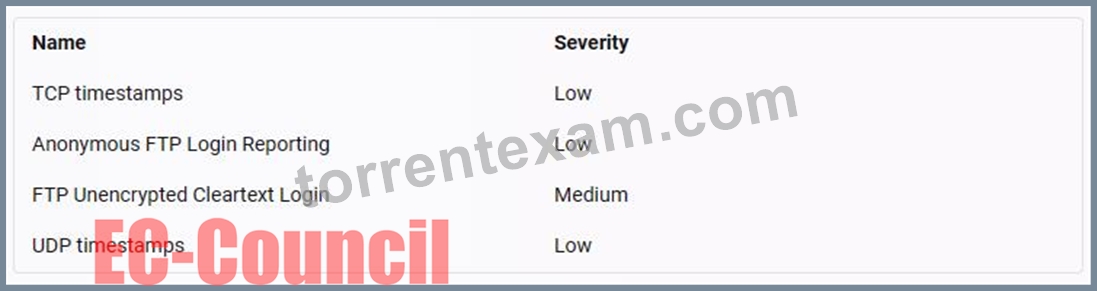
The vulnerability that may affect the website according to the severity factor is FTP Unencrypted Cleartext Login, which has a medium severity level. FTP Unencrypted Cleartext Login is a vulnerability that allows an attacker to intercept or sniff FTP login credentials that are sent in cleartext over an unencrypted connection. An attacker can use these credentials to access or modify files or data on the FTP server. TCP timestamps and UDP timestamps are vulnerabilities that allow an attacker to estimate the uptime of a system or network by analyzing the timestamp values in TCP or UDP packets. Anonymous FTP Login Reporting is a vulnerability that allows an attacker to access an FTP server anonymously without providing any username or password.
NEW QUESTION # 79
Desmond, a forensic officer, was investigating a compromised machine involved in various online attacks. For this purpose. Desmond employed a forensic tool to extract and analyze computer-based evidence to retrieve information related to websitesaccessed from the victim machine. Identify the computer-created evidence retrieved by Desmond in this scenario.
- A. Address books
- B. Documents
- C. Compressed files
- D. Cookies
Answer: D
Explanation:
Cookies are the computer-created evidence retrieved by Desmond in this scenario. Cookies are small files that are stored on a user's computer by a web browser when the user visits a website. Cookies can contain information such as user preferences, login details, browsing history, or tracking data. Cookies can be used to extract and analyze computer-based evidence to retrieve information related to websites accessed from the victim machine2. References: Cookies
NEW QUESTION # 80
An loT device placed in a hospital for safety measures has sent an alert to the server. The network traffic has been captured and stored in the Documents folder of the "Attacker Machine-1". Analyze the loTdeviceTraffic.pcapng file and identify the command the loT device sent over the network. (Practical Question)
- A. Tempe_Low
- B. High_Tcmpe
- C. Low_Tem p e
- D. Temp_High
Answer: D
Explanation:
The loT device sent the command Temp_High over the network, which indicates that the temperature in the hospital was above the threshold level. This can be verified by analyzing the loTdeviceTraffic.pcapng file using a network protocol analyzer tool such as Wireshark4. The command Temp_High can be seen in the data field of the UDP packet sent from the loT device (192.168.0.10) to the server (192.168.0.1) at 12:00:03. The screenshot below shows the packet details5: References: Wireshark User's Guide, [loTdeviceTraffic.pcapng]
NEW QUESTION # 81
Ruben, a crime investigator, wants to retrieve all the deleted files and folders in the suspected media without affecting the original files. For this purpose, he uses a method that involves the creation of a cloned copy of the entire media and prevents the contamination of the original media. Identify the method utilized by Ruben in the above scenario.
- A. Bit-stream imaging
- B. Sparse acquisition
- C. Logical acquisition
- D. Drive decryption
Answer: A
Explanation:
Bit-stream imaging is the method utilized by Ruben in the above scenario. Bit-stream imaging is a method that involves creating a cloned copy of the entire media and prevents the contamination of the original media. Bit-stream imaging copies all the data on the media, including deleted files and folders, hidden partitions, slack space, etc., at a bit level. Bit-stream imaging preserves the integrity and authenticity of the digital evidence and allows further analysis without affecting the original media. Sparse acquisition is a method that involves creating a partial copy of the media by skipping empty sectors or blocks. Drive decryption is a method that involves decrypting an encrypted drive or partition using a password or a key. Logical acquisition is a method that involves creating a copy of the logical files and folders on the media using file system commands.
NEW QUESTION # 82
Analyze the executable file ShadowByte.exe located in the Downloads folder of the Attacker Machine-I and determine the Linker Info value of the file. (Practical Question)
- A. 2.25
- B. 6.2
- C. 04.25
- D. 3.5
Answer: A
NEW QUESTION # 83
A large-scale financial Institution was targeted by a sophisticated cyber-attack that resulted In substantial data leakage and financial loss. The attack was unique in its execution, involving multiple stages and techniques that evaded traditional security measures. The institution's cybersecurity team, in their post-incident analysis, discovered that the attackers followed a complex methodology aligning with a well-known hacking framework. Identifying the framework used by the attackers is crucial for the institution to revise its defense strategies. Which of the following hacking frameworks/methodologles most likely corresponds to the attack pattern observed?
- A. ISO/IEC 27001. focusing on information security management systems
- B. OWASP Top Ten. focusing on web application security risks
- C. MITRE ATT&CK, encompassing a wide range of tactics and techniques used in real-world attacks
- D. NIST Cybersecurity Framework, primarily used for managing cybersecurity risks
Answer: C
NEW QUESTION # 84
Ruben, a crime investigator, wants to retrieve all the deleted files and folders in the suspected media without affecting the original files. For this purpose, he uses a method that involves the creation of a cloned copy of the entire media and prevents the contamination of the original medi a.
Identify the method utilized by Ruben in the above scenario.
- A. Bit-stream imaging
- B. Sparse acquisition
- C. Logical acquisition
- D. Drive decryption
Answer: A
NEW QUESTION # 85
Kason, a forensic officer, was appointed to investigate a case where a threat actor has bullied certain children online. Before proceeding legally with the case, Kason has documented all the supporting documents, including source of the evidence and its relevance to the case, before presenting it in front of the jury.
Which of the following rules of evidence was discussed in the above scenario?
- A. Understandable
- B. Authentic
- C. Admissible
- D. Reliable
Answer: C
Explanation:
Admissible is the rule of evidence discussed in the above scenario. A rule of evidence is a criterion or principle that determines whether a piece of evidence can be used in a legal proceeding or investigation. Admissible is a rule of evidence that states that the evidence must be relevant, reliable, authentic, and understandable to be accepted by a court or a jury.Admissible also means that the evidence must be obtained legally and ethically, without violating any laws or rights. In the scenario, Kason has documented all the supporting documents, including source of the evidence and its relevance to the case, before presenting it in front of the jury, which means that he has followed the admissible rule of evidence. Authentic is a rule of evidence that states that the evidence must be original or verifiable as genuine and not altered or tampered with.
Understandable is a rule of evidence that states that the evidence must be clear and comprehensible to the court or jury and not ambiguous or confusing. Reliable is a rule of evidence that states that the evidence must be consistent and trustworthy and not based on hearsay or speculation.
NEW QUESTION # 86
GlobalTech, a multinational tech conglomerate, has been operating across 50 countries for the past two decades. Recently, it faced a significant data breach that affected Its reputation and bottom line. As a result, the board of directors decided to overhaul its existing corporate strategy, with a pronounced focus on enhancing its Information Security Governance. The company believes that a robust governance structure would not only prevent future breaches but would also align with its long-term business objectives of expansion and dominance in the tech market. It has called upon several third-party consultants to pitch an optimal strategy for the conglomerate's unique position.
Which strategy best aligns with GlobalTech's requirement?
- A. Establish a governance framework that integrates security considerations into all business decisions.
- B. Implement a robust intrusion detection system.
- C. Formulate an isolated team for cybersecurity tasks.
- D. Prioritize security audits for quarterly review.
Answer: A
Explanation:
For GlobalTech, the optimal strategy to enhance information security governance and align with long-term business objectives involves:
* Integrated Governance Framework:
* Security Integration: Embed security considerations into all business decisions and processes.
This ensures that security is a fundamental aspect of the company's operations and strategic planning.
* Comprehensive Policies: Develop and enforce comprehensive security policies that cover all aspects of information security, including data protection, access controls, and incident response.
* Executive Support:
* Board-Level Commitment: Ensure that the board of directors and executive management are committed to and support the information security governance framework. This top-down approach is crucial for effective implementation and adherence.
* Regular Reviews and Audits:
* Continuous Improvement: Conduct regular security audits and reviews to assess the effectiveness of the governance framework and identify areas for improvement.
* Security Culture:
* Awareness and Training: Foster a culture of security awareness across the organization through regular training and awareness programs.
References:
* ISO/IEC 27014:2013 Information Security Governance: ISO Standards
* NIST Cybersecurity Framework:NIST CSF
NEW QUESTION # 87
Jaden, a network administrator at an organization, used the ping command to check the status of a system connected to the organization's network. He received an ICMP error message stating that the IP header field contains invalid information. Jaden examined the ICMP packet and identified that it is an IP parameter problem.
Identify the type of ICMP error message received by Jaden in the above scenario.
- A. Type = 3
- B. Type =12
- C. Type = 8
- D. Type = 5
Answer: D
NEW QUESTION # 88
TechTYendz. a leading tech company, is moving towards the final stages of developing a new cloud-based web application aimed at real-time data processing for financial transactions. Given the criticality of data and the high user volume expected. TechTYendz's security team is keen on employing rigorous application security testing techniques. The team decides to carry out a series of tests using tools that can best mimic potential real-world attacks on the application. The team's main concern Is to detect vulnerabilities In the system, including those stemming from configuration errors, software bugs, and faulty APIs. The security experts have shortlisted four testing tools and techniques. Which of the following would be the MOST comprehensive method to ensure a thorough assessment of the application's security?
- A. Utilizing static application security testing (SAST) tools to scan the source code for vulnerabilities.
- B. Conducting a manual penetration test focusing only on the user interface and transaction modules.
- C. Implementing a tool that combines both SAST and DAST features for a more holistic security overview.
- D. Employing dynamic application security testing (DAST) tools that analyze running applications in realtime.
Answer: C
Explanation:
For comprehensive application security testing, combining Static Application Security Testing (SAST) and Dynamic Application Security Testing (DAST) provides the best coverage:
* Static Application Security Testing (SAST):
* Source Code Analysis: Scans the source code to identify vulnerabilities such as code injection, buffer overflows, and insecure APIs.
* Early Detection: Allows developers to fix vulnerabilities early in the development lifecycle.
* Dynamic Application Security Testing (DAST):
* Runtime Analysis: Tests the running application for vulnerabilities, including issues related to configuration, authentication, and authorization.
* Real-World Attacks: Simulates real-world attacks to identify how the application behaves under different threat scenarios.
* Combined Approach:
* Holistic Security: Using both SAST and DAST provides a thorough security assessment, covering both code-level and runtime vulnerabilities.
* Comprehensive Coverage: Ensures that both internal code issues and external attack vectors are addressed.
References:
* OWASP Guide on SAST and DAST: OWASP
* NIST Application Security Guidelines:NIST SP 800-53
NEW QUESTION # 89
Which of the following are examples of physical security controls? (Select all that apply)
- A. Firewalls
- B. Biometric access control
- C. Security guards
- D. Encryption algorithms
Answer: B,C
NEW QUESTION # 90
FinTech Corp, a financial services software provider, handles millions of transactions daily. To address recent breaches In other organizations. It Is reevaluating Its data security controls. It specifically needs a control that will not only provide real-time protection against threats but also assist in achieving compliance with global financial regulations. The company's primary goal is to safeguard sensitive transactional data without impeding system performance. Which of the following controls would be the most suitable for FinTech Corp's objectives?
- A. Implementing DLP (Data Loss Prevention) systems
- B. Enforcing Two-Factor Authentication for all database access
- C. Switching to disk-level encryption for all transactional databases
- D. Adopting anomaly-based intrusion detection systems
Answer: D
NEW QUESTION # 91
Kayden successfully cracked the final round of interview at an organization. After few days, he received his offer letter through an official company email address. The email stated that the selected candidate should respond within a specified time. Kayden accepted the opportunity and provided e-signature on the offer letter, then replied to the same email address. The company validated the e-signature and added his details to their database. Here, Kayden could not deny company's message, and company could not deny Kayden's signature.
Which of the following information security elements was described in the above scenario?
- A. Confidentiality
- B. Non-repudiation
- C. Integrity
- D. Availability
Answer: B
NEW QUESTION # 92
Steve, a network engineer, was tasked with troubleshooting a network issue that is causing unexpected packet drops. For this purpose, he employed a network troubleshooting utility to capture the ICMP echo request packets sent to the server. He identified that certain packets are dropped at the gateway due to poor network connection.
Identify the network troubleshooting utility employed by Steve in the above scenario.
- A. traceroute
- B. ipconfig
- C. dnsenurn
- D. arp
Answer: A
Explanation:
Traceroute is the network troubleshooting utility employed by Steve in the above scenario. Traceroute is a utility that traces the route of packets from a source host to a destination host over a network. Traceroute sends ICMP echo request packets with increasing TTL (Time to Live) values and records the ICMP echo reply packets from each intermediate router or gateway along the path. Traceroute can help identify the network hops, latency, and packet loss between the source and destination hosts . Dnsenum is a utility that enumerates DNS information from a domain name or an IP address. Arp is a utility that displays and modifies the ARP (Address Resolution Protocol) cache of a host. Ipconfig is a utility that displays and configures the IP (Internet Protocol) settings of a host.
NEW QUESTION # 93
An loT device placed in a hospital for safety measures has sent an alert to the server. The network traffic has been captured and stored in the Documents folder of the "Attacker Machine-1". Analyze the loTdeviceTraffic.pcapng file and identify the command the loT device sent over the network. (Practical Question)
- A. Tempe_Low
- B. High_Tcmpe
- C. Low_Tem p e
- D. Temp_High
Answer: D
Explanation:
The loT device sent the command Temp_High over the network, which indicates that the temperature in the hospital was above the threshold level. This can be verified by analyzing the loTdeviceTraffic.pcapng file using a network protocol analyzer tool such as Wireshark4. The command Temp_High can be seen in the data field of the UDP packet sent from the loT device (192.168.0.10) to the server (192.168.0.1) at 12:00:03. The screenshot below shows the packet details5: Reference: Wireshark User's Guide, [loTdeviceTraffic.pcapng]
NEW QUESTION # 94
Malachi, a security professional, implemented a firewall in his organization to trace incoming and outgoing traffic. He deployed a firewall that works at the session layer of the OSI model and monitors the TCP handshake between hosts to determine whether a requested session is legitimate. Identify the firewall technology implemented by Malachi in the above scenario.
- A. Circuit-level gateways
- B. Packet filtering
- C. Network address translation (NAT)
- D. Next generation firewall (NGFW)
Answer: A
Explanation:
A circuit-level gateway is a type of firewall that works at the session layer of the OSI model and monitors the TCP handshake between hosts to determine whether a requested session is legitimate. It does not inspect the contents of each packet, but rather relies on the session information to filter traffic
NEW QUESTION # 95
Johnson, an attacker, performed online research for the contact details of reputed cybersecurity firms. He found the contact number of sibertech.org and dialed the number, claiming himself to represent a technical support team from a vendor. He warned that a specific server is about to be compromised and requested sibertech.org to follow the provided instructions. Consequently, he prompted the victim to execute unusual commands and install malicious files, which were then used to collect and pass critical Information to Johnson's machine. What is the social engineering technique Steve employed in the above scenario?
- A. Phishing
- B. Diversion theft
- C. Quid pro quo
- D. Elicitation
Answer: C
Explanation:
Quid pro quo is the social engineering technique that Johnson employed in the above scenario.
Quid pro quo is a social engineering method that involves offering a service or a benefit in exchange for information or access. Quid pro quo can be used to trick victims into believing that they are receiving help or assistance from a legitimate source, while in fact they are compromising their security or privacy. In the scenario, Johnson performed quid pro quo by claiming himself to represent a technical support team from a vendor and offering to help sibertech.org with a server issue, while in fact he prompted the victim to execute unusual commands and install malicious files, which were then used to collect and pass critical information to Johnson's machine.
NEW QUESTION # 96
......
Authentic Best resources for 212-82 Online Practice Exam: https://dumpscertify.torrentexam.com/212-82-exam-latest-torrent.html
