

Download Free Palo Alto Networks PSE-Strata Exam Questions & Answer
Online VALID PSE-Strata Exam Dumps File Instantly
The PSE-Strata exam covers a range of topics related to network security, including firewalls, virtualization, NAT, IPsec VPNs, SSL VPNs, and more. PSE-Strata exam is designed to test candidates' knowledge of these topics as well as their ability to apply this knowledge to real-world scenarios. PSE-Strata exam consists of 50 multiple-choice questions and candidates have 90 minutes to complete it.
Palo Alto Networks PSE-Strata (Palo Alto Networks System Engineer Professional - Strata) Certification Exam is designed for individuals who are looking to validate their knowledge of network security concepts and best practices. Palo Alto Networks System Engineer Professional - Strata Exam certification exam is suitable for system engineers, security engineers, and other professionals who work with Palo Alto Networks solutions. The PSE-Strata exam is the first step in the certification path for Palo Alto Networks System Engineer Professional certification.
NEW QUESTION # 82
Which two products can send logs to the Cortex Data Lake? (Choose two.)
- A. AutoFocus
- B. Prisma Public Cloud
- C. Prisma Access
- D. PA-3260 firewall
Answer: C,D
Explanation:
Logs from various products can be sent to the Cortex Data Lake, which serves as a centralized logging and data repository:
* PA-3260 firewall: This next-generation firewall (NGFW) is capable of forwarding comprehensive logs, including threat, traffic, and user activity data, to the Cortex Data Lake for centralized analysis and response.
* Prisma Access: This cloud-delivered security service ensures secure access to applications and data from anywhere. It integrates with Cortex Data Lake to provide consistent security across all users, irrespective of their location, by logging security events and user activities (Palo Alto Networks) (Palo Alto Networks) (Palo Alto Networks).
NEW QUESTION # 83
In Panorama, which three reports or logs will help identify the inclusion of a host source in a command-and-control (C2) incident? (Choose three.)
- A. WildFire analysis reports
- B. threat logs
- C. SaaS reports
- D. data filtering logs
- E. botnet reports
Answer: A,B,E
Explanation:
In Panorama, the centralized management tool for Palo Alto Networks firewalls, WildFire analysis reports, threat logs, and botnet reports are essential for identifying the inclusion of a host source in a command-and-control (C2) incident. WildFire analysis reports provide detailed insights into malware behavior and characteristics. Threat logs record events related to security threats, such as attempted intrusions or malware detections. Botnet reports specifically track botnet activity, identifying compromised hosts that communicate with known botnet servers. By reviewing these reports and logs, administrators can accurately identify and mitigate C2 incidents.
NEW QUESTION # 84
Which two of the following does decryption broker provide on a NGFW? (Choose two.)
- A. Eliminates the need for a third party SSL decryption option which allows you to reduce the total number of third party devices performing analysis and enforcement
- B. Decryption broker allows you to offload SSL decryption to the Palo Alto Networks next-generation firewall and decrypt traffic only once
- C. Provides a third party SSL decryption option which allows you to increase the total number of third party devices performing analysis and enforcement
- D. Decryption broker allows you to offload SSL decryption to the Palo Alto Networks next-generation firewall and decrypt traffic multiple times
Answer: A,B
NEW QUESTION # 85
Match the WildFire Inline Machine Learning Model to the correct description for that model.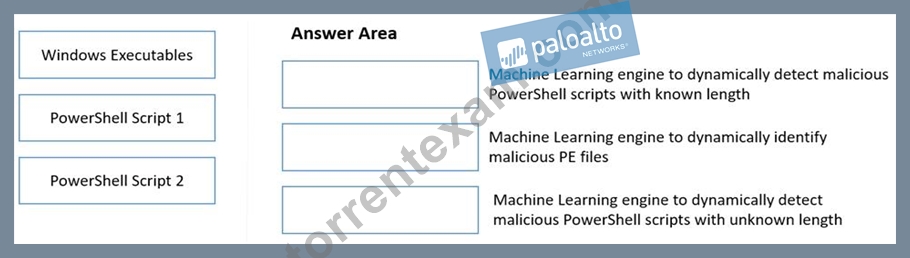
Answer:
Explanation: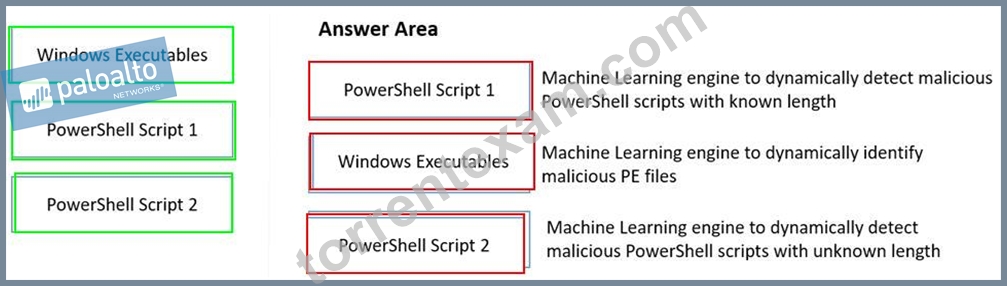
NEW QUESTION # 86
The firewall includes predefined reports, custom reports can be built for specific data and actionable tasks, or predefined and custom reports can be combined to compile information needed to monitor network security The firewall provides which three types of reports? (Choose three.)
- A. User or Group Activity Reports
- B. SNMP Reports
- C. PDF Summary Reports
- D. Botnet Reports
- E. Netflow Reports
Answer: A,D,E
NEW QUESTION # 87
A price-sensitive customer wants to prevent attacks on a Windows Virtual Server. The server will max out at 100Mbps but needs to have 45.000 sessions to connect to multiple hosts within a data center Which VM instance should be used to secure the network by this customer?
- A. VM-200
- B. VM-300
- C. VM-50
- D. VM-100
Answer: C
NEW QUESTION # 88
Which two components must be configured within User-ID on a new firewall that has been implemented?
(Choose two.)
- A. Group Mapping
- B. User Mapping
- C. 802.1X Authentication
- D. Proxy Authentication
Answer: A,B
Explanation:
Explanation
https://www.paloaltonetworks.com/documentation/71/pan-os/pan-os/user-id/enable-user-id
NEW QUESTION # 89
What two types of traffic should you exclude from a decryption policy? (Choose two.)
- A. All Mutual Authentication traffic
- B. All SSL/TLS 1.3 traffic
- C. All Business and regulatory traffic
- D. All outbound traffic
Answer: C,D
Explanation:
https://docs.paloaltonetworks.com/pan-os/9-1/pan-os-admin/decryption/decryption-exclusions
NEW QUESTION # 90
Which two tabs in Panorama can be used to identify templates to define a common base configuration?
(Choose two.)
- A. Policies Tab
- B. Device Tab
- C. Objects Tab
- D. Network Tab
Answer: B,D
Explanation:
Explanation
https://www.paloaltonetworks.com/documentation/80/pan-os/web-interface-help/panorama-web-interface/panora
NEW QUESTION # 91
Which Security profile on the Next-Generation Firewall (NGFW) includes Signatures to protect against brute force attacks?
- A. Anti-Spyware profile
- B. URL Filtering profile
- C. Vulnerability Protection profile
- D. Antivirus profile
Answer: C
Explanation:
The Vulnerability Protection profile on Palo Alto Networks Next-Generation Firewall includes signatures to protect against a variety of threats, including brute force attacks.
* Vulnerability Protection Profile:
* This profile contains specific signatures designed to detect and block attempts to exploit vulnerabilities, including those used in brute force attacks.
NEW QUESTION # 92
Which three methods used to map users to IP addresses are supported in Palo Alto Networks firewalls? (Choose three.)
- A. Lotus Domino
- B. RADIUS
- C. eDirectory monitoring
- D. Active Directory monitoring
- E. Client Probing
- F. TACACS
- G. SNMP server
Answer: B,E,F
Explanation:
https://www.paloaltonetworks.com/documentation/80/pan-os/pan-os/user-id/user-id- concepts/user-mapping
NEW QUESTION # 93
Which two components must be configured within User-ID on a new firewall that has been implemented? (Choose two.)
- A. Group Mapping
- B. User Mapping
- C. 802.1X Authentication
- D. Proxy Authentication
Answer: A,B
NEW QUESTION # 94
Which three considerations should be made prior to installing a decryption policy on the NGFW? (Choose three.)
- A. Include all traffic types in decryption policy
- B. Exclude certain types of traffic in decryption policy
- C. Deploy decryption setting all at one time
- D. Ensure throughput is not an issue
- E. Inability to access websites
Answer: A,B,E
NEW QUESTION # 95
Which two email links, contained in SMTP and POP3, can be submitted from WildFire analysis with a WildFire subscription? (Choose two.)
- A. HTTP
- B. HTTPS
- C. FTP
- D. RTP
Answer: A,B
Explanation:
With a WildFire subscription, email links contained in SMTP and POP3 messages can be submitted for WildFire analysis if they are either HTTP or HTTPS links. WildFire is a cloud-based threat analysis service that dynamically analyzes these links to detect malicious content. By submitting HTTP and HTTPS links, the system can effectively identify and block threats before they reach the end user, enhancing overall email security.
NEW QUESTION # 96
What is the recommended way to ensure that firewalls have the most current set of signatures for up-to-date protection?
- A. Use dynamic updates with the most aggressive schedule required by business needs
- B. Monitor update announcements and manually push updates to Crewall
- C. Store updates on an intermediary server and point all the firewalls to it
- D. Run a Perl script to regularly check for updates and alert when one is released
Answer: A
Explanation:
To ensure that firewalls have the most current set of signatures for up-to-date protection, it is recommended to use dynamic updates with the most aggressive schedule required by business needs. Dynamic updates allow the firewall to automatically download and install the latest threat signatures and security updates from Palo Alto Networks. This approach minimizes the window of vulnerability by ensuring that the firewall is consistently equipped with the most recent protections against emerging threats. Setting an aggressive update schedule ensures timely application of critical updates, enhancing the overall security posture of the network.
NEW QUESTION # 97
The need for a file proxy solution, virus and spyware scanner, a vulnerability scanner, and HTTP decoder for URL filtering is handled by which component in the NGFW?
- A. SIA (Scan It All) Processing Engine
- B. Stream-based Signature Engine
- C. First Packet Processor
- D. Security Processing Engine
Answer: B
Explanation:
https://media.paloaltonetworks.com/documents/Single_Pass_Parallel_Processing_Architecture.p dfn (page 6)
NEW QUESTION # 98
Which two of the following does decryption broker provide on a NGFW? (Choose two.)
- A. Decryption broker allows you to offload SSL decryption to the Palo Alto Networks next-generation firewall and decrypt traffic only once
- B. Eliminates the need for a third party SSL decryption option which allows you to reduce the total number of third party devices performing analysis and enforcement
- C. Provides a third party SSL decryption option which allows you to increase the total number of third party devices performing analysis and enforcement
- D. Decryption broker allows you to offload SSL decryption to the Palo Alto Networks next-generation firewall and decrypt traffic multiple times
Answer: A,D
NEW QUESTION # 99
When log sizing is factored for the Cortex Data Lake on the NGFW, what is the average log size used in calculation?
- A. depends on the Cortex Data Lake tier purchased
- B. 8MB
- C. 1500 bytes
- D. 18 bytes
Answer: C
Explanation:
https://knowledgebase.paloaltonetworks.com/KCSArticleDetail?id=kA10g000000ClVMCA0
NEW QUESTION # 100
......
The PSE-Strata exam is designed to test a candidate's understanding of network security concepts, including the design and configuration of firewalls, the deployment of threat prevention technologies, and the management of security policies. PSE-Strata exam consists of multiple-choice questions and is administered online. Candidates have two hours to complete the exam, and a passing score is required to earn certification.
PSE-Strata Exam Dumps For Certification Exam Preparation: https://dumpscertify.torrentexam.com/PSE-Strata-exam-latest-torrent.html
