

[Feb-2024] Updated and Accurate S90.08B Questions & Answers for passing the exam Quickly
Download Real S90.08B Exam Dumps for candidates. 100% Free Dump Files
In order to pass the S90.08B exam, candidates must demonstrate their ability to design and architect SOA solutions with microservices, as well as their knowledge of best practices and industry standards. S90.08B exam is ideal for professionals who are interested in furthering their careers in the field of SOA design and architecture, as well as for organizations looking to hire experts in this area. By passing S90.08B exam, candidates can demonstrate their expertise and commitment to delivering high-quality, scalable, and reliable SOA solutions.
SOA S90.08B exam is a certification exam that focuses on SOA design and architecture. S90.08B exam is designed for IT professionals who specialize in developing software applications and systems using service-oriented architecture (SOA) principles. S90.08B exam is aimed at those who want to prove their skills and knowledge in designing and implementing SOA-based applications and systems.
NEW QUESTION # 10 
Service A is a task service that sends Service B a message (2) requesting that Service B return data back to Service A in a response message (3). Depending on the response received, Service A may be required to send a message to Service C (4) for which it requires no response.
Before it contacts Service B, Service A must first retrieve a list of code values from its own database (1) and then place this data into its own memory. If it turns out that it must send a message to Service C, then Service A must combine the data it receives from Service B with the data from the code value list in order to create the message it sends to Service C. If Service A is not required to invoke Service C, it can complete its task by discarding the code values.
Service A and Service C reside in Service Inventory A. Service B resides in Service Inventory B.
You are told that the services in Service Inventory A were designed with service contracts that are based on different design standards and technologies than the services In Service Inventory B. As a result,Service A is a SOAP-based Web service and Service B Is a REST service that exchanges JSON-formatted messages.
Therefore, Service A and Service B cannot currently communicate. Furthermore, Service C is an agnostic service that is heavily accessed by many concurrent service consumers. Service C frequently reaches its usage thresholds, during which it is not available and messages sent to it are not received.
What steps can be taken to solve these problems?
- A. The Data Model Transformation pattern can be applied by establishing an intermediate processing layer between Service A and Service B that can transform a message from one data model to another at runtime. The Intermediate Routing and Service Agent patterns can be applied so that when Service B sends a response message, a service agent can intercept the message and, based on its contents, either forward the message to Service A or route the message to Service C. The Service Statelessness principle can be applied with the help of the State Repository pattern so that Service A can write the code value data to a state database while it is waiting for Service B to respond.
- B. The Data Format Transformation pattern can be applied by establishing an intermediate processing layer between Service A and Service B that can transform a message from one data format to another at runtime. The Asynchronous Queuing pattern can be applied to establish an intermediate queue between Service A and Service B so that when Service A needs to send a message to Service B, the queue will store the message and retransmit it to Service B until it is successfully delivered. The Service Reusability principle can be further applied to Service C together with the Redundant Implementation pattern to help establish a more reusable and scalable service architecture.
- C. The Data Model Transformation pattern can be applied by establishing an intermediate processing layer between Service A and Service B that can transform a message from one data model to another at runtime. The Intermediate Routing and Service Agent patterns can be applied so that when Service B sends a response message, a service agent can intercept the message and, based on its contents, either forward the message to Service A or route the message to Service C. The Service Autonomy principle can be further applied to Service C together with the Redundant Implementation pattern to help establish a more reliable and scalable service architecture.
- D. The Data Format Transformation pattern can be applied by establishing an intermediate processing layer between Service A and Service B that can transform a message from one data format to another at runtime. The Asynchronous Queuing pattern can be applied to establish an intermediate queue between Service A and Service C so that when Service A needs to send a message to Service C, the queue will store the message and retransmit it to Service C until it is successfully delivered. The Service Autonomy principle can be further applied to Service C together with the Redundant Implementation pattern to help establish a more reliable and scalable service architecture.
Answer: D
Explanation:
Explanation
The problem is that Service A and Service B are using different technologies and cannot communicate.
Therefore, an intermediate processing layer can be established that can transformmessages from one data format to another at runtime. This can be achieved using the Data Format Transformation pattern.
Additionally, Service C frequently reaches its usage thresholds and is not always available, so an Asynchronous Queuing pattern can be applied to establish an intermediate queue between Service A and Service C. This queue will store the messages sent by Service A to Service C and retransmit them until they are successfully delivered. This approach improves the reliability of the system.
Moreover, the Redundant Implementation pattern can be applied to Service C to ensure its availability and scalability, and the Service Autonomy principle can be applied to make Service C independent of other services.
NEW QUESTION # 11
Refer to Exhibit.
Service A is an entity service that provides a set of generic and reusable service capabilities. In order to carry out the functionality of any one of its service capabilities, Service A is required to compose Service B (1) and Service C (2), and Service A is required to access Database A (3), Database B (4), and Database C (5). These three databases are shared by other applications within the IT enterprise.
All of service capabilities provided by Service A are synchronous, which means that for each request a service consumer makes, Service A is required to issue a response message after all of the processing has completed.
Service A is one of many entity services that reside In a highly normalized service Inventory. Because Service A provides agnostic logic, it is heavily reused and is currently part of many service compositions.
You are told that Service A has recently become unstable and unreliable. The problem has been traced to two issues with the current service architecture. First, Service B, which Is also an entity service, is being increasingly reused and has itself become unstable and unreliable. When Service B fails, the failure is carried over to Service A.
Secondly, shared Database B has a complex data model. Some of the queries issued by Service A to shared Database B can take a very long time to complete.
What steps can be taken to solve these problems without compromising the normalization of the service inventory?
- A. The Redundant Implementation pattern can be applied to Service B, thereby making duplicate deployments of the service available. This way, when one implementation of Service B is too busy, another implementation can be accessed by Service A instead. The Data Model Transformation pattern can be applied to establish a dedicated database that contains an exact copy of the data from shared Database B that is required by Service A.
- B. The Redundant Implementation pattern can be applied to Service B, thereby making duplicate deployments of the service available. This way, when one implementation of Service B is too busy, another implementation can be accessed by Service A instead. The Service Data Replication pattern can be applied to establish a dedicated database that contains a copy of the data from shared Database B that is required by Service A. The replicated database is designed with an optimized data model to improve query execution performance.
- C. The Redundant Implementation pattern can be applied to Service A, thereby making duplicate deployments of the service available. This way, when one implementation of Service A is too busy, another implementation can be accessed by service consumers instead. The Service Data Replication pattern can be applied to establish a dedicated database that contains an exact copy of the data from shared Database B that is required by Service A.
- D. The Redundant Implementation pattern can be applied to Service A, thereby making duplicate deployments of the service available. This way, when one implementation of Service A is too busy, another implementation can be accessed by service consumers instead. The Service Statelessness principle can be applied with the help of the State Repository pattern In order to establish a state database that Service A can use to defer state data it may be required to hold for extended periods, thereby improving its availability and scalability.
Answer: B
Explanation:
This solution addresses both issues with the current service architecture. By applying the Redundant Implementation pattern to Service B, duplicate deployments of the service are made available, ensuring that when one implementation fails, another can be accessed by Service A. Additionally, the Service Data Replication pattern can be applied to establish a dedicated database that contains a copy of the data from shared Database B that is required by Service A. This replicated database is designed with an optimized data model to improve query execution performance, ensuring that queries issued by Service A to the database can complete more quickly, improving the overall stability and reliability of Service A. By applying these patterns, the problems with Service A can be solved without compromising the normalization of the service inventory.
NEW QUESTION # 12
Refer to Exhibit.
Service Consumer A and Service A reside in Service Inventory A. Service B and Service C reside in Service Inventory B. Service D is a public service that can be openly accessed via the World Wide Web. The service is also available for purchase so that it can be deployed independently within IT enterprises. Due to the rigorous application of the Service Abstraction principle within Service Inventory B, the only information that is made available about Service B and Service C are the published service contracts. For Service D, the service contract plus a service level agreement (SLA) are made available. The SLA indicates that Service D has a planned outage every night from 11:00pm to midnight.
You are an architect with a project team that is building services for Service Inventory A. You are told that the owners of Service Inventory A and Service Inventory B are not generally cooperative or communicative. Cross-inventory service composition is tolerated, but not directly supported. As a result, no SLAs for Service B and Service C are available and you have no knowledge about how available these services are. Based on the service contracts you can determine that the services in Service Inventory B use different data models and a different transport protocol than the services in Service Inventory A. Furthermore, recent testing results have shown that the performance of Service D is highly unpredictable due to the heavy amount of concurrent access it receives from service consumers from other organizations. You are also told that there is a concern over how long Service Consumer A will need to remain stateful while waiting for a response from Service A.
What steps can be taken to solve these problems?
- A. The Event-Driven Messaging pattern can be applied to establish a subscriber-publisher relationship between Service Consumer A and Service A. This gives Service A the flexibility to provide its response to Service Consumer A whenever it is able to collect the three data values without having to require that Service Consumer A remain stateful. The Asynchronous Queuing pattern can be applied to position a central messaging queue between Service A and Service B and between Service A and Service C. The Data Model Transformation and Protocol Bridging patterns can be applied to enable communication between Service A and Service B and between Service A and Service C. The Redundant Implementation pattern can be applied so that a copy of Service D is brought in-house and made part of Service Inventory A.
- B. The Containerization pattern can be applied to establish an environment for Service A to perform its processing autonomously. This gives Service A the flexibility to provide Service Consumer A with response messages consistently. The Asynchronous Queuing pattern can be applied so that a central messaging queue is positioned between Service A and Service B, between Service A and Service C, and between Service A and Service D. The Data Model Transformation and Protocol Bridging patterns can be applied to enable communication between Service A and Service B and between Service A and Service C.
- C. The Asynchronous Queuing pattern can be applied to position a message queue between Service A and Service B, between Service A and Service C, and between Service A and Service D. Additionally, a separate messaging queue is positioned between Service A and Service Consumer A. The Data Model Transformation and Protocol Bridging patterns can be applied to enable communication between Service A and Service B, between Service A and Service C, and between Service A and Service D. The Redundant Implementation pattern can be applied so that a copy of Service D is brought in-house. The Legacy Wrapper pattern can be further applied to wrap Service D with a standardized service contract that is in compliance with the design standards used in Service Inventory B.
- D. The Asynchronous Queuing pattern can be applied to position a central messaging queue between Service A and Service B and between Service A and Service C and so that a separate messaging queue is positioned between Service A and Service Consumer A. The Data Model Transformation and Protocol Bridging patterns can be applied to enable communication between Service A and Service B and between Service A and Service C. The Redundant Implementation pattern can be applied so that a copy of Service D is brought in-house. The Legacy Wrapper pattern can be further applied to wrap Service D with a standardized service contract that is in compliance with the design standards used in Service Inventory A.
Answer: C
Explanation:
The Asynchronous Queuing pattern is applied to position a messaging queue between Service A, Service B, Service C, Service D, and Service Consumer A. This ensures that messages can be passed between these services without having to be in a stateful mode.
The Data Model Transformation and Protocol Bridging patterns are applied to enable communication between Service A and Service B, Service A and Service C, and Service A and Service D, despite their different data models and transport protocols.
The Redundant Implementation pattern is applied to bring a copy of Service D in-house to ensure that it can be accessed locally and reduce the unpredictability of its performance.
The Legacy Wrapper pattern is applied to wrap Service D with a standardized service contract that complies with the design standards used in Service Inventory B. This is useful for service consumers who want to use Service D but do not want to change their existing applications or service contracts.
Overall, this approach provides a comprehensive solution that addresses the issues with Service A, Service B, Service C, and Service D, while maintaining compliance with the Service Abstraction principle.
NEW QUESTION # 13 
Service A sends a message to Service B (1). After Service B writes the message contents to Database A (2), it issues a response message back to Service A (3). Service A then sends a message to Service C (4). Upon receiving this message, Service C sends a message to Service D (5), which then writes the message contents to Database B (6) and issues a response message back to Service C (7).
Service A and Service D are located in Service Inventory A. Service B and Service C are located in Service Inventory B.
You are told that In this service composition architecture, all four services are exchanging invoice-related data in an XML format. However, the services in Service Inventory A are standardized to use a different XML schema for invoice data than the services in Service Inventory B. Also, Database A can only accept data in the Comma Separated Value (CSV) format and therefore cannot accept XML-formatted data. Database B only accepts XML-formatted data. However, it is a legacy database that uses a proprietary XML schema to represent invoice data that is different from the XML schema used by services in Service Inventory A or Service Inventory B.
What steps can be taken to enable the planned data exchange between these four services?
- A. The Protocol Bridging pattern can be applied so that protocol conversion logic is positioned between the Service B logic and Database A. The Data Format Transformation pattern can be applied so that data format transformation logic is positioned between Service A and Service B, between Service A and Service C, between Service C and Service D, and between the Service D logic and Database B.
- B. The Data Model Transformation pattern can be applied so that data model transformation logic is positioned between Service A and Service B, between Service C and Service D, and between the Service D logic and Database B. The Data Format Transformation pattern can be applied so that data format transformation logic is positioned between Service A and Service C, and between the Service B logic and Database A.
- C. The Protocol Bridging pattern can be applied so that protocol conversion logic is positioned between Service A and Service B, between Service A and Service C, and between Service C and Service D. The Data Format Transformation pattern can be applied so that data format transformation logic is positioned between the Service B logic and Database A and between the Service D logic and Database B
- D. The Data Model Transformation pattern can be applied so that data model transformation logic is positioned between Service A and Service B, between Service A and Service C, between Service C andService D, and between the Service D logic and Database B. The Data Format Transformation pattern can be applied so that data format transformation logic is positioned between the Service B logic and Database A.
Answer: D
Explanation:
Explanation
This solution addresses the two main challenges in the service composition architecture: the different XML schema used by services in Service Inventory A and Service Inventory B, and the incompatible data formats of the two databases.
By applying the Data Model Transformation pattern, data model transformation logic can be inserted to map the invoice-related data between the different XML schemas used by the services in Service Inventory A and Service Inventory B. This can be done at the appropriate points in the message flow: between Service A and Service B, between Service A and Service C, between Service C and Service D, and between the Service D logic and Database B.
By applying the Data Format Transformation pattern, data format transformation logic can be inserted to convert the XML-formatted data used by the services to the CSV format required by Database A, and to convert the proprietary XML schema used by Database B to the XML schema used by the services. This can be done between the Service B logic and Database A.
The Protocol Bridging pattern is not necessary in this case because all services are already communicating using the same protocol (presumably HTTP or a similar protocol).
NEW QUESTION # 14
Refer to Exhibit.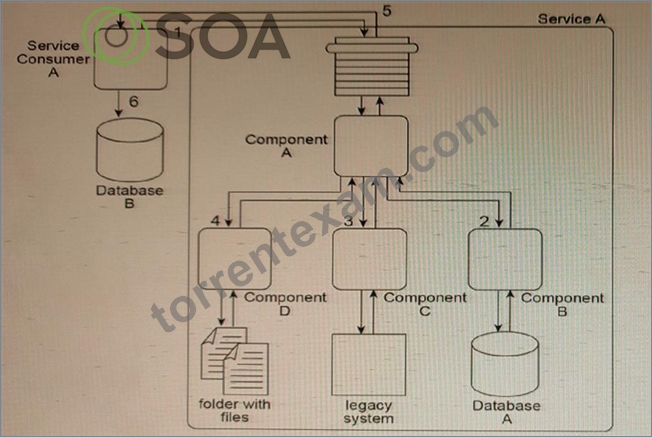
When Service A receives a message from Service Consumer A (1), the message is processed by Component A.
This component first invokes Component B (2), which uses values from the message to query Database A in order to retrieve additional data. Component B then returns the additional data to Component A. Component A then invokes Component C (3), which interacts with the API of a legacy system to retrieve a new data value. Component C then returns the data value back to Component A.
Next, Component A sends some of the data It has accumulated to Component D (4), which writes the data to a text file that is placed in a specific folder. Component D then waits until this file is imported into a different system via a regularly scheduled batch import. Upon completion of the import, Component D returns a success or failure code back to Component A. Component A finally sends a response to Service Consumer A (5) containing all of the data collected so far and Service Consumer A writes all of the data to Database B (6).
Components A, B, C, and D belong to the Service A service architecture. Database A, the legacy system and the file folders are shared resources within the IT enterprise.
Service A is an entity service with a service architecture that has grown over the past few years. As a result of a service inventory-wide redesign project, you are asked to revisit the Service A service architecture in order to separate the logic provided by Components B, C, and D into three different utility services without disrupting the behavior of Service A as it relates to Service Consumer A.
What steps can be taken to fulfill these requirements?
- A. The Legacy Wrapper pattern can be applied so that Component B Is separated into a separate utility service that wraps the shared database. The Legacy Wrapper pattern can be applied again so that Component C is separated into a separate utility service that acts as a wrapper for the legacy system API. The Legacy Wrapper pattern can be applied once more to Component D so that it is separated into another utility service that provides standardized access to the file folder. The Service Fagade pattern can be applied so that three fagade components are added: one between Component A and each of the new wrapper utility services. This way, the fagade components can compensate for any change in behavior that may occur as a result of the separation. The Service Composability principle can be further applied to Service A and the three new wrapper utility services so that all four services are optimized for participation in the new service composition. This will help make up for any performance loss that may result from splitting the three components into separate services.
- B. The Legacy Wrapper pattern can be applied so that Component B is separated into a separate wrapper utility service that wraps the shared database. The Asynchronous Queuing pattern can be applied so that a messaging queue is positioned between Component A and Component C, thereby enabling communication during the times when the legacy system may be unavailable or heavily accessed by other parts of the IT enterprise. The Service Fagade pattern can be applied so that a fagade component is added between Component A and Component D so that any change In behavior can be compensated. The Service Autonomy principle can be further applied to Service A to help make up for any performance loss that may result from splitting the component into a separate wrapper utility service.
- C. The Legacy Wrapper pattern can be applied so that Component B is separated into a separate wrapper utility service that wraps the shared database. The State Repository and State Messaging patterns can be applied so that a messaging repository is positioned between Component A and Component C, thereby enabling meta data-driven communication during the times when the legacy system may be unavailable or heavily accessed by other parts of the IT enterprise. The Service Fagade pattern can be applied so that a fagade component is added between Component A and Component D so that any change in behavior can be compensated. The Service Statelessness principle can be further applied to Service A to help make up for any performance loss that may result from splitting the component into a separate wrapper utility service.
- D. The Legacy Wrapper pattern can be applied so that Component B is separated into a separate utility service that wraps the shared database. The Legacy Wrapper pattern can be applied again so that Component C is separated into a separate utility service that acts as a wrapper for the legacy system API. Component D can also be separated into a separate service and the Event-Driven Messaging pattern can be applied to establish a publisher-subscriber relationship between this new service and Component A. The interaction between Service Consumer A and Component A can then be redesigned so that Component A first interacts with Component B and the new wrapper service. Service A then issues a final message back to Service Consumer A. The Service Composability principle can be further applied to Service A and the three new wrapper utility services so that all four services are optimized for participation in the new service composition. This will help make up for any performance loss that may result from splitting the three components into separate services.
Answer: A
NEW QUESTION # 15
Refer to Exhibit.
Service A is an entity service that provides a Get capability which returns a data value that is frequently changed.
Service Consumer A invokes Service A in order to request this data value (1). For Service A to carry out this request, it must invoke Service B (2), a utility service that interacts (3, 4) with the database in which the data value is stored. Regardless of whether the data value changed, Service B returns the latest value to Service A (5), and Service A returns the latest value to Service Consumer A (6).
The data value is changed when the legacy client program updates the database (7). When this change will occur is not predictable. Note also that Service A and Service B are not always available at the same time.
Any time the data value changes, Service Consumer A needs to receive It as soon as possible. Therefore, Service Consumer A initiates the message exchange shown In the figure several times a day. When it receives the same data value as before, the response from Service A Is ignored. When Service A provides an updated data value, Service Consumer A can process it to carry out its task.
The current service composition architecture is using up too many resources due to the repeated invocation of Service A by Service Consumer A and the resulting message exchanges that occur with each invocation.
What steps can be taken to solve this problem?
- A. The Event-Driven Messaging pattern can be applied by establishing a subscriber-publisher relationship between Service Consumer A and Service A. This way, every time the data value is updated, an event is triggered and Service A, acting as the publisher, can notify Service Consumer A, which acts as the subscriber. The Asynchronous Queuing pattern can be applied between Service Consumer A and Service A so that the event notification message sent out by Service A will be received by Service Consumer A, even when Service Consumer A is unavailable.
- B. The Asynchronous Queuing pattern can be applied so that messaging queues are established between Service A and Service B and between Service Consumer A and Service A. This way, messages are never lost due to the unavailability of Service A or Service B.
- C. The Event-Driven Messaging pattern can be applied by establishing a subscriber-publisher relationship between Service Consumer A and a database monitoring agent introduced through the application of the Service Agent pattern. The database monitoring agent monitors updates made by the legacy client to the database. This way, every time the data value is updated, an event is triggered and the database monitoring agent, acting as the publisher, can notify Service Consumer A, which acts as the subscriber.
The Asynchronous Queuing pattern can be applied between Service Consumer A and the database monitoring agent so that the event notification message sent out by the database monitoring agent will be received by Service Consumer A, even when Service Consumer A is unavailable. - D. The Event-Driven Messaging pattern can be applied by establishing a subscriber-publisher relationship between Service A and Service B. This way, every time the data value is updated, an event is triggered and Service B, acting as the publisher, can notify Service A, which acts as the subscriber. The Asynchronous Queuing pattern can be applied between Service A and Service B so that the event notification message sent out by Service B will be received by Service A, even when Service A is unavailable.
Answer: D
Explanation:
This solution is the most appropriate one among the options presented. By using the Event-Driven Messaging pattern, Service A can be notified of changes to the data value without having to be invoked repeatedly by Service Consumer A, which reduces the resources required for message exchange. Asynchronous Queuing ensures that the event notification message is not lost due to the unavailability of Service A or Service B. This approach improves the efficiency of the service composition architecture.
NEW QUESTION # 16
Refer to Exhibit.
Service A is a utility service that provides generic data access logic to a database containing data that is periodically replicated from a shared database (1). Because the Standardized Service Contract principle was applied to the design of Service A, its service contract has been fully standardized.
The service architecture of Service A Is being accessed by three service consumers. Service Consumer A accesses a component that is part of the Service A Implementation by Invoking it directly (2). Service Consumer B invokes Service A by accessing Its service contract (3). Service Consumer C directly accesses the replicated database that Is part of the Service A Implementation (4).
You've been told that the reason Service Consumers A and C bypass the published Service A service contract is because, for security reasons, they are not allowed to access a subset of the capabilities in the API that comprises the Service A service contract. How can the Service A architecture be changed to enforce these security restrictions while avoiding negative forms of coupling?
- A. The Contract Centralization pattern can be applied to force service consumers to access the Service A architecture via its published service contract only. The Service Loose Coupling principle can then be applied to ensure that the centralized service contract does not contain any content that is dependent on or derived from the underlying service implementation.
- B. The Contract Centralization pattern can be applied to force all service consumers to access the Service A architecture via its published service contract. This will prevent negative forms of coupling that could lead to problems when the database is replaced. The Service Abstraction principle can then be applied to hide underlying service architecture details so that future service consumers cannot be designed to access any part of the underlying service implementation.
- C. The Contract Centralization pattern can be applied to force service consumers to access the Service A architecture via its published service contract only. The Concurrent Contracts pattern can be applied to Service A in order to establish one or more alternative service contracts. This allows service consumers with different levels of authorization to access different types of service logic via Service A's published service contracts.
- D. The Contract Centralization pattern can be applied to force service consumers to access the Service A architecture via its published service contract only. The Idempotent Capability pattern can be applied to Service A to establish alternative sets of service capabilities for service consumers with different levels of authorization.
Answer: C
Explanation:
The Contract Centralization pattern can be applied to force service consumers to access the Service A architecture via its published service contract only. The Service Loose Coupling principle can then be applied to ensure that the centralized service contract does not contain any content that is dependent on or derived from the underlying service implementation. This will enforce the security restrictions while avoiding negative forms of coupling. By ensuring loose coupling, changes to the implementation of Service A will not require changes to its published service contract, making it easier to maintain and evolve the service.
NEW QUESTION # 17
Refer to Exhibit.
Service A, Service B, and Service C are entity services, each designed to access the same shared legacy system. Service A manages order entities, Service B manages invoice entities, and Service C manages customer entities. Service A, Service B, and Service C are REST services and are frequently reused by different service compositions. The legacy system uses a proprietary file format that Services A, B, and C need to convert to and from.
You are told that compositions involving Service A, Service B, and Service C are unnecessarily complicated due to the fact that order, invoice, and customer entitles are all related to each other. For example, an order has a customer, an invoice has an order, and so on. This results In calls to multiple services to reconstruct a complete order document. You are asked to architect a solution that will simplify the composition logic by minimizing the number of services required to support simple business functions like order management or bill payment. Additionally, you are asked to reduce the amount of redundant data transformation logic that is found in Services A, B, and C.
How will you accomplish these goals?
- A. The Enterprise Service Bus pattern can be applied to introduce an intermediate processing layer between Services A, B, and C and the legacy system. The enterprise service bus can be used to consolidate and execute the necessary transformation logic currently held within the services. The Endpoint Redirection pattern can be applied to re-route calls from one service to another to provide access to related entity data.
- B. The Enterprise Service Bus pattern can be applied to introduce an intermediate processing layer between Services A, B, and C and the legacy system. The enterprise service bus can be used to consolidate and execute the transformation logic currently held within the services. The Content Negotiation pattern can be applied to return a content link to related entity data to a service consumer, which allows for simpler and more dynamic composition logic. The service consumer effectively invokes the relevant service through the returned link to obtain the related entity data.
- C. The Legacy Wrapper pattern can be applied to create a service to expose the legacy system through a standardized service contract. The core logic of the wrapping service would provide all necessary data transformation functionality to convert between inventory-standardized data representations and the proprietary format. The Lightweight Endpoint pattern can be applied to establish lightweight capabilities that can return related entity data directly to service consumers.
- D. The Legacy Wrapper pattern can be applied to create a service to expose the legacy system through a standardized service contract. The core logic of the wrapping service would provide all necessary data transformation functionality to convert between inventory-standardized data representations and the proprietary format. The Endpoint Redirection pattern can be applied to return a link to related entity data to a service consumer, which allows for simpler and more dynamic composition logic. The service consumer effectively invokes the relevant service through the returned link to obtain the related entity data.
Answer: C
Explanation:
The Lightweight Endpoint pattern can be applied to establish lightweight capabilities that can return related entity data directly to service consumers, simplifying the composition logic by minimizing the number of services required to support simple business functions like order management or bill payment. This approach provides a standardized and simplified interface for the legacy system, reducing the complexity of the integration process with the entity services, and enabling them to focus on their core functionality.
NEW QUESTION # 18
Refer to Exhibit.
The Client and Vendor services are agnostic services that are both currently part of multiple service compositions. As a result, these services are sometimes subjected to concurrent access by multiple service consumers.
The Client service primarily provides data access logic to a client database but also coordinates with other services to determine a clients credit rating. The Vendor service provides some data access logic but can also generate various dynamic reports based on specialized business requirements.
After reviewing historical statistics about the runtime activity of the two services, it is discovered that the Client service is serving an ever-increasing number of service consumers. It is regularly timing out, which in turn increases its call rate as service consumers retry their requests. The Vendor service occasionally has difficulty meeting its service-level agreement (SLA) and when this occurs, penalties are assessed.
Recently, the custodian of the Client service was notified that the Client service will be made available to new service consumers external to its service inventory. The Client service will be providing free credit rating scores to any service consumer that connects to the service via the Internet. The Vendor service will remain internal to the service inventory and will not be exposed to external access.
Which of the following statements describes a solution that addresses these issues and requirements?
- A. The Official Endpoint pattern can be applied to the Client service to establish a managed endpoint for consumption by service consumers external to the service inventory. The Concurrent Contracts pattern can be applied to the Vendor service, enabling it to connect with alternative Client service implementation, should the first attempt to connect fail.
- B. The API Gateway pattern, together with the Inventory Endpoint pattern, can be applied to the service inventory to establish an inventory endpoint service and an intermediary layer of processing that will be accessed by external service consumers and that will interact with the Client service to process external service consumer requests. The Redundant Implementation pattern can be applied to both the Client and Vendor services to increase their availability and scalability.
- C. The Microservice Deployment pattern is applied to the Client service to improve its autonomy and responsiveness to a greater range of service consumers. The Containerization pattern is applied to the Vendor service to establish a managed environment with a high degree of isolation for its report-related processing. The Endpoint Redirection pattern is further applied to ensure that request messages from service consumers outside of the service inventory are redirected away from the Client service.
- D. The State Repository pattern can be applied to the Client and Vendor services to establish a central statement management database that can be used to overcome runtime performance problems. The Official Endpoint pattern can be further applied to increase the availability and scalability of the Client service for service consumers external to the service inventory.
Answer: B
Explanation:
This solution addresses the specific requirements and issues identified in the scenario. The Official Endpoint pattern can be applied to the Client service to establish a managed endpoint for consumption by service consumers external to the service inventory, which will allow for controlled and managed access to the service. The Concurrent Contracts pattern can be applied to the Vendor service, which will enable it to connect with alternative Client service implementation if the first attempt to connect fails, thereby increasing its availability and reducing the possibility of penalties being assessed due to not meeting its SLA.
NEW QUESTION # 19 
Service Consumer A sends a message to Service A. There are currently three duplicate implementations of Service A (Implementation 1, Implementation 2 and Implementation 3). The message sent by Service Consumer A is intercepted by Service Agent A (1), which determines at runtime which implementation of Service A to forward the message to. All three implementations of Service A reside on the same physical server.
You are told that despite the fact that duplicate implementations of Service A exist, performance is still poor at times. You are also informed that a new service capability will soon need to be added to Service A to introduce functionality that will require access to a shared database being used by many other clients and applications in the IT enterprise. This is expected to add further performance demands on Service A.
How can this service architecture be changed to improve performance in preparation for the addition of the new service capability?
- A. The Service Loose Coupling principle can be applied together with the Standardized Service Contract principle to ensure that Service Consumer A is not indirectly coupled to the shared database after the new service capability is added to the service contract. The Legacy Wrapper pattern can be applied to establish a new utility service that will provide standardized data access service capabilities for the shared database.
- B. The Service Autonomy principle can be applied to further isolate the individual implementations of Service A by separating them onto different physical servers. When the new service capability is added, the State Repository pattern can be applied to give each implementation of Service A its own copy of the data it requires from the shared database.
- C. The Service Autonomy principle can be applied to further isolate the individual implementations of Service A by separating them onto different physical servers. When the new service capability is added, the Service Data Replication pattern can be applied to give each implementation of Service A its own copy of the data it requires from the shared database.
- D. The Standardized Service Contract principle can be applied to ensure that the new service capability extends the existing service contract in a manner that is compliant with current design standards. The Redundant Implementation pattern can be applied to establish separate implementations of Service A that include duplicate databases with copies of the data that Service A requires from the shared database.
Answer: C
Explanation:
Explanation
By separating the individual implementations of Service A onto different physical servers, they can be isolated from each other and from other clients and applications in the IT enterprise, which can help improve performance. Additionally, using the Service Data Replication pattern to give each implementation of Service A its own copy of the data it requires from the shared database can help reduce the load on the shared database and improve performance. This can be especially important when a new service capability is added that requires access to the shared database, as it can help ensure that the performance of Service A is not impacted by the additional demands placed on the shared database.
NEW QUESTION # 20 
Our service inventory contains the following three services that provide Invoice-related data access capabilities: Invoice, InvProc and Proclnv. These services were created at different times by different project teams and were not required to comply with any design standards. Therefore, each of these services has a different data model for representing invoice data.
Currently, each of these three services has a different service consumer: Service Consumer A accesses the Invoice service (1), Service Consumer B (2) accesses the InvProc service, and Service Consumer C (3) accesses the Proclnv service. Each service consumer invokes a data access capability of an invoice-related service, requiring that service to interact with the shared accounting database that is used by all invoice-related services (4, 5, 6).
Additionally, Service Consumer D was designed to access invoice data from the shared accounting database directly (7). (Within the context of this architecture, Service Consumer D is labeled as a service consumer because it is accessing a resource that is related to the illustrated service architectures.) Assuming that the Invoice service, InvProc service and Proclnv service are part of the same service inventory, what steps would be required to fully apply the Official Endpoint pattern?
- A. Because Service Consumers A, B, and C are already carrying out their data access via published contracts, they are not affected by the Official Endpoint pattern. Service Consumer D needs to be redesigned so that it does not access the shared accounting database directly, but instead performs its data access by interacting with the official invoice-related service. The Service Abstraction principle can be further applied to hide the existence of the shared accounting database and other implementation details from current and future service consumers.
- B. One of the invoice-related services needs to be chosen as the official service providing invoice data access capabilities and logic from the other two services needs to be moved to execute within the context of the official Invoice service. Service Consumers A, B, and C then need to be redesigned to only access the chosen invoice-related service. Service Consumer D also needs to be redesigned to not access the shared accounting database directly, but to also perform its data access by interacting with the official invoice-related service. The Service Abstraction principle can be further applied to hide the existence of the shared accounting database and other implementation details from current and future service consumers.
- C. One of the invoice-related services needs to be chosen as the official service providing invoice data access capabilities. Because Service Consumer D does not rely on an invoice-related service, it is not affected by the Official Endpoint pattern and can continue to access the accounting database directly.
The Service Loose Coupling principle can be further applied to decouple Service Consumers A, B, and C from the shared accounting database and other implementation details. - D. One of the invoice-related services needs to be chosen as the official service providing invoice data access capabilities. Service Consumers A, B, and C then need to be redesigned to only access the chosen invoice-related service. Because Service Consumer D does not rely on an invoice-related service, it is not affected by the Official Endpoint pattern and can continue to access the accounting database directly. The Service Abstraction principle can be further applied to hide the existence of the shared accounting database and other implementation details from current and future service consumers.
Answer: B
Explanation:
Explanation
he Legacy Wrapper pattern can be applied so that Component B is separated into a separate utility service that wraps the shared database. The Legacy Wrapper pattern can be applied again so that Component C is separated into a separate utility service that acts as a wrapper for the legacy system API. The Legacy Wrapper pattern can be applied once more to Component D so that it is separated into another utility service that provides standardized access to the file folder. The Service Facade pattern can be applied so that three facade components are added: one between Component A and each of the new wrapper utility services. This way, the facade components can compensate for any change in behavior that may occur as a result of the separation.
The Service Composability principle can be further applied to Service A and the three new wrapper utility services so that all four services are optimized for participation in the new service composition. This will help make up for any performance loss that may result from splitting the three components into separate services.
By applying the Legacy Wrapper pattern to separate Components B, C, and D into three different utility services, the shared resources within the IT enterprise (Database A, the legacy system, and the file folders) can be properly encapsulated and managed by dedicated services. The Service Facade pattern can then be used to create a facade component between Component A and each of the new wrapper utility services, allowing them to interact seamlessly without affecting Service Consumer A's behavior.
Finally, the Service Composability principle can be applied to ensure that Service A and the three new wrapper utility services are optimized for participation in the new service composition. This will help to mitigate any performance loss that may result from splitting the three components into separate services.
NEW QUESTION # 21 
Service A, Service B, and Service Care entity services, each designed to access the same shared legacy system.
Service A manages order entities, Service B manages invoice entities, and Service C manages customer entities. Service A, Service B, and Service C are REST services and are frequently reused by different service compositions. The legacy system uses a proprietary file format that Services A, B, and C need to convert to and from.
You are told that compositions involving Service A, Service B, and Service C are unnecessarily complicated due to the fact that order, invoice, and customer entitles are all related to each other. For example, an order has a customer, an invoice has an order, and so on. This results In calls to multiple services to reconstruct a complete order document. You are asked to architect a solution that will simplify the composition logic by minimizing the number of services required to support simple businessfunctions like order management or bill payment. Additionally, you are asked to reduce the amount of redundant data transformation logic that is found in Services A, B, and C.
How will you accomplish these goals?
- A. The Enterprise Service Bus pattern can be applied to introduce an intermediate processing layer between Services A, B, and C and the legacy system. The enterprise service bus can be used to consolidate and execute the necessary transformation logic currently held within the services. The Endpoint Redirection pattern can be applied to re-route calls from one service to another to provide access to related entity data.
- B. The Enterprise Service Bus pattern can be applied to introduce an intermediate processing layer between Services A, B, and C and the legacy system. The enterprise service bus can be used to consolidate and execute the transformation logic currently held within the services. The Content Negotiation pattern can be applied to return a content link to related entity data to a service consumer, which allows for simpler and more dynamic composition logic. The service consumer effectively invokes the relevant service through the returned link to obtain the related entity data.
- C. The Legacy Wrapper pattern can be applied to create a service to expose the legacy system through a standardized service contract. The core logic of the wrapping service would provide all necessary data transformation functionality to convert between inventory-standardized data representations and the proprietary format. The Lightweight Endpoint pattern can be applied to establish lightweight capabilities that can return related entity data directly to service consumers.
- D. The Legacy Wrapper pattern can be applied to create a service to expose the legacy system through a standardized service contract. The core logic of the wrapping service would provide all necessary data transformation functionality to convert between inventory-standardized data representations and the proprietary format. The Endpoint Redirection pattern can be applied to return a link to related entity data to a service consumer, which allows for simpler and more dynamic composition logic. The service consumer effectively invokes the relevant service through the returned link to obtain the related entity data.
Answer: C
Explanation:
Explanation
The Lightweight Endpoint pattern can be applied to establish lightweight capabilities that can return related entity data directly to service consumers, simplifying the composition logic by minimizing the number of services required to support simple business functions like order management or bill payment. This approach provides a standardized and simplified interface for the legacy system, reducing the complexity of the integration process with the entity services, and enabling them to focus on their core functionality.
NEW QUESTION # 22 
The architecture for Service A displayed in the figure shows how the core logic of Service A has expanded over time to connect to a database and a proprietary legacy system (1), and to support two separate service contracts (2) that are accessed by different service consumers.
The service contracts are fully decoupled from the service logic. The service logic is therefore coupled to the service contracts and to the underlying implementation resources (the database and the legacy system).
Service A currently has three service consumers. Service Consumer A and Service Consumer B access Service A's two service contracts (3, 4). Service Consumer C bypasses the service contracts and accesses the service logic directly (5).
You are told that the database and legacy system that are currently being used by Service A are being replaced with different products. The two service contracts are completely decoupled from the core service logic, but there is still a concern that the introduction of the new products will cause the core service logic to behave differently than before.
What steps can be taken to change the Service A architecture in preparation for the introduction of the new products so that the impact on Service Consumers A and B is minimized? What further step can be taken to avoid consumer-to-implementation coupling with Service Consumer C?
- A. A third service contract can be added together with the application of the Contract Centralization pattern. This will force Service Consumer C to access Service A via the new service contract. The Service Fagade pattern can be applied to position a fagade component between the new service contract and Service Consumer C in order to regulate the behavior of Service A. The Service Abstraction principle can be applied to hide the implementation details of Service A so that no future service consumers are designed to access any of Service A's underlying resources directly.
- B. The Service Fagade pattern can be applied to position fagade components between the core service logic and the implementation resources (the database and the legacy system). These fagade components will be designed to insulate the core service logic of Service A from the changes in the underlying implementation resources. The Schema Centralization and Endpoint Redirection patterns can also be applied to force Service Consumer C to access Service A via one of its existing service contracts.
- C. The Service Fagade pattern can be applied to position fagade components between the core service logic and Service Consumers A and B. These fagade components will be designed to regulate the behavior of Service A. The Service Abstraction principle can be applied to hide the implementation details of the core service logic of Service A, thereby shielding this logic from changes to the implementation. The Schema Centralization pattern can be applied to force Service Consumer C to access Service A via one of its existing service contracts.
- D. The Service Fagade pattern can be applied to position fagade components between the core service logic and the two service contracts. These fagade components will be designed to regulate the behavior of Service A. The Service Loose Coupling principle can be applied to avoid negative forms of coupling.
Answer: B
Explanation:
Explanation
The Service Fagade pattern can be applied to position fagade components between the core service logic and the implementation resources (the database and the legacy system). These fagade components will be designed to insulate the core service logic of Service A from the changes in the underlying implementation resources.
This will minimize the impact of the introduction of the new products on Service Consumers A and B since the service contracts are fully decoupled from the coreservice logic. The Schema Centralization and Endpoint Redirection patterns can also be applied to force Service Consumer C to access Service A via one of its existing service contracts, avoiding direct access to the core service logic and the underlying implementation resources.
NEW QUESTION # 23 
Service A is a utility service that provides generic data access logic to a database containing data that is periodically replicated from a shared database (1). Because the Standardized Service Contract principle was applied to the design of Service A, its service contract has been fully standardized.
The service architecture of Service A Is being accessed by three service consumers. Service Consumer A accesses a component that is partof the Service A Implementation by Invoking it directly (2). Service Consumer B invokes Service A by accessing Its service contract (3). Service Consumer C directly accesses the replicated database that Is part of the Service A Implementation (4).
You've been told that the reason Service Consumers A and C bypass the published Service A service contract is because, for security reasons, they are not allowed to access a subset of the capabilities inthe API that comprises the Service A service contract. How can the Service A architecture be changed to enforce these security restrictions while avoiding negative forms of coupling?
- A. The Contract Centralization pattern can be applied to force all service consumers to access the Service A architecture via its published service contract. This will prevent negative forms of coupling that could lead to problems when the database is replaced. The Service Abstraction principle can then be applied to hide underlying service architecture details so that future service consumers cannot be designed to access any part of the underlying service implementation.
- B. The Contract Centralization pattern can be applied to force service consumers to access the Service A architecture via its published service contract only. The Idempotent Capability pattern can be applied to Service A to establish alternative sets of service capabilities for service consumers with different levels of authorization.
- C. The Contract Centralization pattern can be applied to force service consumers to access the Service A architecture via its published service contract only. The Concurrent Contracts pattern can be applied to Service A in order to establish one or more alternative service contracts. This allows service consumers with different levels of authorization to access different types of service logic via Service A's published service contracts.
- D. The Contract Centralization pattern can be applied to force service consumers to access the Service A architecture via its published service contract only. The Service Loose Coupling principle can then be applied to ensure that the centralized service contract does not contain any content that is dependent on or derived from the underlying service implementation.
Answer: D
Explanation:
Explanation
The Contract Centralization pattern can be applied to force service consumers to access the Service A architecture via its published service contract only. The Service Loose Coupling principle can then be applied to ensure that the centralized service contract does not contain any content that is dependent on or derived from the underlying service implementation. This will enforce the security restrictions while avoiding negative forms of coupling. By ensuring loose coupling, changes to the implementation of Service A will not require changes to its published service contract, making it easier to maintain and evolve the service.
NEW QUESTION # 24
......
Candidates who pass the SOA S90.08B exam will be certified as SOA Design & Architecture Lab Specialists, which is a highly respected credential in the industry. SOA Design & Architecture Lab with Services & Microservices certification demonstrates to employers and clients that the individual has the skills and expertise needed to design and implement complex SOA and microservices architectures that are both efficient and effective.
Prepare Important Exam with S90.08B Exam Dumps: https://dumpscertify.torrentexam.com/S90.08B-exam-latest-torrent.html
