

[Sep 30, 2023] AD0-E208 Exam Dumps PDF Guaranteed Success with Accurate & Updated Questions
Pass AD0-E208 Exam - Real Test Engine PDF with 52 Questions
Adobe AD0-E208 certification exam is designed for professionals who want to demonstrate their expertise in the field of Adobe Analytics Business Practitioner. Adobe Analytics is a powerful tool that can help businesses understand their customers better, make data-driven decisions, and optimize their digital marketing strategies. Adobe Analytics Business Practitioner Expert certification exam is designed to test the candidate's knowledge and skills in using Adobe Analytics to drive business growth and success.
Adobe AD0-E208 exam covers a wide range of topics, including data collection, report creation, data analysis, and data visualization. AD0-E208 exam consists of 60 multiple-choice questions that need to be completed within 90 minutes. The passing score for the exam is 550 out of 700. Candidates who pass the exam will receive a certificate from Adobe, indicating their proficiency in Adobe Analytics Business Practitioner Expert. Adobe Analytics Business Practitioner Expert certification is valid for two years, after which candidates need to retake the exam to maintain their certification.
NEW QUESTION # 14
The analytics team has created an Analysis Workspace project featuring a Freeform Table and a Flow Visualization in one Panel.
Why is the scheduled report just showing the Panel Name?
- A. The Freeform Table and Flow Visualization were expanded.
- B. The Freeform Table and Flow Visualization in the Panel were minimized.
- C. The Project was never curated.
Answer: B
Explanation:
Explanation
When scheduling a report from an Analysis Workspace project, only the expanded visualizations in each panel will be included in the report. If the Freeform Table and Flow Visualization in the Panel were minimized, they will not show up in the scheduled report, only the Panel Name will.
References:
https://experienceleague.adobe.com/docs/analytics/analyze/analysis-workspace/share/schedule-project.html?lang
https://experienceleague.adobe.com/docs/analytics/analyze/analysis-workspace/share/schedule-project.html?lang
NEW QUESTION # 15
What column options can an analyst choose to manage data feeds?
- A. Feed Name, Data Dimensions, Start Date and End Date
- B. Report Suite, Destination Type, Destination Host and Interval
- C. Feed Name, Data Columns, Interval and Job history
Answer: B
Explanation:
Explanation
The column options that an analyst can choose to manage data feeds are Report Suite, Destination Type, Destination Host and Interval. These columns show information about each data feed configuration, such as which report suite it belongs to, what type of destination it uses (FTP or SFTP), what host name it connects to, and what interval it runs on (hourly or daily). Feed Name, Data Columns, Data Dimensions, Start Date and End Date are not column options for managing data feeds.
References: https://experienceleague.adobe.com/docs/analytics/export/data-feeds/data-feeds-ui.html?lang=en
https://experienceleague.adobe.com/docs/analytics/export/data-feeds/data-feeds-ui.html?lang=en#manage-data-f
NEW QUESTION # 16
Refer to the exhibit: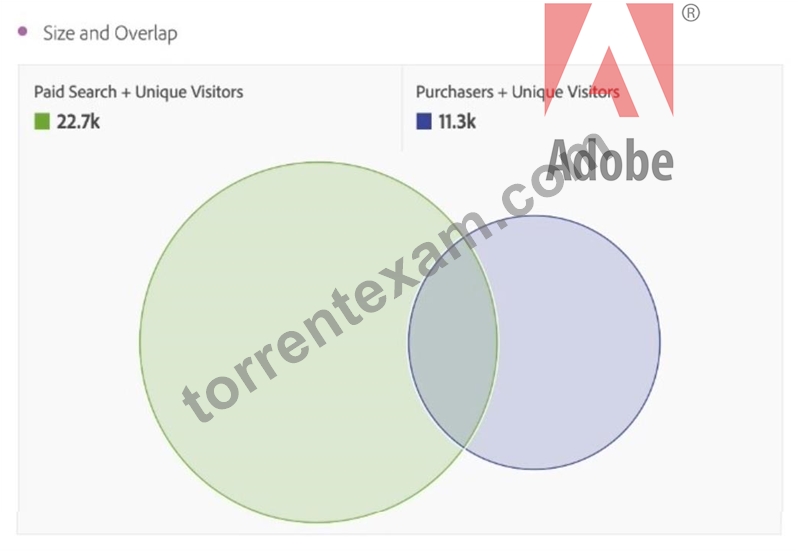
A marketing analyst wants to look into visitors who originated from paid search and made a purchase.
Which two options can be done directly from this Visualization? (Choose two.)
- A. Right click to create a segment from one side of the Venn Visualization.
- B. Right click to create a new segment from the overlap region of the Venn Visualization.
- C. Transform the Venn diagram into a Freeform Table by clicking on the managed data source colored dot next to the Venn header.
- D. Drag a third segment onto the Venn Visualization to see how it relates to the other two.
Answer: B,D
Explanation:
Explanation
A Venn Visualization is a tool that shows how segments overlap or differ from each other. It can also support up to three segments in one visualization. Two options that can be done directly from this Visualization are:
Drag a third segment onto the Venn Visualization to see how it relates to the other two. This will show how the third segment intersects or excludes the other two segments in different regions. Right click to create a new segment from the overlap region of the Venn Visualization. This will create a new segment based on the criteria that match both segments in the overlap region.
References:
https://experienceleague.adobe.com/docs/analytics/analyze/analysis-workspace/visualizations/venn.html?lang=en
https://experienceleague.adobe.com/docs/analytics/analyze/analysis-workspace/visualizations/venn.html?lang=en
NEW QUESTION # 17
Various reports show None, Unspecified, Other, or Unknown, depending on the specific report viewed.
Generally, this breakdown means that the variable was not defined or otherwise unavailable.
Which statement explains the possible behavior of the data?
- A. Similarly to non-mobile hits in mobile reports, mobile hits in all Visitor Profile I Technology reports are listed as 'UNSPECIFIED'.
- B. When viewing classification data, any value that does not have data associated with that particular classification returns "OTHER". To resolve this issue, create a classification export file and classify the appropriate columns.
- C. This happens when a user comes to a site for the first time and makes a purchase without firing eVar1. If orders are viewed in the eVar1 report, there is no value to attribute this order to, so it will appear as "NONE".
Answer: C
Explanation:
Explanation
The statement that explains the possible behavior of the data is that this happens when a user comes to a site for the first time and makes a purchase without firing eVar1. If orders are viewed in the eVar1 report, there is no value to attribute this order to, so it will appear as "NONE". This means that eVar1 was not set on any page or hit during the visit where the order occurred, so there is no way to associate the order with any value of eVar1. The other statements are not correct explanations of why None, Unspecified, Other, or Unknown may appear in various reports.
References:
https://experienceleague.adobe.com/docs/analytics/components/variables/conversion-variables/conversion-var-ov
https://experienceleague.adobe.com/docs/analytics/components/variables/conversion-variables/conversion-var-ov
NEW QUESTION # 18
Two single condition Segments are set up for creating a Virtual Report Suite. Both Segments are visit scoped and have the following rule using default Dimensions:
Segment A: Marketing Channel equals 'Social Networks' Segment B: Countries equals 'United Kingdom' Which data subset of the source Report Suite will be available when using this Virtual Report Suite?
- A. Visit data for visits coming from a Social Network OR from the United Kingdom
- B. Visit data for visits coming from a Social Network AND from the United Kingdom
- C. All Visitor data for visits coming from a Social Network AND from the United Kingdom
Answer: B
Explanation:
Explanation
The data subset of the source report suite that will be available when using this virtual report suite is visit data for visits coming from a Social Network AND from the United Kingdom. This is because when two single condition segments are set up for creating a virtual report suite, they are combined with an AND logic. This means that only the visits that match both segments will be included in the virtual report suite.
References:
https://experienceleague.adobe.com/docs/analytics/components/virtual-report-suites/vrs-overview.html?lang=en
https://experienceleague.adobe.com/docs/analytics/components/virtual-report-suites/vrs-overview.html?lang=en#
NEW QUESTION # 19
The analytics team has created an Analysis Workspace project featuring a Freeform Table and a Flow Visualization in one Panel.
Why is the scheduled report just showing the Panel Name?
- A. The Freeform Table and Flow Visualization were expanded.
- B. The Freeform Table and Flow Visualization in the Panel were minimized.
- C. The Project was never curated.
Answer: B
Explanation:
Explanation
When scheduling a report from an Analysis Workspace project, only the expanded visualizations in each panel will be included in the report. If the Freeform Table and Flow Visualization in the Panel were minimized, they will not show up in the scheduled report, only the Panel Name will.
References:
https://experienceleague.adobe.com/docs/analytics/analyze/analysis-workspace/share/schedule-project.html?lang
https://experienceleague.adobe.com/docs/analytics/analyze/analysis-workspace/share/schedule-project.html?lang
NEW QUESTION # 20
When changing the Fallout visualization from Eventual Path to Next Hit, the analyst notices that the data reports zero Visitors across the report.
Why would this occur?
- A. There was no direct path from the second and third fallout touchpoints.
- B. Across all visitors, the fallout depicted never was completed as an eventual path conversion.
- C. Across all visitors, the fallout depicted never was completed as a next step conversion.
Answer: C
Explanation:
Explanation
When changing the Fallout visualization from Eventual Path to Next Hit, the report shows only the conversions that happened in the immediate next hit after each step. If the report shows zero visitors across the report, it means that none of the visitors completed the fallout as a next step conversion.
References:
https://experienceleague.adobe.com/docs/analytics/analyze/analysis-workspace/visualizations/fallout.html?lang=
NEW QUESTION # 21
Analyzing the data in the image below, a data analyst verifies that the report of "entries" per page, shows that the "HomePage A" page is responsible for only 3.4% of the total "entries" to the site: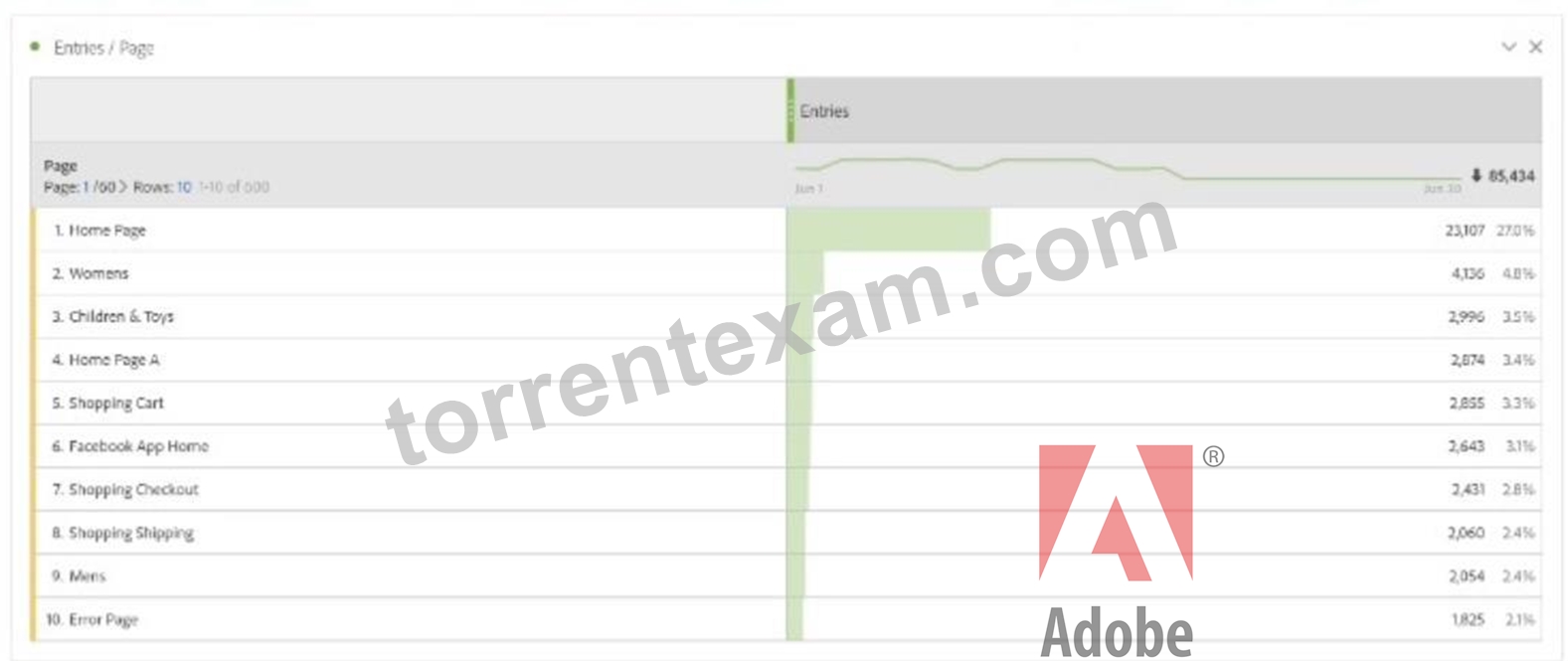
When comparing this information with the Occurrences per Entry Pages report below, it verifies that the
"Homepage A" page has 4.5% of the total Occurrences of the Entry Pages:
Based on both the images and knowledge on the standard metrics of Adobe Analytics, which statement is correct?
- A. The Entries metric refers to entries on a given page, and is counted every time the page loads on a visit.
- B. Occurrences refers to all hits associated with a particular entry page, also counting events triggered throughout the session.
- C. The Entry Page Dimension refers exclusively to the first page that a visitor lands on the site on every visit, so there are distortions regarding the period of analysis.
Answer: B
Explanation:
Explanation
Occurrences is a metric that counts every hit where a dimension value is set, including page views and events.
Therefore, if an entry page has more occurrences than entries, it means that visitors who entered through that page also triggered other events during their session. Entries is a metric that counts only the first hit of a visit where a dimension value is set, such as an entry page.
References: https://experienceleague.adobe.com/docs/analytics/components/metrics/occurrences.html?lang=en
https://experienceleague.adobe.com/docs/analytics/components/metrics/entries.html?lang=en
NEW QUESTION # 22
An analyst wants to exclude visits where a page with the name "Shopping Checkout" was viewed.
How would these visits be excluded from a report?
- A. A visit-based segment with one exclude condition: Page equals "Shopping Checkout"
- B. A hit-based segment with one exclude condition: Page equals "Shopping Checkout"
- C. A visit-based segment with one include condition: Page does not equal "Shopping Checkout"
Answer: A
Explanation:
Explanation
The best way to exclude visits where a page with the name "Shopping Checkout" was viewed is to use a visit-based segment with one exclude condition: Page equals "Shopping Checkout". This will ensure that only the visits that did not include any hit where Page equals "Shopping Checkout" are included in the report. A hit-based segment with one exclude condition: Page equals "Shopping Checkout" will not work, as it will only exclude the hits where Page equals "Shopping Checkout", but not the entire visits. A visit-based segment with one include condition: Page does not equal "Shopping Checkout" will not work either, as it will include any visit that had at least one hit where Page does not equal "Shopping Checkout", even if it also had a hit where Page equals "Shopping Checkout".
References:
https://experienceleague.adobe.com/docs/analytics/components/segments/segment-tips.html?lang=en
https://experienceleague.adobe.com/docs/analytics/components/segments/segment-tips.html?lang=en#exclude-vi
NEW QUESTION # 23
A UI/UX manager is concerned that a recent change in the design of a landing page may be confusing to visitors.
Which two variables would be used to evaluate the impact of the design change on site traffic to that landing page? (Choose two.)
- A. Entries
- B. Visitors
- C. Time Spent on Page
- D. Bounce Rate
Answer: C,D
Explanation:
Explanation
Bounce rate and time spent on page are two metrics that can indicate how engaging and user-friendly a landing page is. A high bounce rate means that visitors are leaving the site after viewing only one page, which may suggest that the page is not relevant or appealing to them. A low time spent on page means that visitors are not spendingenough time to explore the content or take action on the page, which may also imply that the page is confusing or uninteresting.
References: https://experienceleague.adobe.com/docs/analytics/components/metrics/bounce-rate.html?lang=en
https://experienceleague.adobe.com/docs/analytics/components/metrics/time-spent.html?lang=en
NEW QUESTION # 24
The web analyst for a beauty products company wants to create a report to analyze the number of sample requests for one of their product pages.
The following items are available from the default configuration:
* prop3, which registers the product page name and is fired in the first page load
* eVar4, which registers the product page name and is fired in the first page load
* event1 2, which fires when a visitor clicks on "Request a sample'' call to action How can the analyst accomplish the creation of this report?
- A. Use eVar4 in combination with event1 2 as a metric.
- B. Use either prop3 or eVar4 in combination with event1 2 as a metric.
- C. Use prop3 in combination with event1 2 as a metric.
Answer: A
Explanation:
Explanation
The best way to create a report to analyze the number of sample requests for one of their product pages is to use eVar4 in combination with event12 as a metric. eVar4 registers the product page name and is fired in the first page load, so it will capture and persist the value for each visit. event12 fires when a visitor clicks on
"Request a sample" call to action, so it will measure the number of sample requests. Using eVar4 as a dimension and event12 as a metric will show how many sample requests were made for each product page.
Using prop3 instead of eVar4 will not work, as prop3 does not persist across hits or visits.
References:
https://experienceleague.adobe.com/docs/analytics/components/variables/conversion-variables/conversion-var-ov
https://experienceleague.adobe.com/docs/analytics/components/variables/traffic-variables/traffic-var-overview.h
NEW QUESTION # 25
A UI/UX manager asks an analyst to create an Analysis workspace visualization that shows all visits to English (/En) pages. The workspace is accessible by multiple stakeholders, most of whom have edit access.
Which visualization approach would be used?
- A. Create a Freeform Table with Page Name and Visits. Filter Page Name by "ends with = /en"
- B. Create a Freeform Table with Page Name and Visits. Filter Page Name by "contains = /en"
- C. Create a Freeform Table with Visits and drag and drop all Page Names that contain "/en" from the left rail into the rows of the Freeform Table.
Answer: B
Explanation:
Explanation
The best way to create an Analysis Workspace visualization that shows all visits to English (/en) pages is to create a Freeform Table with Page Name and Visits, and then apply a filter to Page Name by "contains = /en".
This will ensure that only the pages that have "/en" in their name will be shown in the table, regardless of their position in the URL. Filtering by "ends with = /en" would exclude pages that have other parameters after
"/en", and dragging and dropping all Page Names that contain "/en" would be tedious and prone to errors.
References:
https://experienceleague.adobe.com/docs/analytics/analyze/analysis-workspace/build/freeform-tables.html?lang=
https://experienceleague.adobe.com/docs/analytics/analyze/analysis-workspace/build/freeform-tables.html?lang=
NEW QUESTION # 26
What is a valid use of a segment as a touchpoint in a Fallout Visualization?
- A. Using a visitor-based segment as a touchpoint inside a visit-context Fallout Visualization
- B. Using a visit-based segment as a touchpoint inside a visit-context Fallout Visualization
- C. Using a visit-based segment as a touchpoint inside a visitor-context Fallout Visualization
Answer: B
Explanation:
Explanation
A valid use of a segment as a touchpoint in a Fallout Visualization is to use a visit-based segment as a touchpoint inside a visit-context Fallout Visualization. This means that the segment will apply to the entire visit and the fallout will show the conversion within the same visit. Using a visitor-based segment as a touchpoint inside a visit-context Fallout Visualization or using a visit-based segment as a touchpoint inside a visitor-context Fallout Visualization are not valid uses, as they will cause mismatched scopes and inaccurate results.
References:
https://experienceleague.adobe.com/docs/analytics/analyze/analysis-workspace/visualizations/fallout.html?lang=
https://experienceleague.adobe.com/docs/analytics/analyze/analysis-workspace/visualizations/fallout.html?lang=
NEW QUESTION # 27
A media agency is running a Display campaign, but none of the data is credited to the Display marketing channel in Adobe Analytics.
Here are some example tracking codes provided by the media agency:
?cid=disp_lifestyle_summer2019.088653 ?cid=disp_summer2019_branding_647821
?cid=disp_671244_hero_summer2019
The Marketing Channel Processing Rule for the Display channel is configured as follows: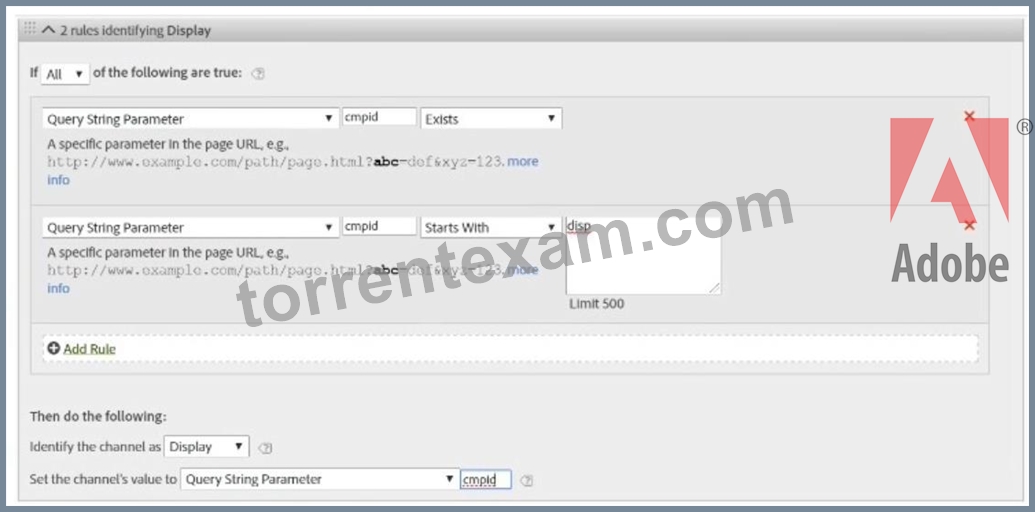
What is causing the loss of data in Adobe Analytics?
- A. The Marketing Channel processing rule is using a different query string parameter.
- B. The variables in the tracking code are not following a consistent taxonomy.
- C. The Marketing Channel processing rule is not set up to collect data for the summer2019 campaign.
Answer: A
Explanation:
Explanation
The reason why none of the data is credited to the Display marketing channel in Adobe Analytics is that the Marketing Channel processing rule is using a different query string parameter. The tracking codes provided by the media agency use the parameter "cid", but the processing rule is looking for the parameter "cmpid".
Therefore, the rule will not match any of the tracking codes and will not assign them to the Display channel.
References:
https://experienceleague.adobe.com/docs/analytics/admin/admin-tools/channel-manager/marketing-channels-ove
https://experienceleague.adobe.com/docs/analytics/admin/admin-tools/channel-manager/marketing-channels-ove
NEW QUESTION # 28
A user without administrator rights needs to share an important segment with a group of users in a Product Profile.
How would the segment be shared?
- A. All users, Product Profile Group, or Individual Users
- B. Individual Users and Product Profile Group
- C. All users and Individual Users
Answer: A
Explanation:
Explanation
A user without administrator rights can share an important segment with a group of users in a Product Profile by choosing one of the following options: All users, Product Profile Group, or Individual Users. These options are available in the segment settings under the Share With section. All users will make the segment available to everyone who has access to the same report suite. Product Profile Group will make the segment available to a specific group of users who have been assigned to a product profile. Individual Users will make the segment available to specific users who have been selected from a list.
References:
https://experienceleague.adobe.com/docs/analytics/components/segments/segment-sharing.html?lang=en
https://experienceleague.adobe.com/docs/analytics/components/segments/segment-sharing.html?lang=en#sharing
NEW QUESTION # 29
Refer to the exhibit: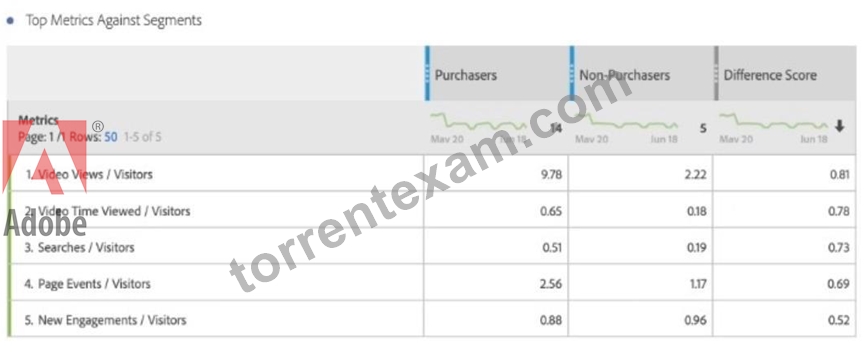
What is a valid interpretation of this Segment Comparison between Purchasers and Non-Purchasers segments?
- A. Video Views/Visitors is the most statistically significant difference between the two segments.
- B. On average, Purchasers view 81 % more videos than Non-Purchasers.
- C. Purchasers are 81 % more likely to complete a Video View than Non-Purchasers.
Answer: B
Explanation:
Explanation
A valid interpretation of this Segment Comparison between Purchasers and Non-Purchasers segments is that on average, Purchasers view 81 % more videos than Non-Purchasers. This means that the average Video Views per Visitor for Purchasers is 81 % higher than that for Non-Purchasers. Video Views/Visitors is not the most statistically significant difference between the two segments, as it has a low confidence level of 68 %.
Purchasers are not 81 % more likely to complete a Video View than Non-Purchasers, as this would imply a probability or conversion rate, not an average.
References:
https://experienceleague.adobe.com/docs/analytics/analyze/analysis-workspace/components/segment-comparison
https://experienceleague.adobe.com/docs/analytics/analyze/analysis-workspace/components/segment-comparison
NEW QUESTION # 30
A curator clicks on a tile inside a Mobile Scorecard with no dimension applied to the tile. Which Dimensions will be displayed as the breakdown Dimension?
- A. Hour or Days
- B. Browser Type or Days
- C. Page Name or Browser
Answer: A
Explanation:
Explanation
A Mobile Scorecard is a visualization that shows key metrics and trends for mobile devices. It can also show breakdowns by dimensions when a tile is clicked. If no dimension is applied to the tile, the default breakdown dimensions are Hour or Day, depending on the date range selected.
References:
https://experienceleague.adobe.com/docs/analytics/analyze/analysis-workspace/visualizations/mobile-scorecard.h
https://experienceleague.adobe.com/docs/analytics/analyze/analysis-workspace/visualizations/mobile-scorecard.h
NEW QUESTION # 31
Refer to the exhibit.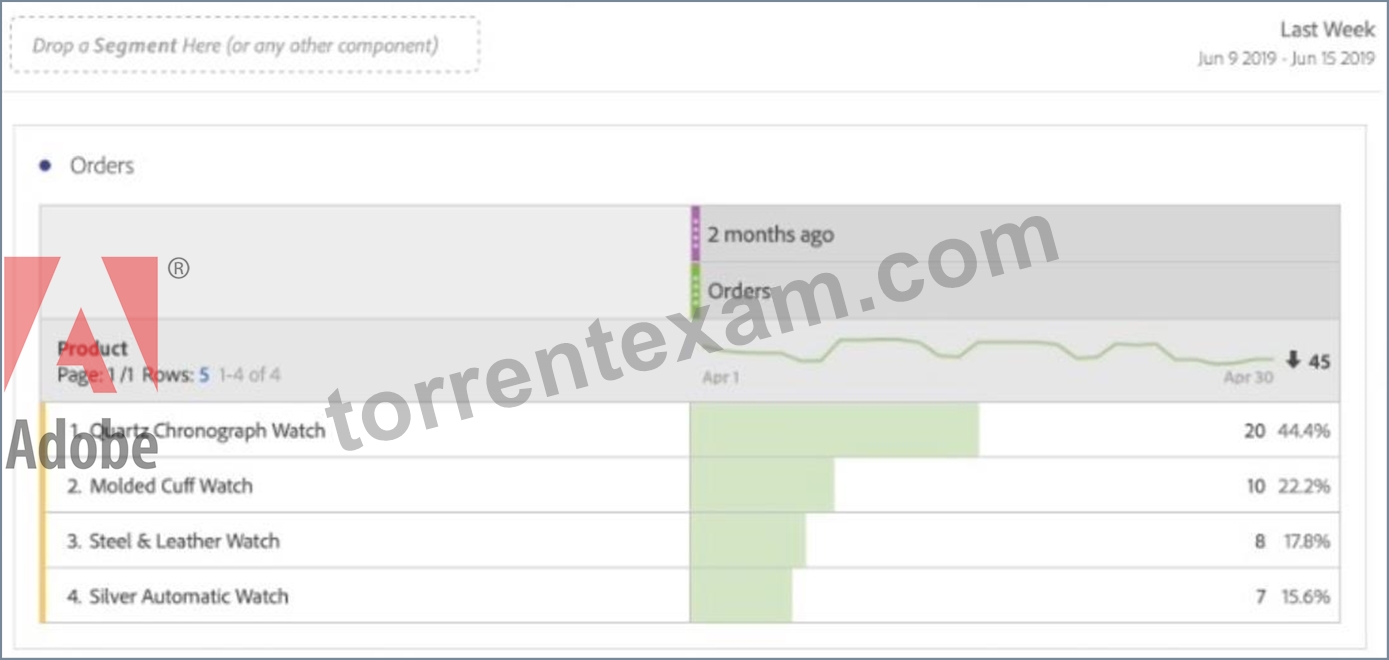
The date range is applied at the panel level, and a different date range is applied on top of the "Orders'' metric.
Which values are displayed in the table?
- A. Product orders recorded two months ago
- B. Product orders recorded last week
- C. Only product orders that have been purchased both two months ago and last week
Answer: C
Explanation:
Explanation
The values displayed in the table are only product orders that have been purchased both two months ago and last week. This is because when a date range is applied at both the panel level and the metric level, the resulting date range is the intersection of both date ranges. In this case, since the panel date range is two months ago and the metric date range is last week, only the data that falls within both date ranges will be shown.
References: https://experienceleague.adobe.com/docs/analytics/components/time/time-overview.html?lang=en
https://experienceleague.adobe.com/docs/analytics/components/time/time-overview.html?lang=en#date-range-in
NEW QUESTION # 32
What is the correct functionality when setting up Intelligent Alerts?
- A. Send an alert by SMS with a link to your Analysis Workspace project
- B. Send an alert by e-mail with a link to your Analysis Workspace project
- C. Send an alert by e-mail or SMS with a link to an auto-generated Analysis Workspace project
Answer: B
Explanation:
Explanation
Intelligent Alerts is a feature that allows you to set up alerts based on data anomalies or thresholds in your Analysis Workspace projects. You can choose to send an alert by e-mail with a link to your Analysis Workspace project when the alert is triggered. Youcannot send an alert by SMS or with a link to an auto-generated Analysis Workspace project.
References:
https://experienceleague.adobe.com/docs/analytics/analyze/analysis-workspace/predictive-analytics/intelligent-al
https://experienceleague.adobe.com/docs/analytics/analyze/analysis-workspace/predictive-analytics/intelligent-al
NEW QUESTION # 33
A pharmaceutical client wants to see a Freeform Table in Analysis Workspace that lists out all the Products by the number of visits each of its website pages receive. Each product can have varying number of pages but has a unique product name included in all its URLs. The client also wants to ensure that the Products in the Freeform Table are arranged in a specific order by product name.
How would an analyst use segments to do this?
- A. Create a stacked segment for all of the product names by page name segments and drag and drop them in order in a Freeform Table with Visits.
- B. Create segments for all of the product names by page name and drag and drop them in order into the Table Builder of a Freeform Table with Visits.
- C. Create segments for all of the product names by page name and drag and drop them in order in a Freeform Table with Visits.
Answer: B
Explanation:
Explanation
The best way to use segments to create a Freeform Table in Analysis Workspace that lists out all the Products by the number of visits each of its website pages receive is to create segments for all of the product names by page name and drag and drop them in order into the Table Builder of a Freeform Table with Visits. The Table Builder is a tool that allows you to customize your table layout by dragging and dropping dimensions, metrics, or segments into rows or columns. Creating segments for all of the product names by page name will ensure that only the pages that belong to each product are included in the table. Dragging and dropping them in order into the Table Builder will arrange them by product name as desired.
References:
https://experienceleague.adobe.com/docs/analytics/components/table-builder/table-builder-overview.html?lang=
https://experienceleague.adobe.com/docs/analytics/components/table-builder/table-builder-overview.html?lang=
NEW QUESTION # 34
The conversion percentage from one step to another in a Fallout Visualization is 104%. What could be the reason the percentage is over 100%?
- A. Success events cannot be added to a funnel.
- B. The success event can be fired outside of the specified funnel order.
- C. Another report suite's data is polluting the funnel.
Answer: B
Explanation:
Explanation
The Fallout visualization can show a conversion percentage over 100% if the success event can be fired outside of the specified funnel order. For example, if a visitor completes a purchase before viewing a product, the purchase event will still be counted in the fallout even though it happened before the product view event.
References:
https://experienceleague.adobe.com/docs/analytics/analyze/analysis-workspace/visualizations/fallout.html?lang=
NEW QUESTION # 35
......
Get New AD0-E208 Certification Practice Test Questions Exam Dumps: https://dumpscertify.torrentexam.com/AD0-E208-exam-latest-torrent.html
