

2025 TorrentExam Nutanix NCP-US-6.5 Dumps and Exam Test Engine
Nutanix NCP-US-6.5 DUMPS WITH REAL EXAM QUESTIONS
Nutanix NCP-US-6.5 Exam Syllabus Topics:
| Topic | Details |
|---|---|
| Topic 1 |
|
| Topic 2 |
|
| Topic 3 |
|
| Topic 4 |
|
| Topic 5 |
|
| Topic 6 |
|
| Topic 7 |
|
| Topic 8 |
|
| Topic 9 |
|
NEW QUESTION # 56
Which error logs should the administrator be reviewing to determine why the relates service is down?
- A. Solver.log
- B. Arithmos.ERROR
- C. Cerebro.ERROR
- D. Tcpkill.log
Answer: C
Explanation:
The error log that the administrator should review to determine why the relay service is down is Cerebro.ERROR. Cerebro is a service that runs on each FSVM and provides relay functionality for Data Lens. Relay service is responsible for collecting metadata and statistics from FSVMs and sending them to Data Lens via HTTPS. If Cerebro.ERROR log shows any errors or exceptions related to relay service, it can indicate that relay service is down or not functioning properly. Reference: Nutanix Files Administration Guide, page 23; Nutanix Data Lens User Guide
NEW QUESTION # 57
An existing Object bucket was created for backups with these requirements:
* WORM policy of one year
* Versioning policy of one year
* Lifecycle policy of three years
A recent audit has reported a compliance failure. Data that should be retained for three years has been deleted prematurely.
How should the administrator resolve the compliance failure within Objects?
- A. Recreate a new bucket with the retention policy of three years.
- B. Modify the existing bucket versioning policy from one year to three years.
- C. Modify the existing bucket WORM policy from one year to three years.
- D. Create a tiering policy to store deleted data on cold storage for three years.
Answer: C
Explanation:
The administrator should resolve the compliance failure within Objects by modifying the existing bucket WORM (Write-Once Read-Many) policy from one year to three years. WORM is a feature that prevents anyone from modifying or deleting data in a bucket while the policy is active. WORM policies help comply with strict data retention regulations that mandate how long specific data must be stored. The administrator can extend the WORM retention period for a bucket at any time, but cannot reduce it or delete it. By extending the WORM policy from one year to three years, the administrator can ensure that data in the bucket is retained for the required duration and not deleted prematurely. Reference: Nutanix Objects User Guide, page 17; Nutanix Objects Solution Guide, page 9
NEW QUESTION # 58
Deploying Files instances require which two minimum resources? (Choose two)
- A. 4 vCPUs per host
- B. 8 vCPUs per host
- C. 8 GiB of memory per host
- D. 12 GiB of memory per host
Answer: A,C
Explanation:
The two minimum resources that are required for deploying Files instances are 8 GiB of memory per host and 4 vCPUs per host. Memory and vCPUs are resources that are allocated to VMs (Virtual Machines) to run applications and processes. Files instances are file server instances (FSIs) that run on FSVMs (File Server VMs) on a Nutanix cluster. FSVMs require at least 8 GiB of memory and 4 vCPUs per host to function properly and provide SMB and NFS access to file shares and exports. The administrator should ensure that there are enough memory and vCPUs available on each host before deploying Files instances. Reference: Nutanix Files Administration Guide, page 27; Nutanix Files Solution Guide, page 6
NEW QUESTION # 59
Which Nutanix Unified Storage capability allows for monitoring usage for all Files deployment globally?
- A. Data Lens
- B. File Analytics
- C. Nutanix Cloud Manager
- D. Files Manager
Answer: A
Explanation:
Data Lens is a feature that provides insights into the data stored in Files across multiple sites, including different geographical locations. Data Lens allows administrators to monitor usage, performance, capacity, and growth trends for all Files deployments globally. Data Lens also provides reports on file types, sizes, owners, permissions, and access patterns3. Reference: Nutanix Data Lens Administration Guide3
NEW QUESTION # 60
Which two prerequisites are needed when deploying Objects to a Nutanix cluster? (Choose two.)
- A. Data Services IP is configured on the PI
- B. AHV IPAM is disabled on the VLAN used for Objects.
- C. DNS is configured on the PE.
- D. Microsegmentation is enabled.
Answer: A
Explanation:
Nutanix Objects requires a Data Services IP to be configured on the Prism Infrastructure (PI) cluster, which is used to expose the S3 API endpoint for accessing buckets and objects. Nutanix Objects also requires AHV IP Address Management (IPAM) to be disabled on the VLAN used for Objects, as Objects uses its own DHCP service to assign IP addresses to the Objects VMs1. References: Nutanix Objects Administration Guide1
NEW QUESTION # 61
What are two ways to manage Objects? (Choose two.)
- A. API
- B. CLI
- C. SSH
- D. PC
Answer: A,D
Explanation:
There are two ways to manage Objects: PC (Prism Central) and API (Application Programming Interface). PC is a web-based user interface that allows administrators to create, configure, monitor, and manage Objects clusters, buckets, users, and policies. API is a set of S3-compatible REST APIs that allows applications and users to interact with Objects programmatically. API can be used to perform operations such as creating buckets, uploading objects, listing objects, downloading objects, deleting objects, and so on. References: Nutanix Objects User Guide; Nutanix Objects API Reference Guide
NEW QUESTION # 62
Which ransomware prevention solution for Files is best when the list of malicious file signatures to block is greater than 300?
- A. Third-party solution
- B. Flow Security Central
- C. Data Lens
- D. File Analytics
Answer: A
Explanation:
Nutanix Files provides a built-in ransomware prevention feature that allows administrators to block malicious file signatures from being written to the file system. However, this feature has a limit of 300 signatures per share or export. If the list of malicious file signatures to block is greater than 300, a third-party solution is recommended2. Reference: Nutanix Files Administration Guide2
NEW QUESTION # 63
What tool can be used to report on a specific user's activity within a Files environment?
- A. Prism Element Alerts menu
- B. Data Lens Audit Trails
- C. Files Console Usage
- D. Prism Central Activity menu
Answer: B
Explanation:
The tool that can be used to report on a specific user's activity within a Files environment is Data Lens Audit Trails. Data Lens Audit Trails is a feature that provides detailed logs of all file operations performed by users on Files shares and exports, such as create, read, write, delete, rename, move, copy, etc. Data Lens Audit Trails can help administrators track and audit user actions and identify any unauthorized or malicious activities. The administrator can use Data Lens Audit Trails to filter and search for a specific user's activity based on various criteria, such as file name, file type, file size, file path, file share, file server, operation type, operation time, operation status, and so on. References: Nutanix Files Administration Guide, page 98; Nutanix Data Lens User Guide Nutanix Files, part of Nutanix Unified Storage (NUS), supports monitoring and reporting on user activities to track file access, modifications, and other operations. To report on a specific user's activity, a tool that provides detailed audit trails at the file level is required.
Analysis of Options:
* Option A (Prism Element Alerts menu): Incorrect. The Alerts menu in Prism Element provides cluster-level alerts (e.g., hardware failures, storage issues), but it does not offer detailed user activity reports for Files shares.
* Option B (Files Console Usage): Incorrect. The Files Console provides usage statistics for shares (e.g., storage consumption, share-level metrics), but it does not provide granular user activity reports or audit trails for specific users.
* Option C (Data Lens Audit Trails): Correct. Nutanix Data Lens, a service integrated with Nutanix Files, provides audit trails that track user activities at the file level. This includes details such as file access, modifications, deletions, and permission changes, allowing administrators to report on a specific user's actions within the Files environment.
* Option D (Prism Central Activity menu): Incorrect. The Activity menu in Prism Central provides high-level activity logs for cluster operations (e.g., VM creation, policy updates), but it does not provide detailed file-level user activity reports for Nutanix Files.
Why Data Lens Audit Trails?
Nutanix Data Lens is designed for data governance and security, offering features like audit trails, anomaly detection, and ransomware protection. The Audit Trails feature specifically allows administrators to filter and report on user activities, such as which files a user accessed, modified, or deleted, making it the ideal tool for this task.
Exact Extract from Nutanix Documentation:
From the Nutanix Data Lens Administration Guide (available on the Nutanix Portal):
"Data Lens Audit Trails provide detailed tracking of user activities within Nutanix Files shares.
Administrators can view and filter audit logs to report on specific user actions, including file access, modifications, deletions, and permission changes. This feature is accessible via the Data Lens dashboard."
:
Nutanix Data Lens Administration Guide, Version 4.0, Section: "Using Audit Trails for User Activity Monitoring" (Nutanix Portal).
Nutanix Certified Professional - Unified Storage (NCP-US) Study Guide, Section: "Nutanix Data Lens Features".
NEW QUESTION # 64
An administrator has created a distributed share on the File cluster. The administrator connects to the share using Windows Explorer and starts creating folders in the share. The administrator observes that none of the created folder can be renamed as the company naming convention requires.
How should the administrator resolve this issue?
- A. Use the Files MMC Snapln and rename the folders.
- B. Use the Microsoft Shared Folder MMC Snapln.
- C. Modify the read/write permissions on the created folders.
- D. Modify the Files shares to use the NFS protocol.
Answer: A
Explanation:
The administrator should resolve this issue by using the Files MMC Snap-in and renaming the folders. The Files MMC Snap-in is a tool that allows administrators to manage Files shares and exports from a Windows machine. The administrator can use the Files MMC Snap-in to connect to a distributed share or export and rename the top-level directories that are hosted by different FSVMs. Renaming the directories from Windows Explorer will not work because Windows Explorer does not recognize the distributed nature of the share or export and will try to rename all directories on the same FSVM, which will fail. Reference: Nutanix Files Administration Guide, page 35; Nutanix Files MMC Snap-in User Guide
NEW QUESTION # 65
An administrator has received an alert AI60068 - ADSDuplicationIPDetected details of alert as follows: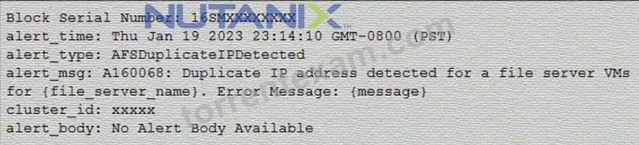
Which error log should the administrator review to determine the related Duplicate IP address involved?
- A. Solver.log
- B. Minerva_cvm.log
- C. Minerva.nvm.log
- D. Tcpkill.log
Answer: C
Explanation:
https://portal.nutanix.com/page/documents/kbs/details?targetId=kA00e000000CvHICA0
NEW QUESTION # 66
A healthcare administrator configure a Nutanix cluster with the following requirements:
* Enable for long-term data retention of large files
* Data should be kept for two years
* Deletion or overwrite of the data must not be allowed
Which Nutanix-enabled technology should the administrator employ to satisfy these requirements?
- A. Objects - Life Cycle Policy
- B. Files - Read-only share
- C. Files - Connected share
- D. Objects - WORM with versioning
Answer: D
Explanation:
The Nutanix-enabled technology that meets these requirements is Objects - WORM with versioning. WORM (Write-Once Read-Many) is a feature that prevents anyone from modifying or deleting data in a bucket while the policy is active. WORM policies help comply with strict data retention regulations that mandate how long specific data must be stored. Versioning is a feature that keeps multiple versions of an object in a bucket whenever it is overwritten or deleted. Versioning policies help preserve previous versions of an object for backup or recovery purposes. By enabling WORM and versioning for an Objects bucket, the administrator can ensure that data is kept for two years without being deleted or overwritten. Reference: Nutanix Objects User Guide, page 17; Nutanix Objects Solution Guide, page 9
NEW QUESTION # 67
What are two ways to manage Objects? (Choose two.)
- A. API
- B. CLI
- C. SSH
- D. PC
Answer: A,D
Explanation:
There are two ways to manage Objects: PC (Prism Central) and API (Application Programming Interface). PC is a web-based user interface that allows administrators to create, configure, monitor, and manage Objects clusters, buckets, users, and policies. API is a set of S3-compatible REST APIs that allows applications and users to interact with Objects programmatically. API can be used to perform operations such as creating buckets, uploading objects, listing objects, downloading objects, deleting objects, and so on. Reference: Nutanix Objects User Guide; Nutanix Objects API Reference Guide
NEW QUESTION # 68
Which metric is utilized when sizing a Files deployment based on performance requirements?
- A. Quantity of NFS exports
- B. Quantity of SMB shares
- C. SMB concurrent connections
- D. NFS concurrent connections
Answer: C
Explanation:
This metric indicates the number of active clients that are accessing the Files cluster via SMB protocol, which affects the performance of the Files cluster. NFS concurrent connections is also a relevant metric, but it is not the best answer, as it only applies to NFS protocol, not SMB. The quantity of SMB shares or NFS exports does not directly affect the performance of the Files cluster, as they are logical entities that do not consume resources. Reference: Nutanix Files Sizing Guide
NEW QUESTION # 69
Life Cycle manager must the compatible versions of which two components before installing or upgrading Files? (Choose two.)
- A. Acropolis Operating System
- B. Nutanix Cluster Check
- C. File Server Mobile
- D. Active Directory Services
Answer: B
Explanation:
Before installing or upgrading Files, Life Cycle Manager (LCM) must check the compatibility versions of Nutanix Cluster Check (NCC) and Acropolis Operating System (AOS). NCC is a framework of scripts that helps diagnose cluster health, and AOS is the core operating system that runs on each node in a Nutanix cluster. LCM will not proceed with the installation or upgrade if NCC or AOS versions are incompatible with Files. Reference: Nutanix Files Administration Guide, Nutanix Cluster Check Guide
NEW QUESTION # 70
What is the minimum and maximum file size limitations for Smart Tiering?
- A. 64 KiB minimum and 5 TiB maximum
- B. 64 KiB minimum and 15 TiB maximum
- C. 128 IOB minimum and 5 TiB maximum
- D. 128 KiB minimum and 13 TiB maximum
Answer: A
Explanation:
Smart Tiering is a feature that allows Files to tier data across different storage tiers based on the file size and access frequency. Smart Tiering supports files with a minimum size of 64 KiB and a maximum size of 5 TiB2. References: Nutanix Files Administration Guide2
NEW QUESTION # 71
An administrator is required to place all iSCSI traffic on an isolated network.
How can the administrator meet this requirement?
- A. Create a new network interface on the CVMs via ncli.
- B. Configure the Data Services IP on an isolated network.
- C. Create a Volumes network in Prism Central.
- D. Configure network segmentation for Volumes.
Answer: D
Explanation:
The administrator can meet this requirement by configuring network segmentation for Volumes. Network segmentation is a feature that allows administrators to isolate network traffic for different types of services, such as Volumes, Files, or Objects, on a Nutanix cluster. Network segmentation can improve the security, performance, and manageability of network traffic. By configuring network segmentation for Volumes, the administrator can place all iSCSI traffic on an isolated network and prevent it from interfering with other services or applications. Reference: Nutanix Volumes Administration Guide, page 15; Nutanix Volumes Solution Guide, page 7
NEW QUESTION # 72
An administrator has performed an upgrade to Files. After upgrading, the file server cannot reach the given domain name with the specified DNS server list.
Which two steps should the administrator perform to resolve the connectivity issues with the domain controller servers? (Choose two.)
- A. Verify the DNS settings in Prism Element.
- B. Verify the DNS settings in Prism Central.
- C. DNS server addresses of the domain controllers.
- D. DNS entries for the given domain name.
Answer: A,D
Explanation:
The two steps that the administrator should perform to resolve the connectivity issues with the domain controller servers are:
* Verify the DNS settings in Prism Element: DNS (Domain Name System) is a system that translates domain names into IP addresses. DNS settings are configurations that specify which DNS servers to use for resolving domain names. Verifying the DNS settings in Prism Element is a step that the administrator should perform, because it can help identify and correct any incorrect or outdated DNS server addresses or domain names that may cause connectivity issues with the domain controller servers.
* Verify the DNS entries for the given domain name: DNS entries are records that map domain names to IP addresses or other information. Verifying the DNS entries for the given domain name is another step that the administrator should perform, because it can help check and update any incorrect or outdated IP addresses or other information that may cause connectivity issues with the domain controller servers.
References: Nutanix Files Administration Guide, page 32; Nutanix Files Troubleshooting Guide
NEW QUESTION # 73
Workload optimization for Files is based on which entity?
- A. Block size
- B. Protocol
- C. File type
- D. FSVM quantity
Answer: D
Explanation:
Workload optimization in Nutanix Files, part of Nutanix Unified Storage (NUS), refers to the process of tuning the Files deployment to handle specific workloads efficiently. This involves scaling resources to match the workload demands, and the primary entity for optimization is the number of File Server Virtual Machines (FSVMs).
Analysis of Options:
* Option A (Protocol): Incorrect. While Nutanix Files supports multiple protocols (SMB, NFS), workload optimization is not directly based on the protocol. Protocols affect client access, but optimization focuses on resource allocation.
* Option B (File type): Incorrect. File type (e.g., text, binary) is not a factor in workload optimization for Files. Optimization focuses on infrastructure resources, not the nature of the files.
* Option C (FSVM quantity): Correct. Nutanix Files uses FSVMs to distribute file service workloads across the cluster. Workload optimization involves adjusting the number of FSVMs to handle the expected load, ensuring balanced performance and scalability. For example, adding more FSVMs can improve performance for high-concurrency workloads.
* Option D (Block size): Incorrect. Block size is relevant for block storage (e.g., Nutanix Volumes), but Nutanix Files operates at the file level, not the block level. Workload optimization in Files does not involve block size adjustments.
Why FSVM Quantity?
FSVMs are the core entities that process file operations in Nutanix Files. Optimizing for a workload (e.g., high read/write throughput, many concurrent users) typically involves scaling the number of FSVMs to distribute the load, adding compute and memory resources as needed, or adjusting FSVM placement for better performance.
Exact Extract from Nutanix Documentation:
From the Nutanix Files Administration Guide (available on the Nutanix Portal):
"Workload optimization in Nutanix Files is achieved by adjusting the number of FSVMs in the file server. For high-performance workloads, you can scale out by adding more FSVMs to distribute the load across the cluster, ensuring optimal resource utilization and performance."
:
Nutanix Files Administration Guide, Version 4.0, Section: "Optimizing Nutanix Files for Workloads" (Nutanix Portal).
Nutanix Certified Professional - Unified Storage (NCP-US) Study Guide, Section: "Nutanix Files Performance Optimization".
NEW QUESTION # 74
ionization deployed Files in multiple sites, including different geographical locations across the globe. The organization has the following requirements to improves their data management lifecycle:
* Provide a centralized management solution.
* Automate archiving tier policies for compliance purposes.
* Protect the data against ransomware.
Which solution will satisfy the organization's requirements?
- A. Data Lens
- B. Files Analytics
- C. Prims Central
Answer: A
Explanation:
Data Lens can provide a centralized management solution for Files deployments in multiple sites, including different geographical locations. Data Lens can also automate archiving tier policies for compliance purposes, by allowing administrators to create policies based on file attributes, such as age, size, type, or owner, and move files to a lower-cost tier or delete them after a specified period. Data Lens can also protect the data against ransomware, by allowing administrators to block malicious file signatures from being written to the file system. References: Nutanix Data Lens Administration Guide
NEW QUESTION # 75
After configuring Smart DR, an administrator is unable see the policy in the Policies tab. The administrator has confirmed that all FSVMs are able to connect to Prism Central via port 9440 bidirectional.
What is the possible reason for this issue?
- A. The primary and recovery file servers do not have the same protocols.
- B. Port 7575 should be open for all External/Client IPS of FSVMs on the Source and Target cluster.
- C. The primary and recovery file servers do not have the same version.
- D. Port 7575 should be open for all Internal/Storage IPs of FSVMs on the Source and Target.
Answer: B
Explanation:
Smart DR is a feature that allows share-level replication between active file server instances for disaster recovery. To configure Smart DR, one of the prerequisites is to open TCP port 7575 for all External/Client IPs of FSVMs on the Source and Target cluster. This port is used for communication between the FSVMs and Prism Central. If this port is not open, Smart DR policies will not be visible in the Policies tab in Prism Central. Reference: Nutanix Files Administration Guide, page 79; Nutanix Files Solution Guide, page 9
NEW QUESTION # 76
An administrator has been directed to configure Volumes to Nutanix's best practices for security.
What should the administrate! do to be compliant?
- A. Segment iSCSI traffic to a physically separate network.
- B. Use data services IP for external host connectivity.
- C. Configure Volume Groups to use CHAP.
- D. Enable at-rest encryption on Volume Groups.
Answer: C
Explanation:
Nutanix Volumes is a feature that allows users to create and manage block storage devices (volume groups) on a Nutanix cluster. Volume groups can be accessed by external hosts using the iSCSI protocol. To secure volume groups from unauthorized access, Nutanix recommends configuring CHAP (Challenge-Handshake Authentication Protocol) for each volume group in Prism Element. CHAP is a security feature that authenticates iSCSI initiators and targets before allowing access to a volume group. CHAP requires both the initiator and the target to have a shared secret (a password) that is used to generate a challenge and a response during the authentication process. CHAP can prevent unauthorized access to volume groups and protect data from malicious attacks. References: Nutanix Volumes Administration Guide, page 25; Nutanix Volumes Security Guide Nutanix's best practices for Volumes security emphasize securing iSCSI connections through authentication.
Configuring Volume Groups to use CHAP ensures that only authorized initiators can access the storage, preventing unauthorized access and aligning with security compliance requirements. This is a direct and mandatory step for securing Volumes, making it the best choice among the options.
Exact Extract from Nutanix Documentation:
From the Nutanix Volumes Administration Guide (available on the Nutanix Portal):
"To align with Nutanix best practices for security, configure Volume Groups to use CHAP (Challenge- Handshake Authentication Protocol) for iSCSI authentication. This ensures that only authorized initiators can access the Volume Group, protecting against unauthorized access and enhancing security."
:
Nutanix Volumes Administration Guide, Version 6.0, Section: "Security Best Practices for Nutanix Volumes" (Nutanix Portal).
Nutanix Certified Professional - Unified Storage (NCP-US) Study Guide, Section: "Nutanix Volumes Security Configuration".
NEW QUESTION # 77
......
2025 New TorrentExam NCP-US-6.5 PDF Recently Updated Questions: https://dumpscertify.torrentexam.com/NCP-US-6.5-exam-latest-torrent.html
